
with Coach Jeff Rome
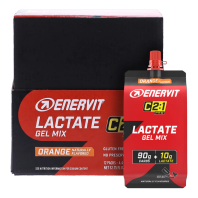
The past two years have seen two new fueling products hit the market in high-priced packages: bicarb and lactate gels. Four servings of bicarb from Maurten will run you $70 before tax, and Enervit’s lactate gels cost a whopping $117 for a 12-pack. Are they actually worth it? Let’s take a look.
What does bicarb do?
If you watch Maurten’s promotional video for their bicarb system, you’ll get the standard marketing formula:
✔ Dramatic music
✔ Black-and-white filming (so you know it’s
fancy)
✔ Heavy scientific reasoning
✔ Intense athletic montages
If you’ve braved the video, kudos to you. It does a great job explaining why bicarb works as a performance-enhancing fuel. If you skipped it, here is the gist: intense anaerobic exercise causes a buildup of lactic acid, which splits into two things—hydrogen ions and lactate ions.
Contrary to popular belief, it’s the hydrogen ions, not the lactate, that wreck your muscle acidity and function. By increasing the concentration of bicarbonate in your blood, you improve your body’s ability to transport those pesky hydrogen ions out of the muscles, counteracting the rising acidity.
Historically, swallowing straight baking soda caused catastrophic GI distress. Maurten found a clever way around this by trapping the bicarb in mini-tablets designed to pass safely through the stomach and release later in the digestive process.
What do we know so far?
A lot of elite endurance athletes use it. Most notably, Sebastian Sawe used a bicarbonate protocol prior to breaking the 2-hour barrier at the London Marathon. [1, 2]
The science shows sodium bicarbonate is most effective for high-intensity exercise lasting between 30 seconds and 12 minutes when taken 60 to 120 minutes before an event. The minimal effective dose is 0.2 grams per kilogram (g/kg) of body mass, with a standard performance dose at 0.3 g/kg. Exceeding these amounts does not increase performance benefits; it only intensifies gastrointestinal side effects. [1, 2]
Can I use this in a long race?
Yes. Some endurance athletes utilize a multi-day loading protocol to accumulate a chronic buffering system against muscle acidity. [1, 2]
This strategy involves taking 0.4 to 0.5 g/kg per day, split into 3 or 4 smaller doses taken with meals, for 3 to 7 days leading up to the race. No bicarbonate is consumed on race day itself. This protocol is highly effective for distance runners who expect to push into the anaerobic zone during sustained uphill climbs or a late-race kick. [1]
Should I ever use bicarb during a race?
Possibly, though the delivery method matters. A 2021 study by Dalle and colleagues published in the Journal of Science and Medicine in Sport found that cyclists who ingested 50 mg of bicarbonate per kg of body mass per hour during a 3-hour event sustained 3% more power during a final 90-second all-out sprint compared to a placebo group. The participants also consumed 60 grams of carbohydrates per hour.
Crucially, this protocol was validated on cyclists, not runners. Because the primary side effect of bicarbonate is severe GI distress, the smooth, non-impact mechanics of cycling are far more forgiving on the stomach than the constant up-and-down jarring of running. [1]
What about using bicarb during an ultra?
Test it extensively in training first—and evaluate whether you truly need it. Maurten frequently markets its bicarb system as “the 1% for the 1%,” implying it offers marginal gains intended primarily for top-tier elites. Additionally, these systems are systematically engineered for pre-race loading rather than mid-race fueling. [1]
If there are fundamental areas of your training, hydration, or base fueling that still need refinement, you will find substantially larger performance gains from mastering basic carbohydrate and fluid intake than from experimental buffering strategies.
So what about lactate gels?
What’s the benefit of taking lactate as fuel?
The world’s best cycling team, UAE Team Emirates, was using lactate gels this summer at the Tour de France prior to public availability. If it’s used by the best, should we use it? Let’s look into it.
An alternative absorption pathway
Normally, the body breaks down standard carbohydrates into glucose and fructose, which rely on specific transporters (SGLT1 and GLUT5) in the gut. When you push those transporters to their absolute hourly limit, your stomach can back up.
Lactate gels bypass this bottleneck by using a completely different doorway: the MCT1 pathway. This pathway can transport and metabolize lactate roughly two to three times faster than standard glucose pathways. It is uniquely designed to provide rapid energy during the hardest parts of a race, or in the final hours when a massive push is needed.
Enervit’s lactate gels are still a carbohydrate product, with lactate added.
When and how should I use lactate gels?
Because they act as a buffering agent, lactate gels are frequently compared to sodium bicarbonate (bicarb). If you decide to experiment with them, follow the golden rule: test it in training first.
Lactate gels pack a massive amount of carbohydrates and sodium into a single serving. They are intended to be mixed with 500 to 750 ml of water, and many athletes choose to split a single serving across multiple bottles.
Their primary use is for a single, sustained hard bout in a race. Taking multiple lactate gels for successive intense efforts—especially in a long event like an ultrarun—risks overloading your body with sodium and causing severe GI distress.
Enervit’s Lactate Gels: What we know
Products like Enervit’s new lineup are at the absolute cutting edge of endurance sports science. However, because lactate gels are much newer to the commercial market than traditional bicarb protocols, everyday athletes will need to wait for more independent, real-world research to see if the claims match the hype.
The final verdict
The research is still emerging, and these products are pricey. If you are looking for an edge and have the budget to experiment during training, they may be worth a try.
Just keep your strategy safe:
- Sodium Bicarbonate: Safest when used prior to a race to pre-buffer your system.
- Lactate Gels: Safest when limited to one serving toward the tail end of a race.
- The Risk: Consuming bicarb during a race, or chaining multiple lactate gels together, introduces high GI risks that must be thoroughly practiced before race day.
Ultimately, the biggest gains for any runner won’t be found in a gel packet—they are found within your training consistency. These products sit at the absolute tip of the sports nutrition pyramid. They are meant for experimentalists who already have a flawless training and fueling foundation.
Disclaimer: I have not personally tested either of these products yet. They’re too pricey for me.