
What are they, why do we do them, and what is the true art of mile repeats? Team RunRun coach Jay Bates shares both his love for this classic workout and a comprehensive guide on doing it well.
“Romance lives by repetition, and repetition converts an appetite into an art.”
– Oscar Wilde
Let me tell you why mile repeats are my favorite workout: they not only expand my aerobic engine; they expand my aerobic confidence.
What Are Mile Repeats?
In a recent Team RunRun video, Coach Scott Fauble offered a great explanation of the two basic workouts for distance runners—tempo runs and intervals. He describes a tempo run, or a lactate threshold run, as a continuous and sustained effort (up to 30 to 40 minutes) right below the effort where we start to produce lactate acid. The benefit to a tempo run is it builds aerobic capacity and strength. In comparison he defines an interval workout as a stronger effort broken up into shorter bouts—typically 20 to 30 percent of the effort’s race distance. The advantage here is that a runner can complete two to three times the race distance volume by running repeats with equal rest.
What I like about mile repeats is they can serve a hybrid workout for both speed and strength. The distance of the repeat is short enough that we can attack each bout with controlled aggression, but long enough that we don’t creep into VO2 Max effort. Additionally, the recovery does not allow us full rest for subsequent repeats. The heart rate remains elevated through the duration of the workout.
Workout Structure
The structure of the workout is straight forward: Warm + Dynamics + Mile Repeats @ ~10k effort w/ 5:1 recovery jogs + Cool.
I like to use the McMillan Training Calculator or Jack Daniel’s Formula to determine the optimal pace for the bouts based on a recent race performance.
Depending on where an athlete is in their training block, the number of mile repeats and the length of the recovery jogs will vary. Example: an athlete with a lactate threshold pace of 7:00 per mile might in their first third of a training block run three or four mile repeats at 6:30-6:45 with 90 seconds recovery. As the athlete progresses through the training cycle, the pace of the repeat creeps faster, the number of repeats increases, and the recovery time is shortened.
Over the course of a training cycle, a mile repeat workout can be completed every four to six weeks to gain a benchmark of aerobic improvement. Below is a table that displays my mile repeat workouts from 2025 on my way to running 3:26:06 at the Eugene Marathon (at 58 years old). On Week 4 of my training cycle, I ran just over 21 minutes in a Turkey Trot 5k. Based on that effort, both the McMillan Calculator and the Daniels Formula suggested my mile repeats (also called cruise intervals) should be run at just over 7:00.
| Week 8 | Week 12 | Week 16 | ||||||
| Reps | Pace | Rest | Reps | Pace | Rest | Reps | Pace | Rest |
| 4 | 7:05 | 2:00 | 5 | 6:55 | 1:45 | 6 | 6:48 | 1:40 |
Aerobic Benefit
By Week 16, I ran six repeats at a pace that was faster than the 5k race I ran at the end of Week 4. By running this workout slightly faster than lactate threshold effort and covering a volume that was double the 5k race effort from earlier, the workout stimulus effectively expanded my ability to run faster for a greater accumulated distance. A mile repeat workout trains the aerobic system to run faster and farther without crossing the lactate threshold. While this workout was not the sole reason for the expansion of aerobic capacity, it served as a stimulus for improvement and operated as a barometer of that improvement. For me, six repeats consisted of an assertive effort for 40 minutes. Depending on the distance you are training to race, you can modify this workout to run eight or more repeats, adjusting for proper pace and effort.
Legendary running coach Greg McMillan said this about mile repeats: “It’s not an easy workout, and you probably can’t do it right away, so you’ll need to build up to it with the sequence of workouts outlined here, which, when combined with supplementary workouts, creates an exceptional training plan for your next goal.”
Sage and sound advice, if you ask me.
Mental Benefit
As for the mental benefit of this workout, I hearken back to what Team RunRun coach Adam Frye once told me about fitness and training: “Competence breeds confidence, and confidence breeds competence.” Coach Frye is right—the ability to achieve a goal and the belief that we can achieve a goal are mutually compatible. This workout provides immediate feedback to the athlete, especially if the workouts are completed on the same one-mile route, whether on the road or at a local track. And since the effort feels brisk without being taxing, a runner can gain momentum (both mentally and physically) as they progress through the workout.
To echo Oscar Wilde’s quote from above (even though he was not known to be a runner), a repetition workout like mile repeats feeds the appetite to compete and reach our goals. Romance does indeed live by repetition, and in this case what an athlete repeats leads to an inherent belief and trust—dare I say the love?—for reaching that goal.
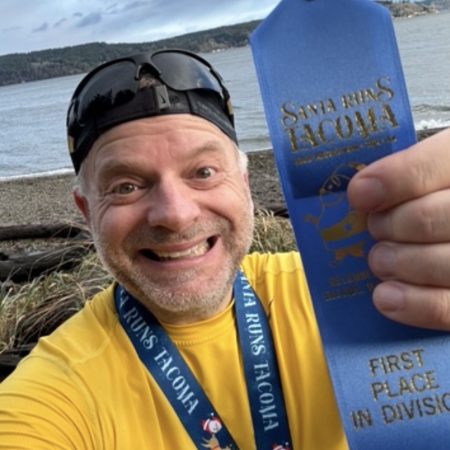
Jay Bates is a seasoned running coach. He is also a runner, writer, teacher and wannabe podcaster. Follow him @coach_bates_says on Instagram.