This article is all about running on air! TRR coach Christina Mather shares her insights and tips on how to view and incorporate body weight supported running options into your training.
Disclaimer: Views and information provided are written from a coaching and athlete perspective. Seek out recommendations of a medical doctor, sports medicine doctor, or physical therapist for details specific to an individual case or injury.
Body Weight Supported Running: Expensive Trend or Valuable Tool
Non-runners often marvel at what drives a person to begin running and to continue the practice of lacing up for days, weeks, months, years, and a lifetime. Despite the lengthy explanations runners give when it comes to this topic, it boils down to 3 motivations or combinations thereof: love of the movement of running, desire to explore personal levels of physical performance (volume, pace, strength), or desire to maintain or improve physical activity level and health.
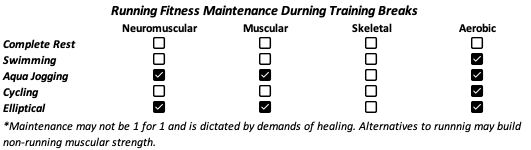
At some point, the body that has allowed an athlete to push will be the body that stops the athlete in their tracks. Running and non-running related injuries, a limit (physical or mental) on the body’s ability to push volume or pace, and training fatigue may require a decrease in or break from running. Typical cross-training alternatives during a running break include complete rest, swimming, aqua jogging, cycling, and the elliptical. While these types of cross-training activities may be necessary to off-load an injured, over-worked, or over-fatigued area, the result for the runner is often frustration or boredom from an activity that is not the preferred movement. Cross-training may also result in a decrease in sport specific neuromuscular, muscular, skeletal, and sometimes aerobic conditioning that running provides. Although many factors contribute to the risk of subsequent running related injuries1, this de-conditioning and potential compensation issues cannot be overlooked. Unlike other modes of cross-training, body weight support (BWS) running provides the injured runner an opportunity to gradually load the skeletal and muscular system in preparation for return to overland running.
Common Body Weight Supported Options
AlterG Anti-Gravity Treadmill
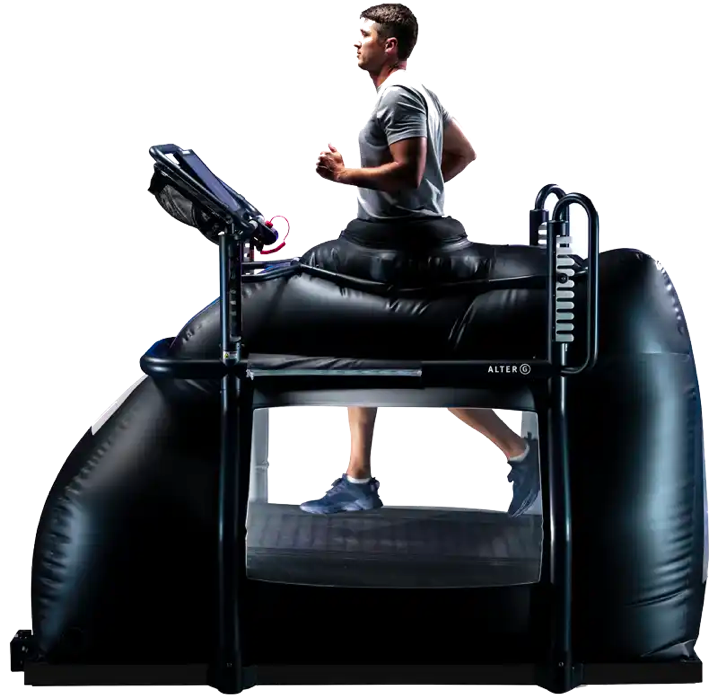
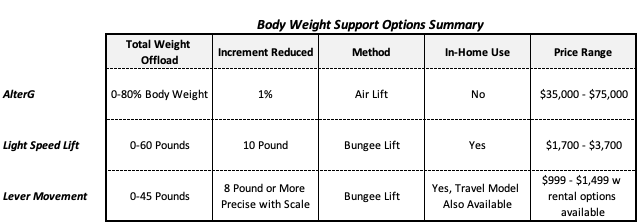
The AlterG Anti-Gravity Treadmill (AlterG) is the original BWS treadmill option. Developed in 2005, the AlterG Anti-Gravity Treadmill uses a patented NASA Differential Air Pressure technology to calibrate air pressure in combination with an athlete’s weight in precise 1% increments to reduce gravitational load on the athlete2. To use, the athlete steps into the lowered air chamber on the treadmill while wearing a pair of AlterG lightweight shorts. Once the air chamber’s frame has been pulled up and locked into place, the athlete zips the shorts into the air chamber to form a seal. Body weight reduction is selected. The athlete crosses arms over chest while the air chamber calibrates and fills with air. Selections to treadmill speed and running occurs as they would on a conventional treadmill. Although the AlterG shorts come in a variety of sizes, the fit may be hit or miss for comfort. The AlterG does not hinder upper body movement; however, some may find a change in arm carriage to prevent arms from hitting the air chamber. The design of the air chamber blocks visibility of the runner to see their feet but includes a window allowing others to monitor gait and movement patterns. Unfortunately, the steep price tag of $35,000 – $75,000 limits use to sports medicine, physical therapy, and athletic facilities with rent by the hour pricing.
Light Speed Lift
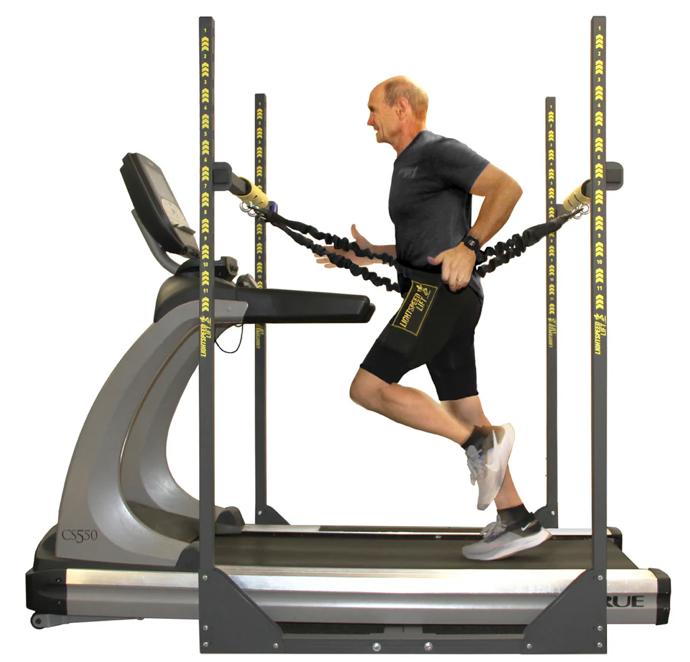
The Light Speed Lift (LSL) was developed in 2012 by Malcom Macaulay as a “more effective, efficient, reliable, and affordable, alternative to existing systems (at the time).”3 The LSL uses steel tubing to create a scaffolding underneath and adjacent to the sides of the treadmill. The user is lifted at the hips by wearing a pair of “magic shorts” which attach to support cords that are connected to the steel tubing. Body weight offload is in 10-pound increments up to a maximum of 40-60 pounds. Instantaneous lift adjustments can be made with the height-adjustable mounting points. LSL systems range from $1,700 for the Home Fitness Version (LS-300) to $3,700 for the Commercial Version (LSX-500) with options to customize the steel support appearance and color scheme.
Lever Movement System
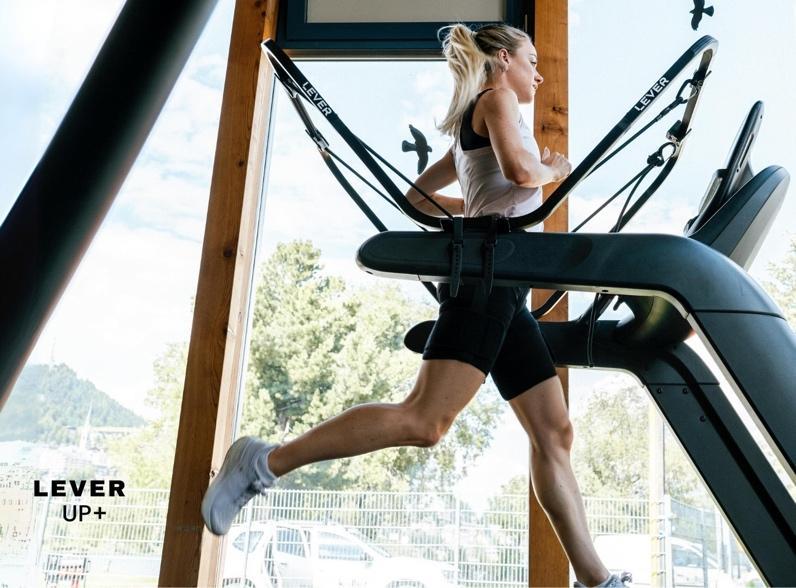
The Lever Movement System (Lever), like LSL, is a BWS that is accessible to the at-home user. Founded in 2019 by Brad Miles and Ryan Ognibene, Lever is a lightweight treadmill attachment that is compatible with most treadmills4. Unlike the LSL, Lever attaches directly to the arms of a user’s treadmill. The user is supported by the frame of the Lever with a bungee that is routed through pulley rollers on the frame and pulley rollers on the user’s Lever shorts. Lever offers 3 models which range in price from $999 to $1,449 with purchase and rental options. Although the base model does not include a scale, the bungee is marked allowing the user to reduce weight in 8-pound increments for up to 45 pounds of weight reduction. The mid-range and travel models include a scale allowing adjustments to the bungee incrementally for up to 45 pounds reduction as displayed though the Lever app. The Lever Go+ Scale model can be folded and transported in a carrying bag.
As much as there is to like about the Lever System, some find that the placement of the bungee cords can interfere with arm movement impacting running and walking gait. Although Lever models include the option of a scale, measurements may not be precise. Despite the availability of a portable BWS, use is up to the discretion of the gym or fitness center and the comfort level of the athlete. Use of a Lever in a crowded gym is noticeable and not discreet. Smaller gyms, hotel gyms, and physical therapy gyms are often more open to the use of the Lever on their equipment.
Effectively Supplementing Training
The caveat to the use of body weight supported running as an effective tool in a runner’s arsenal of options is that it is used at the level required for injury rehab and advanced at a pace that promotes injury recovery and regain of strength. In the case of a healthy athlete using BWS running, it must be done as a supplement to existing running volume and intensity as opposed to in place of to prevent a decrease in muscle and tendon strength, bone density, and aerobic capacity. Research showing alterations in lower limb kinematics as well as stride characteristics5 further demonstrates the need for mindful insertion of BWS into training plans for healthy and injured athletes.
Injury Recovery
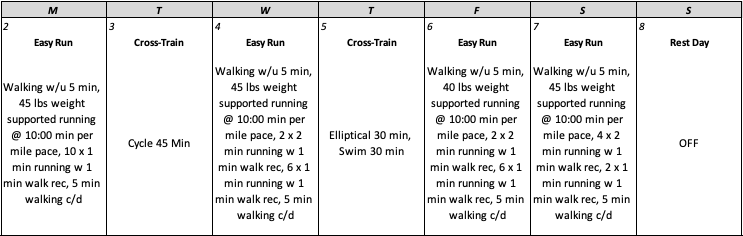
The type of injury will dictate which type of BWS is most appropriate, the amount of weight reduction, rate of progress, and starting point. This is best done in conjunction with the treating medical professional (sports medicine doctor &/or physical therapist) to ensure the proper BWS protocols are in place. Early in the recovery stages from an injury, the AlterG may be more appropriate due to the precision and range of BWS. Once the athlete can start load bearing in the 45–60-pound reduction phase, the athlete may begin a return to full-weight bearing running program using the variables of weight reduction, time, pace, and incline (if available). The guideline of running for 30 minutes at 95% BWS as a threshold for returning to overland running is given by the research article, Role of Antigravity Training in Rehabilitation and Return to Sport After Running Injury.6 Adjusting or introducing one variable at a time gradually loads the body and provides the athlete a clearer picture of what can be pushed forward, maintained, or reduced to avoid prolonging the healing process and return to sport. An example week is as follows:
Athletic Performance
BWS running may also be used as a tool for enhancing athletic performance. An athlete may be struggling with the neuromuscular patterns or mental barriers against increasing pace. In this case, trading a workout session for a BWS session can allow the athlete to experience the feeling of turning over the feet at a faster pace without the added aerobic strain. Over time, weight support can be dialed down so that faster paces are run unsupported.
Athletes wishing to increase volume with less risk of injury may choose to add additional mileage at reduced weight to allow the body to adapt to extra mileage with less pounding on the muscles and joints. This can also be beneficial to athletes who may be on the line of burnout or fatigue but does not want or need to fully pull back on training.
Final Thoughts
The development of the AlterG in 2005 changed the options and approaches available to athletes during injury. Companies like Light Speed Lift and Lever have brought BWS options into the homes of runners from recreational to elite. Professional athletes like Kara Goucher (Lever) and Jordan Hassay (Light Speed Lift) have further helped brands move from novelty status to a recovery tool that can be considered by recreational and competitive athletes. While body weight supported running is not a replacement for road, trail, or treadmill running, appropriate and thoughtful use can be a valuable cross-training option during injury, recovery/post-injury, or to gradually increase volume or practice intensity in a running routine.
Sources:
1 Hulme A, Nielsen RO, Timpka T, Verhagen E, Finch C. Risk and Protective Factors for Middle- and Long-Distance Running-Related Injury. Sports Med. 2017 May;47(5):869-886. doi: 10.1007/s40279-016-0636-4. PMID: 27785775.
2 AlterG, https://alterg.com/our-story. Accessed 1 April 2025.
3 Light Speed Lift, https://www.lightspeedlift.com/pages/about. Accessed 1 April 2025.
4 Lever Movement, https://levermovement.com/pages/who-we-are. Accessed 1 April 2025.
5 Neal M, Fleming N, Eberman L, Games K, Vaughan J. Effect of Body-Weight-Support Running on Lower-Limb Biomechanics. J Orthop Sports Phys Ther. 2016 Sep;46(9):784-93. doi: 10.2519/jospt.2016.6503. PMID: 27581179.
6 Heather K. Vincent, Aimee Madsen, Kevin R. Vincent,
Role of Antigravity Training in Rehabilitation and Return to Sport After Running Injuries,
Arthroscopy, Sports Medicine, and Rehabilitation, Volume 4, Issue 1,
2022, Pages e141-e149, ISSN 2666-061X,https://doi.org/10.1016/j.asmr.2021.09.031.
(https://www.sciencedirect.com/science/article/pii/S2666061X21002339)
https://www.lightspeedlift.com/products/ls-300-1