
Running Safely in Bear Country: Advice from a Ranger Turned Running Coach
It’s spring! Flowers are blooming. Frogs are croaking. Trees are budding. Trails are melting…. And the bears are stirring! In a press release Yellowstone National Park reported that the first sighting of an awake grizzly this year was recorded on March 7. A few days later Grand Teton National Park reported the first grizzly bear sighting within their park on March 13. Both press releases indicated that these sightings were of adult male bears called boars. Protective female bears or sows along with their cubs typically emerge from hibernation throughout April and May. When bears emerge from hibernation, they have lost 15-30% of their body weight per the NPS. Therefore, they wake up in a ravenous and agitated state, similar to how a runner might feel around mile 80 of an ultra-marathon.
With more “hangry” bears waking from their slumber each day, runners need to begin exercising caution when venturing into the backcountry. The year 2021 saw a remarkable uptick in aggressive grizzly bear encounters throughout North America. This included a grizzly sow attack on a trail runner in Idaho. The cause of this upsetting trend can be traced to increasing numbers. After near extinction, the grizzly bear population in the lower 48 States has progressively grown. As a result, the bears are expanding into new territory. At the same time, the population of people recreating in grizzly bear terrain has steadily increased as well. Additionally, the steady growth of outdoor recreation abruptly spiked over the past two years. In the midst of the Covid-19 pandemic, when indoor activities were constrained, people took a renewed interest in exploring wild lands which also happens to be bear country. More bears, plus more people, equals more conflict. Montana is even hiring a dedicated Grizzly Bear Conflict Manager to help mitigate the rising quantity of negative meetings!
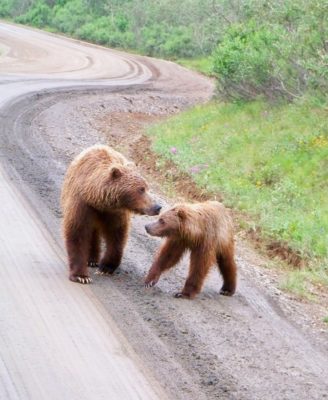
A brief biology lesson….
There are two bears species in North America. The black bears’ (Ursus americanus) range covers most of the forested areas of the North American Continent. Conversely, the grizzly or brown bear (Ursus arctos horribilis) is less widespread. The majority of the population inhabits Alaska and Northwestern Canada. In the lower 48 they can be found in increasing numbers in Northwestern Montana, Northwestern Washington State, The Greater Yellowstone Ecosystem and Northern Utah. Historically, blear bears are far less likely to attack a human than the more aggressive grizzly bear.
I have seen many black bear butts sprinting for the nearest clump of trees in an effort get away from me, the terrifying runner! Why do they behave like this? It all comes down to their environment. In his book, Bear Attacks: Their Causes and Avoidance, Stephen Herrero points out that when black bears feel threated they can easily melt into the forest or climb a tree. Why fight and risk injury if there’s an escape route? Sows will send cubs up trees to safety when threatened. Sometimes she will join them and other times she will remain on the ground and make antagonistic advances toward the source of danger. However, black bear sows rarely make contact with the interloper. However, on occasion, black bears can and do attack people. Do not practice apathy in black bear territory!
On the other side of the spectrum, grizzly bears live in open spaces. Herrero points out that long ago grizzly bears lived in open terrain created by recent glacial retreat. In this exposed landscape grizzly bears could not simply scramble up the nearest tree to safety when in danger. This resulted in grizzlies evolving to be aggressive in order to defend their cubs and themselves in a territory void of trees. Therefore, people are more likely to experience a negative encounter with this larger species of bear.
Running In Bear Country
Back in 2011, before I was a runner, I worked as an Interpretative Park Ranger in Yellowstone National Park. One of my many responsibilities as a ranger was educating visitors on how to recreate safely in bear country. The first rule I told visitors was: don’t run.
Don’t worry! I’m am not suggesting that trail runners should cease all running in the mountains until next winter when the bears are tucked away in their dens. However, it is important to recognize that running does carry an increased risk in bear country for the following reasons:
- If you’re running on the trails, you are likely moving too fast to fully study your surroundings. You might not notice a bear or bear sign.
- As runners we are told to practice “quiet feet.” While this is great for decreasing ground force, it can also lead to surprising a bear who didn’t hear your approach.
- Running can trigger a prey drive in predators, including bears.
- Trail runners often go on solo adventures many miles into the backcountry.
Luckily, even taking the above into account, there are steps to reduce the chances of having a negative grizzly or black bear encounter while on your next 6-hour training run!
Avoiding Bears
The best way to stay safe in bear country is to make an effort to literally not run into one to begin with! There are several strategies to help you avoid bears on the trails:
Gather information!
If you’re going to run in bear country, particularly an area inhabited by grizzlies, it is worth doing your research. Ranger stations, public lands websites and trailhead signage are great resources for learning about recent bear activity in an area.
Be observant!
While you’re running pay close attention not only to the trail and scenery, but the details of your surroundings. Are there scratch marks on the trees? Dug up roots (trademark of a grizzly)? Bear tracks? If you find bear sign everywhere (especially grizzly) you should vacate the area or, at the very least, ramp up your noise efforts as described below.
Make Noise!
For the most part, bears of both species will make an effort to avoid humans. However, in order for them to exit the area they need to know that humans are heading their way. A majority of negative interactions with bears result from a surprise encounter. The best way to let bears know that you’re coming is to make noise. A lot of noise. The bear bells retailers sell do not make a lot of noise. When I was a ranger in Yellowstone, I discouraged visitors from using them as a bear deterrent. They’re simply not loud enough and the sound is not associated with humans. A good practice is to shout something like “hey bear!” or another phase every now and then as you travel along the trail. My ranger friends and I used to loudly identify wildflowers! I am proud to report that at this time, likely due to my copious noise making, I have never encountered a grizzly on the trail. Extra noise efforts should be made as you near a blind turn or around babbling water sources. Researchers led by John Vania in Alaska also had success deterring grizzlies by sounding off air horns in bear dense areas per Stephen Herrero in Bear Attacks: Their Causes and Avoidance.
Travel in groups
In Yellowstone National Park it is suggested that users of the Pelican Valley and Mary Mountain Trails travel in groups of four or more. This is because these routes are grizzly dense. Bears are less likely to attack of group of people, especially if the number is greater than four. As a bonus, groups of people naturally make more noise.
No earbuds!
Though you may enjoy listening to music or your favorite podcast on your run, it should be avoided in bear country. You need to be able to listen for bears in the area.
Avoiding/Defending Attacks
Sometimes you can take every precaution and still encounter a bear on the trail. Hopefully, it will just be the bear’s rear end as it dashes off. However, if the bear lingers the best course of action will depend on the bear’s behavior. In all cases DO NOT RUN! Bears can clock up to 30 mph!
If the bear hasn’t noticed you that’s great! Keep it that way. Stop running and slowly retreat from the area downwind.
If your encounter a bear that notices you wave your arms and identify yourself to the bear in a loud and firm voice. No screaming hysterically or panicking. Remain calm and back away slowly avoiding eye contact. If the bear doesn’t follow continue a hasty retreat at a walk staying acutely aware of your surroundings. Depending on the landscape, you may also have the option of making a huge circle around the bear, but you might risk getting between a sow and her unseen cubs with this method. Keep that in mind!
If the bear approaches, slowly continue to back away and wave your arms without eye contact. You should prepare to use your bear deterrent.
If the bear acts aggressively toward you by swiping the ground or clicking his or her teeth a charge is likely to follow. Ready you deterrent and talk firmly and loudly to bear. If a charge does occur use your deterrent of choice. DO NOT RUN!
Is the bear does not respond to the deterrent and attacks how you respond will mostly depend on species of the bear. The NPS has a wonderful article detailing how to tell the difference between the two species. For grizzlies the general rule is to lie face down with your hands protecting your neck and play dead. Grizzlies usually attack defensibly and, once they feel the threat is neutralized, they will cease the attack. Be sure to remain still and quiet after the attack concludes and be 100% certain the bear is
gone before getting up. If the notability more docile black bear makes hostile contact, then you should fight back aggressively as this is likely a predatory attack.
Tools of the Trade
When I travel through the backcountry I always carry a personal locator beacon with me. This small device can save your life if disaster strikes. One such disaster could very well be a bear attack. It’s worth the investment in my option.
Per my personal risk tolerance, I carry a bear deterrent when I know I am going to run through grizzly country or an area with high black bear density. There are two main bear deterrents: firearms and bear spray. The effectiveness of each is hotly debated and I won’t go into too many details. The general consensus seems to be that the right sized bullet placed in just the right spot will 100% neutralize a bear attack. However, the person being attacked needs to be an excellent marksman under very stressful circumstances. Therefore, bear spray is widely considered the better option for most outdoor recreationalists.
Bear spray is essentially an ultra-powerful pepper spray. The product can typically fit in one of the bottle pockets of a hydration vest. There are also special belts made for the purpose of carrying bear spray. My favorite is the Scat Belt (product review here). If a bear approaches and/or charges the spray can easily be grabbed out of the belt or bottle pocket. The user need only remove the safety clip and spray the product into the bear’s face per the instructions of the particular brand of spray. No special skill is required. It is worth noting that in order for any brand of bear spray to work the user must practice restraint as the spray will only work at close range. Also, bear spray is a deterrent and NOT a repellant. There have been cases of some very unhappy folks attempting to use bear spray as one might use Deet to repel mosquitos!
Whatever you choose as a deterrent, make sure you practice before heading out into the backcountry! And, yes, there is special water based practice bear spray!
Finally…
Have a wonderful time running this season! Hopefully these tips will help you travel safely and confidently through bear country. Remember to make noise!
Dandelion Dilluvio-Scott is a running coach with Team RunRun. To learn more about her or to work with her, check out her coaching page.