
How can you be your best, both with training and racing, as the temperature is increasing? TRR coach Scott Fauble shares his tips for training in the heat – Enjoy!
The temperature may be going up but you still have to get your training in if you want to have a shot at running a PR this fall! As someone who has coached amateur runners for the last 10 years, and trained through many a summer as I prepped for fall marathons, I know how tough it can be to wake up early, hydrate fully, and then look at my watch only to see splits that are nowhere near my expectations, and miles off of what I have done in autumn and spring seasons in the past. The point of this piece is not to teach you how to beat the heat. The point of this piece is to outline the necessary changes you can make in your workouts in order to get the most out of them so that when fall comes around, and race season approaches, you accomplish your goals.

6 Tips for training in the heat
- Slow down
- SLOW DOWN
- SLOW THE $%*^ DOWN
- Hydrate and fuel appropriately
- SLOW DOWN
- Let the heat work for you.
Haha! Ok, point made – slowing down is a big part of the equation. Let’s dive deeper.
Expectation Management
The biggest key to training through the summer is lowering your expectations and accepting that you are not tougher than the sun. You just cannot run the same splits at the same effort when it’s 80 degrees as you can when it’s 40 degrees. But guess what, you don’t have to run the same splits to get the same results and adaptations. Your body doesn’t know pace, it only knows effort. Heart rate, lactate levels, sweat rate… none of the things that we can manipulate in workouts to trigger adaptations are tied to pace. They are all tied to effort. That means that if you can take your ego out of the workout that is 70 degrees and 70% humidity, and slow down, you can still trigger your body to adapt in the ways that the workout is calling for.
“Ok, Scott, how much should I slow down?” You may ask. Good question, if you add up the dew point and temperature that total can inform what % you need to slow down to accommodate the heat.
Temperature + Dew Point => % Pace Adjustment
- 100 or less: no pace adjustment
- 101 to 110: 0% to 0.5% pace adjustment
- 111 to 120: 0.5% to 1.0% pace adjustment
- 121 to 130: 1.0% to 2.0% pace adjustment
- 131 to 140: 2.0% to 3.0% pace adjustment
- 141 to 150: 3.0% to 4.5% pace adjustment
- 151 to 160: 4.5% to 6.0% pace adjustment
- 161 to 170: 6.0% to 8.0% pace adjustment
- 171 to 180: 8.0% to 10.0% pace adjustment
- Above 180: hard running not recommended
Here’s a chart to help calculate what those percentages equate to:
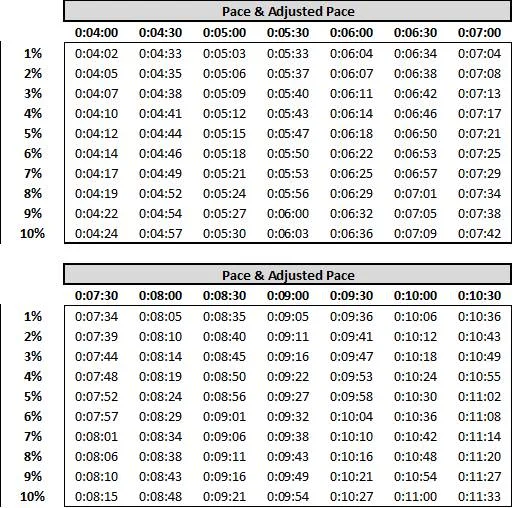
Source: https://www.wickedbonkproof.com/running-training-tips/-adjusting-pace-for-heat
Think Progression
This is a great starting point, but if you really want to dial in your workouts on those hot summer days there are a few other things you can do to make sure that you are getting the most out of your summer training. First up, we return to our initial list and we SLOW DOWN! Heat exposure is kind of like a bowl, the more heat you experience the more it fills up until it’s overflowing. If you push yourself to the point where your metaphorical heat cup runneth over, your body shuts you down. In order to prevent this, it’s helpful to do these summer workouts as progressions because we can always speed up, but when you start too fast it’s really tough to pull the pace back and save the workout. So, start your workouts slower than even the above heat chart suggests.
Fueling and Cooling
The second thing you can do is fuel properly and cool ourselves off during sessions. On hot days I liked to do my intervals back and forth on one stretch of road so I could stash a bottle of ice water or a cooler and a sports drink at the start/finish of intervals, that way I could pour water on my head and make sure that I was getting extra carbs in workouts. Some particularly helpful places to focus on cooling are the back of your neck or the inside of your wrists. You can also run while holding ice.
In addition to using the ice/cold water to cool your body/core, when it’s hot outside you burn more calories because sweating takes energy. Due to that increased energy expenditure, your intake needs to increase as well so crank up the fueling. Additionally, while I usually think that electrolytes are over hyped because the American diet has more than enough salt to cover almost everyone’s needs, if you have a history of cramping you should consider using a carb drink with electrolytes or you can take a salt pill before you start.
Prioritize Effort
The final tip for training in the heat is key to your success: If you can slow down and prioritize effort over pace in the heat, summer training can actually be some of the most effective training that you do. We’ve all seen the army of influencers touting the benefits of sauna use for health, and while I can’t speak to the efficacy of those red-light masks that make you look like MF Doom, I can tell you that heat training (if done right) has some pretty sick side effects. Heat exposure has been shown to jack up natural erythropoietin production which causes your body to create more red blood cells which allows you to transport oxygen more efficiently.
So, this summer when you’re slogging through hot, muggy, sweaty miles and getting ready for that fall marathon, don’t despair. Take your ego out of it, slow down, turn your workouts into progressions, dump ice water on your head, take a couple extra sips of that sports drink, and let the adaptations come!