FKT: Across Hawai’i Volcanoes National Park – Rachel Mason

Runner: Rachel Mason

Name of “Event”: FKT: Across Hawai’i Volcanoes National Park

Date(s) of event: 06/16/2023

Time to complete: 09h49m

Location: Hawaii Volcanoes National Park

Strava Activity Link: https://www.strava.com/activities/9279427019

Gear – What did you bring?

Took my 30L Ultimate Direction Fastpacker (nice pack, horrible color, worse name), just because I wanted to carry poles and a lot of water. I carried a windshirt, very basic first aid kit, headlamp – and poles and a lot of water. I decided to wear full-length leggings and a sun hoodie; I decided that not getting all scratched up in long grass was more important than maybe being a bit cooler. I wore La Sportiva Bushidos (or Akash? can’t remember what they are), which are pretty substantial shoes that feel safe on bare rock.

Fuel – What did you consume and/or not consume?

OK so I haven’t exactly got this down to a fine art. I like those nut butter Clif bars but they’re $11.99 for 5 here so I bought fig bars instead (raspberry flavor, actually). I complemented them with a big bag of chips and a side of these big crunchy cookies from a local bakery. This was topped off with a bag of crystallized ginger aka magic beans and paired with some delectable Nuun tabs. Mmmm.

Logistics – What kind of planning was involved for both prep and implementation?

This whole thing came about because I was looking at maps of the national park while plotting some backcountry explorations, and I realized you could in theory string together a load of trails into an uninterrupted crossing of the park, and it would be about 50k. I had broken my foot last year during one of said backcountry explorations, and I decided that this route would be my first big trail run after coming back. To make it a bit more fun I submitted it as an FKT route a couple weeks before my target date, and it got accepted!

For training, Coach Des had me first build up road mileage, then transition to trails for a few weeks. This felt like a good approach. I made sure to put in some time on the actual trails along the route, to get used to the terrain (an awful lot of lava rock) and get a feel for being out in a very remote, hot, and windswept environment.

On the day, my partner dropped me off shortly before sunrise at the Footprints trailhead, and picked me up at the Pu’u Loa trailhead in the afternoon. Along the way I filtered water at two backcountry cabins/shelters; I must have drunk a good 6 liters in total.

Where to find the info on this:

https://fastestknowntime.com/route/across-hawaii-volcanoes-national-park

What went “right” or at least how you expected it to go?

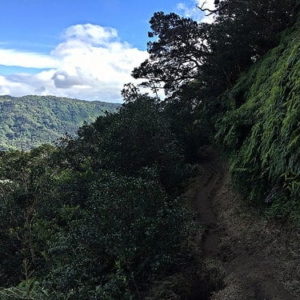
I mean, I finished it? And in the last few miles I did this thing that was slightly faster and more tiring than walking; let’s be generous and call it running. There were some really nice points along the route as well. Setting off below the vast bulk of Mauna Loa starting to turn pink in the sunrise; a small but delightful forest about 18 miles in (basically the only shade that whole day); looking down on the beach at Halape and planning to come back with a hammock and some mai tais; the amazing variety of lava colors and textures in the last 8 miles – that kind of thing.

What went “wrong” or completely unexpected that you had to deal with?

OMG MY FEET. The trail was very overgrown around the 10-mile mark and my feet got soaked and started to rub. I did stop a few miles later to dry them in the sun and brush off the sand (actually volcanic ash), but that wasn’t enough. Soon I had blisters on both heels and the balls of my feet were rubbing as well. Also, the trails are so rocky that every step was some fresh discomfort from stepping on yet another hard, pointy lump. One of the blisters popped a mile or so before the end and that wasn’t pleasant at all.

One other thing is that when I stopped to use the outhouse at the Pepeiao cabin there was a little nest in there with three dead baby birds in it. That was sad and depressing and for some reason made me feel lonely. I put on a running podcast after that, which helped. (Actually it was the one where Coach Des talks about Cocodona, which was great except that bit about feet was a bit much).

Lessons learned for either the next trip or another’s first trip?

Mainly, deal with your feet and take some fresh socks.

Everything else!

So there was this long stretch in the middle where I just walked the whole thing, because it was uphill and the ‘trail’ was just a load of rocks hidden under grass. And at that point I didn’t feel like an ultrarunner at all, just a person doing a very long hike. And I was like “this is going to take 10 hours, that’s 3 mph, how is that a respectable pace, what is the point of this?”. But having had time to digest the whole thing, I’m now just happy to be a middle-aged woman who can push through 31 miles of pretty gnarly trails and still be in one piece at the end. Well, apart from the feet. The feet have opinions about this whole thing…

Some Gorgeous Pictures!

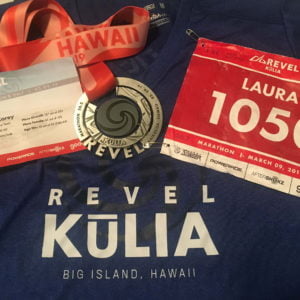
revel kulia marathon race report

Revel Kulia Marathon Race Report – Laura C

Race: Revel Kulia

Runner: Laura C

Race Date: 03/09/2019

Location: Waikoloa, HI

Results: 4:00:00

revel kulia marathon race report

3 Bests – What aspects of the race did you like the most?

Revel is a very informative, organized and helpful organization. There were multiple communication emails that went out prior to the race explaining how things would look like for packet pickup, and race day. As a nervous runner, the more information you give me to visualize the day, the better! They had live online sessions where the course was described with tips on how to run it. Their aid stations were plentiful and well stocked with supplies. And I really liked the touch of having the Hawaiian blessing pre-race. It seemed they really wanted to respect the Hawaiian culture and make sure that the race left a very small footprint on the course.

Not so much – Aspects of the race that didn’t do it for you

The wind! I should have thought about the Hawaiian trade winds, but didn’t. I would have discussed pacing strategies during a headwind with my coach had I been warned. Revel also required that we ride a bus to the starting line. The bus picked us up at 4:30am, exactly two hours prior to the race start. So being a person that is meticulous about my routine in the two hours before a long run or race, I found this to throw my whole timeline off. I was too nervous to eat on the bus with an hour ride to get to the start, and once we got there, it was too close to start time to eat my normal breakfast and drink my coffee. The result, I ate a quarter of my normal pre-race meal and got about three gulps into my coffee.

Weird factor – What’s the weirdest thing about this race?

This was literally the smallest finish area I have ever experienced. The race ended in a field of lava rocks where there was nowhere to sit without squatting down to sit on a pile of rocks. I’m sure they did this to cater to their downhill course, but I think they need to recreate the course a bit to work something else out.

Highlights of your race – What did you do well and enjoy about your race in particular?

I PR’d by 20 minutes and hit 4:00:00 on the dot! I would have loved to have been under 4, but to hit it exactly was a pretty awesome next best thing. I really pushed that last mile when I saw the time, so I was thankful to still have enough in the tank to get that time.

Lessons for others – Share your pro-tips on the race to help the next runner

Don’t start out too fast! The steepest downhill is during the first 9 miles, and then it transitions to more of a rolling hill situation, so if you fly through that downhill you will kill your quads for the remaining 17 miles.

Lessons you learned that will help you next time around

Pay attention to pace if faced with a head or side wind. I pushed it too hard early in the race during a few particularly windy miles and I feel that affected my legs on the rest of the race. I also learned after the race that it helps to stay with a pack of people during windy conditions. I don’t really like to talk when I run, so I was running by myself the majority of the race.

Aesthetics – Is it a pretty course?

Yes and no. The sunrise was amazing, and for a good portion, I had the blue ocean on the horizon to stare at. I even saw a whale at one point! But there was also a good chunk of the race that had a view of lava rocks and/or grass. It’s not in the tropical portion of Hawaii, so if you’re picturing running through palm trees and jungles, you will be disappointed.

Difficulty – Is it a tough course?

The course was tougher than I had imagined. Revel really sells their races as downhill, and yes, they went into detail about the course with us before the race. But the details they gave us discussed the overall grade of each mile and left out the part about the uphill portion of some of the miles. So I trained entirely for a downhill run when I should have been focused more on training to run a steep downhill for the first 9 miles, and then transitioning to rolling hills with a smaller downhill decline.

Organized and well run – Did it feel like a well-oiled machine or were they flying by the seat of their pants?

This race was incredibly well run and organized. Especially for it being their first race at that location.

Aid Stations – Standard fare or anything special to know about the aid stations in terms of what’s available or when?

The aid stations were well staffed and stocked. They offered water, Powerade, Honey Stinger gels and DoTERRA Deep Blue rub, which was fantastic after about mile 17.

Weather and typical race conditions

I was worried about the humidity and heat after training all winter in Spokane. I spent hours strategizing my plan to stay hydrated. Instead, we had temps in the low 70’s, cloud cover and a cool wind. I laughed when I saw some of the volunteers in sweatshirts.

Spectators – Is this a friendly course for your friends?

There were a few spectators along the course but they were few and far between. Most of the time we were running on roads that were open to traffic.

How’s the Swag?

Revel did a great job with the swag. The shirt and medal were both great, everyone got Goodr sunglasses, and my kids loved the temporary tattoos they had available at the race expo.

The Overall Score – How many stars do you give this race and do you recommend that others run it?

Overall I would give Revel Kulia 4 stars. It was a great destination race, it just needs a better finish line!

revel kulia marathon race report

hurt 100 race info

Hurt 100 Race Info

Summary: Situated in the mountains above the city of Honolulu, the HURT 100 course is characterized by its latticework of roots across the single track trails. Runners cover the 100 milers over the course of 5 loops with some partial out and backs, gaining and losing 24,500 feet, crossing 20 streams, and of course, running over countless roots, rocks, puddles and “mud wallows”. It’s certainly not for the faint of heart and takes lots of perseverance and an adventurous mindset.

Lessons Learned from Race Reports

  • Average temps listed are for the city of Honolulu. Expect lower highs and lows, more precipitation, and high humidity (the race is in a rainforest)
  • The dense canopy in the forest causes shorter daytime hours than the sunrise/sunset listed, so be aware of when you need your headlamp during the race
  • Very little of the course lends itself to a consistent stride – be ready to be consistently inconsistent in how you run and navigate the footing and elevation changes of the course
  • There are wild pigs in the forest – exercise caution if you see any, especially any momma and baby pigs
  • Mosquitos are a factor, especially in areas with little air movement
  • Dehydration and hypothermia are big risk factors for runners in this race because of the hot and humid days and cooler night temperatures
  • Of the two stream crossings, one is technical and another is not. Be ready to get your feet wet (if they aren’t wet and muddy already), and be ready to cross scattered and slippery rocks
  • Hiking poles are allowed (and by the looks of course, aren’t a bad idea!)
  • Be sure you know the runner, pacer and crew rules in the Book of Hurt
  • Lots of other day hikers out on the trails, so be aware and respectful of other trail users
  • Sauna sessions as part of training are helpful because of the high humidity in the race
  • The course takes constant mental focus because of the technical footing and twists and turns
  • If you don’t run well with wet feet, have a plan for changing socks and shoes often to have dry feet
  • The first climb starts out in in the dark and will likely feel crowded with runners all in a line, so if you want to be in front, you’ll need to get out fast. If not, do your own pace and don’t be rushed by others pushing from behind.
  • Lots of runners fall apart on loop 4, when the darkness settles in and they still have 40 miles left
  • Know that your pace will slow, likely considerably, once it gets dark. Be prepared to hike.
  • If it’s muddy, which is likely, the mud gets worse as the day progresses because of so many people running over the same trails over and over again
  • Have a very strong headlamp – seems intuitive and normal for any ultra at night, but several races reports noted having a weak headlamp and really suffering because of it.

Tips from Coach Masazumi:

  • Trekking poles save you, so train how to use them before the race if possible. HURT 100 is very technical, and they help place your steps stable. Many use it regardless of whether a runner is fast or slow. Last year, 2nd place runner was using them in his last lap.
  • In addition to Sauna, try the fitness gym. It’s warmer than outside and easier to stay longer than in the Sauna.
  • Loop course is one of the big factors of high DNF rate. It’s getting harder to start another loop when you are tired. Be strong and stay focused on your goal.

Elevation

Total gain/loss: 24,500/24,500

Ft/mile gain: 245

Total climbs: 3 major per lap, each ~1200 feet, for 15 total, along with countless small, steep climbs and descents along the way of each major climb

Course Map (PDF), Elevation profile (page 23), and Google Course Map

Aid stations

Total aid stations: 3 aid stations per lap (5 laps)

Furthest distance apart: 7.4 miles

Locations: Anywhere from 5.2 to 7.4 miles apart on each lap

What’s available: All aid stations have bottled water, an electrolyte drink, and carbonated beverages. Standard aid station fare with hot and cold food options and some vegetarian options. Runners are responsible for their own gels, energy bars, electrolyte supplements, medications (e.g., anti-inflammatory products), personal hygiene products (e.g., sunscreen, lip balm), and typical first-aid items (e.g., bandages, blister treatment).

Crew access

Access Locations: Crew can access all 3 aid stations, but not before 11:00am at aid station #2 or #3. First aid station, Nature Center, is also Start/Finish.

Crew instructions/directions: See Book of Hurt for directions, parking and information.

Pacers

Yes, they are allowed after 60 miles or beginning at 17:00 on Saturday, whichever comes first. One pacer at a time and they must start from an aid station.

Race qualifiers

Western States 100 qualifier

Race reports

https://masazooomirunning.wordpress.com/2017/01/30/h-u-r-t-100/ (Coach Masazumi’s race report with lots of pics)

http://www.hawaiirunninglab.com/race-report/guest-race-report-jeff-frank-hurt-100/

http://crockettclan.org/running/hurt100.html

Strava activities and GPX files

https://www.strava.com/activities/472884761/overview

https://www.strava.com/activities/834058495/overview (lots of photos!)

Race Website

https://www.hurt100.com/

Runner’s Manual (aka Book of Hurt)

Prepping for an ultra? Check out our 7 Steps Towards Running your First Ultra!