As a high school runner, before I knew anything about zone training, my coach would provide me training programs every month. A departure from the tools that we utilize today, these programs were always crafted on pen and paper. Words like “Easy” or “Steady” were used to indicate intensity. Though I had an implicit understanding of what this entailed back then, by today’s standards this language may be seen as vague or ambiguous.
Being a runner in 2024 comes with the opportunity to utilize a variety of tools, built to aid in training and race-day performance. After each run, my Garmin feels compelled to tell me how I’m progressing in my training. Other gadgets on the market, like Whoop’s wristbands and Stryd’s running power meters, add even more layers of information. Gone are the days of pen-and-paper training plans. Today, quantitative data has won the hearts and minds of runners across the globe.
Ryan Woolley racing on the trails with the help of an advanced GPS watch shows how much technology has evolved.
The heart rate zones framework has been a popular reference point for those who are choosing to organize training load according to one particular piece of data – heart rate, collected from either the wrist, upper arm or chest. Heart rate can be correlated with intensity during endurance training. Considering this, coaches and athletes can plan training sessions to fall within a certain intensity range. The desired intensity depends on the goal race, workout purpose and stage in a training cycle. Understanding how to apply these zones is crucial for progressing toward a big race or adventure while managing rest and recovery.
This article is for those who want to make sense and use of heart rate zones. We’ll start by defining heart rate zone training and some it’s nuances. Then we’ll move onto discussing how to apply the framework during your next training block.
What Are Heart Rate Zones?
Heart rate zone training comes from the understanding that the body controls for energy production according to its rate of work. For example, the mix of energy systems used in a 1-mile race differ significantly from those used in a marathon. Heart rate zone training is utilized with the intention of building volume (or time) spent running at race specific intensities. This protocol consists of dividing ranges of exercise intensity into segments that are each associated with a heart rate range. The intensity range goes from walking to maximum sustained exertion running.
The number of zones and how they’re structured will often vary depending on the creator. For simplicity, I’ll reference a 5-zone framework in this article (below). However, other zone frameworks consist of 4 or even 3 zones in association with intensity-related metabolic changes.
Zone
Name
Intensity
Use
1
Active Recovery
Very Light
Hiking, active recovery
2
Easy
Light
Easy days, medium/long runs
3
Aerobic
Moderate
Tempo work
4
Threshold
Hard
Strength-based intervals
5
VO2 Max
Maximum
Power-based intervals
The Wandering Heart and You
Here’s the deal with your heart rate while running: it’s not always a perfect indicator of effort. During long efforts, for example, heart rate can slowly increase over time. This is known as cardiac drift, occurring in response to an increase in the body’s core temperature and sweat losses. As such, running in hot environments can create a bigger discrepancy between heart rate and perceived effort.
Additionally, heart rate numbers during submaximal exercise can be swayed by our emotions – a charged atmosphere can lead to higher average heart rate values due to an increase in sympathetic nervous system tone.
Experience level also plays a role. Seasoned runners are able to pump more blood per beat to the working muscle. This allows them to maintain lower heart rates at higher efforts. In contrast, those who are new to the sport may see higher heart rate values relative to the same level of perceived effort.
Given these variables, it’s clear that heart rate numbers should be taken with a grain of caution. But if heart rate can sometimes mislead, how do we make sense of our training? Connecting intensity zones with target race paces can help to create a more complete picture.
Ryan Woolley running an ultra trail race. (Check out his TRR hat here!)
The “Golden” Zone 2
Zone 2 training is often hailed as the “golden” zone for distance runners. For the past few years, influential coaches, physiologists and runners alike have been taking to social media and speaking to the sweet, sweet taste of this secret sauce. The perfect amount of Zone 2 running (approximately 60 – 70% of maximum heart rate) to add to any training recipe, they say, is 80% of total volume. Regardless of how much time it contributes toward your weekly volume, running within the lower zones of 1 and 2 allows you to build a strong aerobic engine without risking mechanical failure.
What does Zone 2 feel like?
As they say, keep it conversational. Learn how to breathe deep and sink into an easy rhythm. To ensure that you’re not feeling any pressure to maintain a set pace, run to duration on these days. Runners I coach slowly progress up to an hour of running at this intensity before I introduce any harder running. The less experience you have, the more time you’ll need to spend running within this zone each week.
Which Zone and When?
After building a foundation of easy Zone 1 and 2 running, you can start to build volume around harder efforts. The next zone up will typically be the main intensity range that you live in during a marathon. Workouts in Zone 3 might include tempo runs or long intervals at marathon pace, equivalent to a steady, harder than easy but controlled, effort. Start by running for 20 minutes at your target marathon pace, before progressing this workout by adding time, or by slowly increasing your speed towards the end. If you’re really struggling for air at the end of these workouts, adjust your goal times accordingly. Alongside Zone 2 days, one of these sessions per week is plenty.
Once you feel that your body is starting to recover well from Zone 3 work, you can add a little spice with Zone 4 training. Aim to spend more time here if you’re looking to perfect the 5 and 10 kilometer distances.
Zone 4 interval training allows you to safely build volume at this intensity. Considering that you’re likely working within the Zone 4 heart rate range during 5 kilometer and 10 kilometer races, any interval training may be modeled off these target paces. Start with 2 to 3 minute intervals at your target 10 kilometer race pace, before introducing shorter intervals – 300 to 400 meters – at 5 kilometer race pace. Focus on starting small, before slowly increasing the number of intervals while maintaining a consistent pace. Try to keep the recovery to no more than the equivalent of the interval duration. If you find that you need more recovery time to keep a consistent pace, take your foot off the gas and slow down your target times. Treat Zone 4 work as the crescendo of your training block.
During your final weeks of preparation toward a key race, your week will likely include one Zone 3 day, Zone 4 interval day, as well as one day dedicated to running long in Zone 2.
Zone 4 intervals helped prepare Ryan Woolley for a shorter distance XC race.
Final Note on Zone Training
When thinking about the zones framework, context is everything. Three things to consider when organizing your next training block are your:
1) Level of experience
2) Current state of fitness
3) Target race, goal or adventure
Within the design of any program, your progression in training should always be cyclical. At each stage in the cycle of your training block, a different zone will become the focal point. The amount of volume that you work up to within each zone will depend on the intensity range that you’ll be utilizing the most while trying to hit your next running goal. In that sense, heart rate zone training should never exist in a vacuum. Instead, consider the zones as a collection of tools – at any given time, the one that you use will depend on the project at hand.
Ryan Woolley is a coach with Team RunRun based in New Zealand. As a coach, he focuses on strength for performance and injury prevention. He uses his 20 years of competitive experience across many distances and terrains to guide his athletes towards their goals. Ryan also has a strong technical understanding of exercise physiology (BSc, MA) and applies it to his coaching.
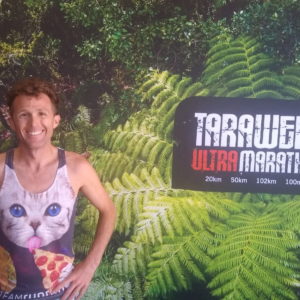
Space Cat Taco tank always reminding me to smile 🙂
This is Coach Matt Urbanski’s 2021 Tarawera 100 miler race report. He shares his story of the race along with tips and insights about the race to help others. Matt is the co-founder of Team RunRun and this is his 15th 100 mile finish.
3 Bests – What aspects of the race did you like the most?
The race atmosphere. There is a vibe here that makes everything about the event feel special. It feels special to be there and to be part of the event. I think that contributed heavily to my feeling grateful all day long.
The course. This course has many elements that make it challenging and exciting. It’s well rounded in the sense that it has flats and hills. It has smooth running and it has technical trails. It has it all, and to do the course well, you have to have a variety of skills as a runner.
The race bloggers! I got to meet these awesome people from the Ironman organization early on, and they were so fun to be with throughout the weekend. They encouraged me, they gave me intel during the race, and they were pushing me forward. I tried to not get wrapped up in the race early on, but they definitely added an edge of excitement to the whole thing that made this even more fun! They also helped me out post race when my mind was a bit foggy – thank you!!!
Weird factor – What’s the weirdest thing about this race?
It’s not so much weird, but it’s unique – the intertwining of the Maori culture into the race was very cool. The Friday morning welcome to the runners at Te Puia, the Haka performed at the start of the race, the Haka at the finish, the pounamu awarded to finishers – all this contributed to a general aura around the race that made it feel meaningful and special.
Highlights of your race – What did you do well and enjoy about your race in particular?
I have a story with this race – here it goes! I DNFed here last year. I dropped around 140k after going into the race underprepared, getting too aggressive in the middle of the race, and ultimately peeing blood a couple times. I figured I wouldn’t get another chance to race this one given that we weren’t likely to be in New Zealand again anytime soon! But as fate would have it, our flight out to Japan in April 2020 was cancelled, and here we were, still in NZ a year later! I got an elite entry into the race, and I got another chance. I’m not one to have beliefs about fate or destiny, but if there was such a thing, this race seemed lined up for something special from the get go, and I felt that!I trained well and it showed on the course. I didn’t have a huge build up b/c I was still working through a foot injury that had plagued me for more than a year. I got some custom orthotics in late August that turned things around for me and enabled me to start training. It wasn’t until October that things started clicking for me. I hit some good workouts, got into generally good runner fitness, and then in the last month, I really worked on my weaknesses – vert and technical trail. We were in Nelson and I spent lots of time in Marsden Valley powering up the Scout trail and the Powerline trail (40% grade on Scout!), and then pushing it down the Involution trail and the Glider road. I specifically remember during the race going up the hill out of Okatina thinking – I’m ready for this – bring it on! I also had some good tune up races in December and January – I didn’t crush these races, but they showed me my weaknesses and helped inform my remaining training time.
So I went into the race ready, I felt a sense of higher meaning to the race, and I was excited to race like I hadn’t been in a long time.
During the race, I managed my day really well. I was patient. I was calm. I stayed positive. I didn’t go to any dark places the entire race, and the time seemed to fly by. I managed my effort, my fueling, and my mental game all day long, and was simply in the moment, enjoying this amazing opportunity. The more of these races I do, the more important these elements seem to be to me – it’s about framing things mentally and being present that sets up a higher likelihood of success, and things all just fell well on race day!
Photo: FinisherPix
The Actual Race
I’m sure my version of the race is different from Carl’s, Doug’s, and Louie’s, and it’s also likely different from how it appeared to those at home watching the little spot tracker dots moving around the circle, and from reading the blog updates. But here’s my take on it!
I went in with the motto that I wasn’t even thinking about racing until 120k. Of course I was paying attention, but I had rules in place for myself to keep me from getting caught up in the race and making costly mistakes early.
From the gun this year, no one took it out fast. I was immediately in the front, with Carl Read right there with me. We chatted a bit, both learned we’d DNFed the previous year, and that we were both looking for redemption. Then about 1km into the run, I realized I hadn’t turned on my spot tracker. So I stopped and got it turned on. I quickly caught the lead guys and at the moment decided that I easily caught them and that an easy start for me was faster than what we were doing. So I moved into the lead and never felt like I was pushing it or making a mistake early. With the terrain smooth, hills small/moderate, and my body fresh, I cruised early. I didn’t know what kind of lead I had but I couldn’t help but thinking about how I was leading and wondering how the day would unfold!
I kept it steady up front without thinking much about who was behind through 30k. Shortly after Buried Village, the course gets more twisty and technical. I was patient and slow. It took awhile, but eventually Carl caught me a few kms before Isthmus aid station. He was quickly gone – he moved well through the rocks and roots, while I cautiously picked my way through! When I got to Isthmus, I confirmed that there were two boats and that I wouldn’t be losing time if I didn’t get on the same boat as him. From then on, aid station workers, the bloggers, and everyone else on the course was giving me intel on how far I was behind Carl.
I could feel that I was chasing him, but I was also confidently running my race. If he ran away with it, good on him. I was going to run my race and keep my legs and gut working for later in the day. I heard reports along the way that I was 7 mins back, 20 mins, 40s mins, even an hour back. I tried to not get too caught up in this, but I was certainly paying attention. One of my rules was that I wasn’t going to ask anyone how far back I was until 120k.
And it was at the 120k mark that Sophie (doing blog updates on the race) told me that I was 20 mins back on Carl, but that he was looking rough and talking about all kinds of problems he was dealing with. She said with confidence that I would catch him. I left Okatina with a spring in my step and a well fueled stomach. I was ready for the climb. As I was nearing what seemed like it had to be the top – there were a few false summits, I saw Carl. He was looking pale and defeated. I was both elated to have caught him, but then also immediately felt bad for him. He was in a rough patch and said he was dropping. He had help with his pacer to get out and I quickly moved past and into the lead.
From then on, I suddenly went from the hunter to the hunted. I hadn’t given any thought up until this point to who was behind me and how far they were back. I began desperately wanting updates on my lead!
In 2017 I raced the Cascade Crest 100 in Washington state. I lead from mile 30 to mile 98 (of 102). I thought I had that race in the bag, and then Lindsay Hamoudi ran me down and won in an amazing display of patience and determination. I was determined to not have that happen again! I kept on my race plan, thinking to myself, “patient, calm, in control” and I just kept plugging along. At 149k, Julie said she thought I had a 30 minute lead as of Millar aid station. The intel from the race staff was 20 mins officially as of Okatina (but that was 29k back, so it could have changed dramatically during that time!)
I was running a bit scared from 149k on. I pushed hard as a result and spent more energy than I should have before Redwoods. However, I saw Julie, and she quickly told me that she’d stayed at Blue Lake (149k) for 30 mins and didn’t see second place. So with greater than 30 mins ahead, and a body that was tiring, I powered home with some confidence. I was ready to push if I had to but I also didn’t want to do anything stupid and lose the race either. I came home with the win and it didn’t really soak in until I was coming into the finish area that I was really going to win. It was pretty damn sweet from there forward!
Photo: FinisherPix
Lessons for others – Share your pro-tips on the race to help the next runner
It’s not so much about going out slow that is important on this course, it’s most important to manage each varying element of the course well. If you’re comfortable running smoother faster trail/roads, don’t go too slow early on. If you are less skilled on technical trail, be patient on those sections (that’s my story!) Be patient in the middle! It’s easy to get into racing this one on the smooth roads and dirt tracks from 47k to 93k, and then to be pushing on the technical stuff from 93k to 120k – I blew my race on these sections in 2020, and this year I was simply waiting for the challenges from 120k on!
The section from 120k to 137k is a crux of the race! There is a big steady climb (5kish of generally uphill), and a 16.4km section between aid stations. I peed blood during that section last year and I struggled getting to Millar. It killed my race. This year I was ready for it, I was ready for the climb, and I also was mindful about keeping it cool through here b/c there was more runnable stuff ahead.
Use the water and sponges at the aid stations! It gets warm out there – keep your core cool!
Drop bags: it’s tough to get crew in the middle of this race. You need a bus trip for 103k and 120k. My crew was only able to access me at 54, 62, and 149k (they could have come to a couple more, but with 2 little kids, Julie crushed it!) The drop bag I had at 103k was a big help (all fueling), and they were quick to get me in and out of there.
149k to 158k was an ass kicker! I wasn’t ready for this and had my race been like the women’s race (within 90 seconds of each other!) I would have been toast! There were some good, seemingly relentless climbs and then some big steep downhill steps that just wore me down late in the race. By the time I got to the flat section through the sulphur flats over the final 7k, I was just shuffling to home b/c that penultimate section worked me!
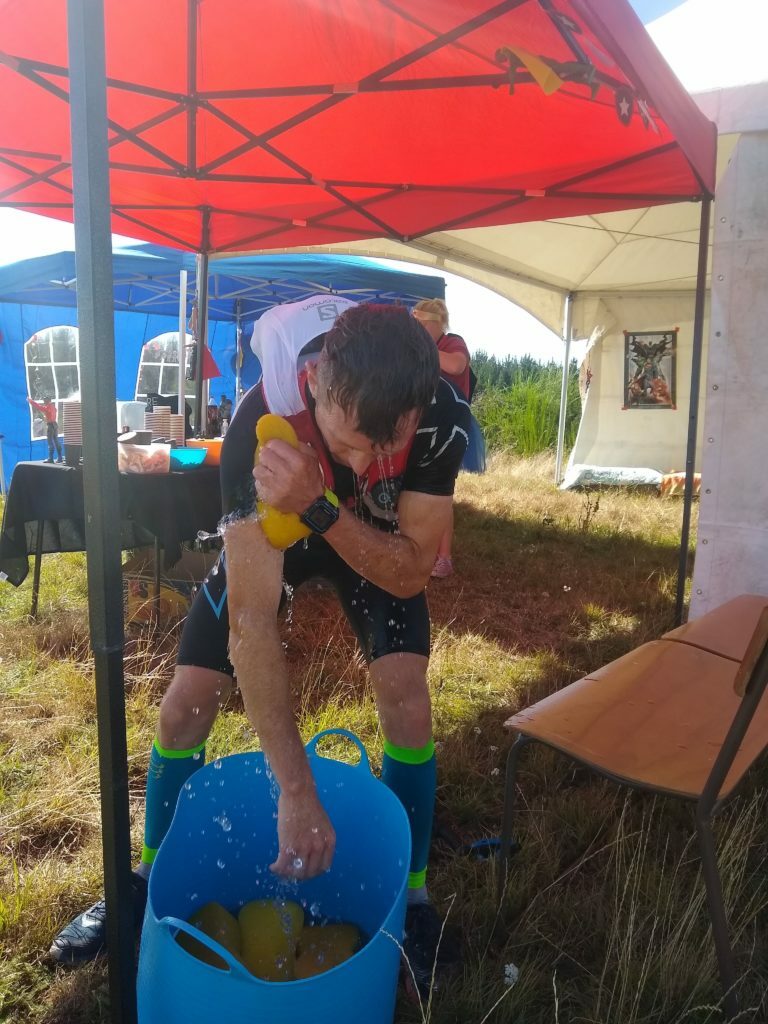
Cooling down with the sponges at 62k
Lessons you learned that will help you next time around
Be even more patient! I could have finished stronger. I was thinking that I was going to be in the mid to low 17s with 50k to go, but I mismanaged things a bit. My fueling got off track and I could have done that better. With all the hills and challenges on the back half of the course, I had a tougher time fueling, and my gut was just not into it. I wasn’t puking, and I was still getting calories in, but it wasn’t nearly as smooth as the first 100k!
Most important course specific knowledge to know about the race
It’s a tale of different trail skills. Here’s the summary:
Start to 30k – smooth, fast, runnable
30k to 46k – technical, slower, single track.
47k to 93k – smooth fast roads or dirt forest roads
93k to 120k – technical and slow
120k to 126k – uphill with some steep sections
126k to 137k – generally smooth and runnable single track
137k to 149k – some roads but also some little technical sections interspersed
149k to 158k – some smooth fast stuff, and then some ass kicking uphills and downhills!
158k to finish – fast, flat, and stinky!
Aesthetics – Is it a pretty course?
Love it! So much good scenery. Bush terrain, great lake views, rushing rivers and creeks, redwood forests – it’s awesome!
Photo: FinisherPix
Difficulty – Is it a tough course?
It’s not the slowest course and it’s not the fastest course. It’s tough depending on your skill sets. If you’re a technical trail rockstar but not as great on roads, you’ll be challenged. If you’re fast on roads but suck at techy trail, you’ll be challenged. It’s a course suited for a well rounded trail runner – I think it’s awesome!
Organized and well run – Did it feel like a well-oiled machine or were they flying by the seat of their pants?
Ironman puts on a solid event and I was stoked to be part of it! They had a BBQ on Wednesday and I got to meet the organizers – super cool crew. They were welcoming and they had their shit together! And looking back, knowing that NZ limited gatherings to under 100 people literally hours after the event finished given a COVID issue in Auckland, it’s amazing they pulled this off. The race went smoothly, it was professionally done, and it felt special to be part of it – they rock!
Competition – Is there a strong field?
Normally it’s really strong! With 40% of the field being international historically, this year was less competitive (but I’m not complaining!) 🙂
Logistics – Does it require a special handshake, registration a year in advance, hotels all booked? Give us the low down on the nuts and bolts of making the race happen.
The entire process was pretty easy. I did the elite registration and Ironman was super cool about this and accommodating. Lodging was easy, though we did end up in a kind of crappy hotel. It’s a tourist town so there is plenty of lodging, but if you book early, you likely get the better places and prices.
Aid Stations – Standard fare or anything special to know about the aid stations in terms of what’s available or when?
Standard fare. The volunteers knew the game well though and they were awesome! I’d get into an aid station with my bottle tops off. I’d tell them specifically what I wanted, then I’d head to the ice water buckets to cool off. By the time I was soaked, they’d have my bottles for me and I was out of there. I used the Pure sports drink they offered, but otherwise carried all my own fueling. I had crew at 54k, 62k, and 149k. At 54k I just had a quick snack and carried very little b/c it was all road running until 62k. At that point I picked up a bunch of calories and my poles knowing I wouldn’t have a drop bag or crew until 103k.
I had a drop bag at 103k with a bunch of calories. And then I had another at 149k. Julie was able to get my drop bag at 149k for me and have it ready. I wasn’t fueling well at that point so wasn’t going through my stuff nearly as quickly by then. But I did fuel well early and that helped me make it home!
Some may want to know specifics of what I fueled with. Here it is. I used Spring energy gels – Speednut, both the caffeinated and the hemp oil ones (250 cals each), the Coffee one (210 cals), Long Haul (110), Spring Hill (100) and a couple Plum ones (90 cals). I would have had Canaberry too, but they were out of stock! I used water and the Pure drink they had on course for hydration.
At 54k I had crew access and ate half a PB&J. I also chugged some Gatorade, and had a 20 ounce bottle of Starbucks cold brew that I took with me. This was my jet fuel and I was stoked for this. I only drink coffee twice per month and I was eager! At 62k I had the usual gel resupply, along with some Pringles already in ziploc bags (BBQ and regular), and a small bag of Sour Patch Kids. I ate all this by the 93k mark.
At 103k I had the same resupply, minus the cold brew. 🙁 I wouldn’t get that again until 149k when I saw Julie at Blue Lake.
I ate less and less as the day went on. I finished carrying way too much extra liquid and calories. I did get some cold brew in at 149k, but in general, I was forcing down gels and Pure the last 50k.
No major gut issues though, no puking, and no bonking. But had the race been a few more hours, I would have had to make some serious adjustments or things would have gotten ugly.
Picking up my poles from my 5 year old son, Paavo, at 62k. Best crew ever.
Weather and typical race conditions
Warm, 70s-80s. We had sunny skies. There have been rainy years too, but not for me! 🙂
Gear – Did you need anything special or is there anything you’d recommend for the next runner?
I’m a big fan of poles! I didn’t need them until 93k but they saved me later in the race. I had a calf issue early on and that turned into knee issues later. I really noticed my left knee (quad med) on the downhill around 94k. I was able to take weight off the knee for the rest of the time by using my poles effectively. There are lots of sections where poles aren’t needed, but when it was technical or steep up/down, they were awesome! I wore compression gear and still chafed something nasty out there! It’s a few days later and it’s still a bit sore! Yuck!
Feet stayed reasonably dry and really only got wet from dumping water on myself at aid stations. A few minor blisters, but nothing bad.
Wore my Salomon AdvSkin 8L and the required gear all fit fine.
Hoka Torrent shoes – I bought them at the expo and ran in them for the first time for the race (with custom orthotics). Risky, yes! But I’ve loved those shoes and wasn’t confident in my other pair I was planning to use – worked out well on race day – never thought about my feet during the race!
Spectators – Is this a friendly course for your friends?
Yes and no. The beginning and the end are easy to access with good spots for cheering. The middle is largely on private land and you need to use a shuttle to access 103k and 120k stations. I think they were $22 NZD for each one. Going from 62k to 149k without seeing my family was a long stretch! But the crowds at the finish, Redwood, and Blue Lake were fantastic!
All my crew at the awards ceremony the next day.
How’s the Swag?
Awesome! I usually don’t keep much of what is given to me (living as a nomad traveler, I’m particular about the things I keep). The one thing I likely keep from this race is the jade pounamu necklace. From what I know, in Maori culture, it’s not something you can buy, but something that must be earned and given to you. When the 100 milers cross the line, they go to the table and pick the pounamu that calls to them. I picked mine out and I will be keeping this as a memory of this cool event.
Photo: FinisherPix
The Overall Score – How many stars do you give this race and do you recommend that others run it?
10 out of 10. Clearly I’m biased b/c this is the first 100 miler I’ve ever won. But all in, from the organization, to the course, to the experience, and to the memories, this one ranks really highly for me. Thank you Ironman for putting on a kick ass event, and thank you Rotorua for having us all there to share in your special part of the world – I’m forever grateful and thankful for the opportunity!
Matt Urbanski is a coach and the co-founder of Team RunRun. To reach out to him, email him at [email protected].
3 Bests – What aspects of the race did you like the most?
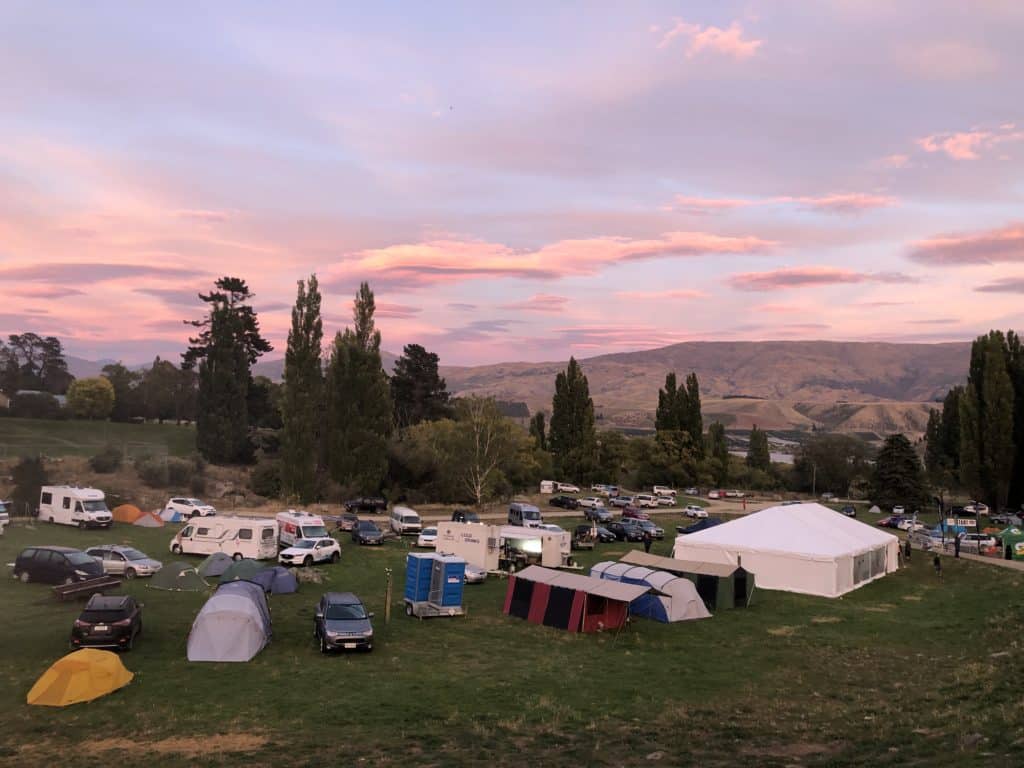
The Vibe. This is a small, friendly, family event. We camped at the start/finish area and were almost instantly greeted by other runners who welcomed us and made us feel like locals! Our kids quickly made friends and romped around in wild packs for hours. The camaraderie continued throughout the race – everyone was lighthearted, chatty and having the time of their lives.
The Terrain. The loop course begins and ends on dirt ranch roads reminiscent of southern California fire road, but the terrain in between is unlike anything I’ve run before. There are no trails other than the occasional sheep track, the ground is very rough and the course unrelenting. There are sections of dry grass, minefields of stabbing plants called Prickly Spaniards, a beautiful soft grass creek, a moon-like rocky plateau and bouncy wet moss. Nothing is easy at Northburn. If it’s a hill, it’s super steep; and if it’s flat it will be uneven, wobbly and challenging. Sometimes you even get super steep, wobbly, challenging, stinging-stabbing plants all at the same time!
Self Sufficiency. This race perfects giving you everything you need and nothing that you don’t. The course marking was phenomenal – very necessary considering there was no trail! There was one Aid Station with water, electrolyte and a bag of chips at the halfway mark and 3 other water drops as well as a natural stream with cold, clean drinkable water (a must-do!) You must carry everything you plan to eat for the entire race as well as the very extensive mandatory gear list for all the races (marathon and longer.)
Not so much – Aspects of the race that didn’t do it for you
While a long, tough race with a heavy pack may not be for everyone, Northburn Station offers races of all different distances/ability levels! On Saturday the Marathon, 50k, 100k, and 100 Miler early in the morning. The super fun/ adventurous kids events are run that afternoon. These are followed by 5k and 10k night races. And Sunday there is the super speedy Half Marathon. This schedule allowed my whole family to compete in different events so we all got to experience Northburn!
Weird factor – What’s the weirdest thing about this race?
I usually run in places were filtering water is necessary so to drink unfiltered water from the streams was a little weird. I will say that it was delicious and cold and all part of the experience of Northburn! PS – no one has ever gotten sick and I’m happy to report that I am 100% fine so far!
Highlights of your race – What did you do well and enjoy about your race in particular?
I really committed to improving my fast-hiking with the heavy pack in training and it really paid off. Being somewhat used to the weight allowed me to keep pushing despite feeling like a toddler learning to walk over the gnarly terrain. I had so much fun and I was able to laugh at my many blunders (lots of flailing arms, falling over into the Prickly Spaniards, getting off track…) I think I gave the locals a good laugh too!
Lessons for others – Share your pro-tips on the race to help the next runner
Train to carry the pack weight.
For races longer than 50k I would consider using trekking poles.
Be prepared to be self-sufficient with your nutrition.
Lessons you learned that will help you next time around
Keeping the pack weight as light as possible, while still carrying everything you need is tough. Some of the mandatory gear that I have is pretty outdated and on the bulky side. At a steep section around mile 7 I was cursing the weight and decided to borrow/invest in some newer, lighter weight layers should I ever have to carry this stuff in a race again! I also overpacked food but I recorded how much I used so I won’t do that again.
Most important course specific knowledge to know about the race
As the race director says “Northburn Station: Where suffering is the prize, and everyone’s a winner!” It’s true for all distances. Plan to work hard.
Aesthetics – Is it a pretty course?
Northburn Station is a private, fully operational livestock ranch and vineyard. The landowner opens his property up just once a year for the race. It is very beautiful and you will likely get to see the sheep where your Icebreaker wool clothing comes from! There is also a wine tasting room not far from the start/finish line area if you would like to taste the wines that are produced on the ranch.
Photo: Allan Ure
Difficulty – Is it a tough course?
Definitely difficult but enjoyable and there are lenient cutoffs. I would say that the races get more challenging as they increase in distance (not just because of the added miles but the terrain in those later sections is very tough.) The 100 Miler is a Hardrock qualifier and has a 48-hour cutoff.
Organized and well run – Did it feel like a well-oiled machine or were they flying by the seat of their pants?
Extremely well organized but in no way uptight. The race directors and landowner work their tails off all weekend but you can tell they truly love what they are doing. There were tons of folks volunteering as course marshals (even runners volunteered after running or dropping) and the Race Director creatively put the older kids to work giving them special course marshaling jobs – which the runners and kids equally loved!
Competition – Is there a strong field?
There are runners of all levels at this race.
Logistics – Does it require a special handshake, registration a year in advance, hotels all booked? Give us the low down on the nuts and bolts of making the race happen.
Our family tacked this event on to the end of a 10 day camper van trip around the South Island of New Zealand – must do if you have the time! Registration is easy and doesn’t involve a lottery – you can even jump into the shorter distances on the spot! There is free tent and camper van camping right at the start/finish. The local town of Cromwell has lodging, restaurants, orchards, wine tasting and the most amazing fresh fruit ice cream! The Race Director goes out of his way to accommodate travelers. There is a registration option that includes transportation from the airport, a ride to the grocery store to purchase supplies for the race, coordination of your lodging and rides to/from the race!
Aid Stations – Standard fare or anything special to know about the aid stations in terms of what’s available or when?
For the 50k and lower distances, you must carry all your nutrition. The 100k and 100 milers have some food later in the races but very minimal. All races are loops/cloverleaf courses so you can access your own supplies at mile 31 and 62. There is plenty of water available on the courses.
Weather and typical race conditions
The race begins in the dark and you will run by the light of your headlamp for about an hour and a half. The weather is very unpredictable, can change quickly and is known to vary dramatically throughout the course (hence all the mandatory gear.) As a rule of thumb, the weather will be to an extreme. If it’s windy, it’s really windy. There can be snow or rain. And like this year, it can be extremely hot and dry. The entire course is exposed so runners must embrace whatever the weather happens to be on race day!
Gear – Did you need anything special or is there anything you’d recommend for the next guy?
There is an extensive mandatory gear list, a required gear check at the runner registration, and a mandatory pre-race briefing.
Spectators – Is this a friendly course for your friends?
This is not a race where you can see your runner frequently but my family was able to surprise me on the course once!
How’s the Swag?
This is definitely a low-key race so don’t expect a big bag of useless stuff. The awards were terrific and if you are interested in 100-mile buckles this is one of the best I’ve seen! All runners, regardless of distance, get to partake in a great BBQ!
The Overall Score – How many stars do you give this race and do you recommend that others run it?