Cocodona 250 Race Report – Coach Dandelion Dilluvio-Scott

Cocodona 250 Race Report – Coach Dandelion Dilluvio-Scott

Race: Cocodona 250 by Aravaipa Running

Runner: Team RunRun Coach Dandelion Dilluvio-Scott

Race Date: 05/06/2024

Location: Black Canyon City, AZ

Result: Overall:99 DP:20 finishing in 4 days, 9 hours, 28 minutes, and 27 seconds!

3 Bests – What aspects of the race did you like the most?
1. My Crew

Ultras are a team effort at any distance. However, I think the 200+ mile length amplifies this concept. Putting together a reliable crew that I 100% trusted to make decisions for me and would also work well together took a great deal of planning. Crewing is arguably more difficult than racing in many ways and not many individuals are willing to give up days of their time to follow a sweaty, dirty, smelly runner through the desert. My team consisted of outdoor athletes of various personality types who all brought a unique skill and/or outlook to the table. It is this diversity that made the team so remarkable. I loved that Cocodona 250 gave me the opportunity to spend so much time with this truly outstanding and gifted group of athletes. Without the people listed below I am convinced I would not have crossed the finish line:
1. Damien: husband, multisport mountain athlete, “the nice one”
2. Luke: friend, crusher ultra-runner, “the drill sergeant one”
3. Jess: friend, climber, endurance rider, RD for City of Rocks Ultra, “the dependable one”
4. Byron: friend, climber, RD for City of Rocks Ultra, coach-to-17-mile pacer, “the chill one”
5. Zack: friend, multisport desert athlete, brand rep for my sponsor UltrAspire, “the fun one”

2. Strategy

All ultras involve strategy, but I think that a really strong athlete can use fitness to override poor tactics to some extent. However, in a 200+ I would make the argument that fitness cannot override a poorly executed plan. The longer the time and distance the more chances there are for things to go wrong. It becomes a game of efficiency and the ability to solve small problems before they become monumental issues is critical. Additionally, there is no playbook or formula for the 200+ mile distance. We are still learning the best way to pull off this milage as a community which makes creating a personal strategy even more exciting! So much beauty in the unknown!

3. AZ Desert

I really enjoy races that are of out my out of my comfort zone (alpine desert, slickrock and high mountains). These events offer the best learning experiences! I was intrigued by Cocodona 250 not only because it was a new distance for me, but because the unique environment of the race. Outside of running the Black Canyon 100K, I was not as familiar with the terrain and climate of the Arizona desert prior to running Cocodona 250. I loved learning to move through the novel landscape leading to Sedona and reaching the familiar alpine ecosystem in Flagstaff toward the end of the race when I was most tired!

Not so much – Aspects of the race that didn’t do it for you

Honestly, I cannot come up with anything about Cocodona 250 that I disliked. Sure, I wasn’t a fan of sleep deprivation, but no one signs up for a 200+ miler thinking that they won’t get tired! It’s part of the excitement!

Weird factor – What’s the weirdest thing about this race?

Nothing weird per say. However, it’s interesting to observe other racers’ tactics. Strategy is huge during 200s and, since there is no standard, the techniques folks use are wildly varied! Only taking two 20min naps… raw milk… jester costumes… watermelon dipped in pickle juice… the list goes on!

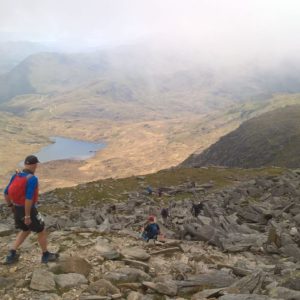
Dandelion hiking up a steep section of Cocodona 250.
Highlights of your race – What did you do well and enjoy about your race in particular?
Beginning

Day 1 of Cocodona 250 is known as The Crux. The first 38 miles ascends over 10,000ft of rugged, rocky vert in full exposure of the sun. In fact, this section is so difficult that there is a 19-hour cut off! It is what makes or breaks the race for many athletes; the highest DNF rate is the first day. With slightly cooler temperatures than normal, I suspected that the race would begin briskly. I knew I needed to resist the desire to compete during this section. I would have to focus entirely on measured breathing, efficiency and keeping my pace in check. Out of the gate I was with the top women, but let myself drift back slightly and congratulated myself for not getting swept up in the mayhem. No need to be in the front in the first mile of a 200+!

Early miles in tough conditions

Throughout the section, I kept waiting for the “hard” part. Yes, there was a ton of climbing on loose rock, but as an alpinist I’m accustomed to talus and vert. Yes, it was sunny and hot, but my pace seemed to follow a lot of the shade and there was a delightful breeze. I carried five liters of water from Cottonwood Aid and sipped the fluid diligently. In the wind I wasn’t sweating much, but I knew I was still losing moisture. I also kept eating along the way, even if I wasn’t quite hungry. At Milk Creek I followed my coach’s sage advice and sat in the water for a moment to cool down and reset myself even though I wasn’t overly hot. This was preventative. I felt cool and refreshed over the next few miles! At Lane Mountain Aid I stopped again and had ice put in my sleeves and freezing water poured over my head. Again, preventative. I never cared how many people passed me, knowing I was doing what I needed to endure not just the moment, but the days ahead. Sticking to my schedule, and utilizing my strengths, I didn’t worry about the pack, and gradually worked my way up. I was competing by following what I thought would work for me long term. For this reason, I believe that the crux of the race was one of my best executed segments.

The lowest low

As you will read in the next sections, my sleep strategy derailed my body’s equilibrium and resulted in a scary episode of heat exhaustion on my way to Sedona. In short, my body stopped regulating temperature and I found myself shivering in 80-degree weather! My pacer put me in in the shade wearing my puffy and pants at a water station to take a dirt nap. In my daze I heard him talking to a volunteer about my state and asking if there was a medic (there wasn’t one). My thought process was: “This sucks. It would be really nice to get medically pulled from the race. I mean, that’s not the same a quitting, right? Medically pulled is for my safety so it’s a legit reason…. NO! You’re not in rough enough shape to be medically pulled. Remember when your coach made up back pain last year hoping to be medically pulled because it sounded better than quitting? Then he didn’t quit… instead he got the course record! You’re not going to use this setback as a reason to drop. You started this and you are going to finish this, so get it together and figure out a way to move forward even if you have to crawl.”

Turning it around

Looking back, I am really proud of myself for recognizing that I was in an unpleasant situation, allowing a brief indulgence of considering a medical pull and then seconds later dismissing those thoughts and focusing on problem resolution. When I began running ultras it was about finishing and not racing. The competitive edge came later in my running journey as a way to add another layer of challenge and encourage me to push my limits further. However, getting to the finish line remains my number one objective in events. If I am not performing as I hoped in a race, I would much rather shuffle along the course at ½ mph and time out than drop. I am stoked that I maintained my “I ain’t no quitter” attitude when I experienced the lowest low of my ultra running career. I was also pleased that I let go of podiuming or top ten women very easily. The transition happened seamlessly in my head and I never once felt disheartened by the goal adjustment. I was still in the race, after all!

End

I bounced back from the heat exhaustion and enjoyed a fun day in the desert with my pacers and crew! The next night was rough on me again though. This time my body didn’t tolerate cold well which was extra frustrating because I am a snow runner! Plus, everything just plain hurt! My husband was pacing me for this section and knew exactly how to make this frustration morph from exasperation, to anger to warrior mode. At Walnut Canyon, the last crewed aid station, I took a 1.5-hour nap. Despite waking up feeling hungover, I was very aware that I needed to get it together for the final 22 miles. I asked for five minutes alone to dig the warrior mode back up, before merrily trotted out of the aid station with my pacer, Luke, feeling confident. I was an alpinist about to climb Mount Elden! We ran the final 22 miles of Cocodona 250 methodically and playfully. I’m really happy I was able to ascend Elden with good climber style and pull off a strong finish at a full run on the fifth day of the race. It seemed that every time I thought I had nothing left along the course I was always able to find a new level of grit… with the help of my crew of course!

Lessons for others – Share your pro-tips on the race to help the next runner
Having a crew and pacers you trust is critical: Every decision takes energy and, at some point, there will not be much energy to spare during the race! If you trust your team, you can let go so they can make decisions for you. This frees up mental energy so you can focus on deciding to place one foot in front of the other…over and over and over again!
Plan in advance: My planning process for Cocodona 250 actually began 2 years prior to my race. I am absolutely of the extreme sort and really enjoy long term projects to obsess over! For most folks I think a year is sufficient to figure out an overall training strategy, plan training camps, test gear, find crew/pacers, plot logistics, organize your fuel/hydration, etc.
Make it easy for the crew: Your crew is going to be working vigilantly and non-stop to support you. Make their lives as easy as possible by organizing and labeling your gear well. Provide them with charts and checklists to help them best help you. I had an entire binder of information with different tabs for easy navigation! Have a zoom meeting to discuss ideas and tactics beforehand to make aid station visits more efficient. Remember that you are not their boss. I believe that the effort is a collaboration and everyone’s ideas should be heard! Afterall, you chose these people because they have something to bring to the table and you trust them. Oh, and THANK them profusely for being willing to follow your cranky self around for a week!
Finances: The race entry fee is around $1500… and it’s probably the least expensive part of Cocodona 250! The cost of nutrition, electrolytes, transportation, lodging, a desert kit, training camps and crew gear adds up in a hurry. I was still ordering more gels a week out from the race!
Lessons you learned that will help you next time around

This race taught me a great deal about the side effects of sleep deprivation. I didn’t want to wait and sleep until the second night of the race, but I wasn’t convinced that I would be able to sleep the first night either. I love 100-milers and have never had a problem staying up all night for a race of that distance. My coach and I decided that if I could fall asleep the first night I should. Otherwise, I would sleep in the car sometime on day 2. When I arrived at Whiskey Row late on day 1 I wasn’t tired, so I pressed on into sunrise. I attempted sleep at Iron King, but couldn’t so again continued. I ended up finally falling asleep for an hour at Fain Ranch at around mile 100 of Cocodona 250.

Conditions taking hold

Even though I normally tolerate heat decently and had also done a sauna protocol, the sun exposure slowed me down on the climb up to Mingus. I believe fatigue made my body less resilient to environmental factors. Still, I was able to eat and drink normally…. Or not so normally (I consumed three plates of lasagna at Mingus!). I began sleep walking just after Jerome and slept for an hour at Deadhorse before heading back out around sunrise. It was here that I should have taken a least a two- or three-hour nap. Trekking through the hot, exposed section of the course near Sedona my body finally decided to that was unhappy with a few brief dirt naps and two 2-hour sleeps and rebelled.

Crisis point

The growing sleep deficient plus general body fatigue completely obliterated my body’s ability to maintain equilibrium. I could only take tiny sips of fluid. All my fuel made me want to hurl. Most concerning, it was over 80F and I started to shiver leading me to put on pants and a puffy for a while. My pacer was extremely attentive and we made a joint decision to wait in the shade for an hour. When the temperature dropped in early evening, I would be able to move faster and get to the next aid station with less stress on my body. I was taken off course to a dispersed campsite and informed that I was going to sleep for 6-7 hours at the Sedona aid station. Mingus to Sedona is where I stopped racing and began surviving.

Learning from the lows

I am convinced that my sleep strategy is what led to heat exhaustion and me sliding from the front to the middle of the pack. It’s easy to focus on the “woulda, shoulda, coulda” after a race. However, the reality is that, without previous 200+ experience, my sleep plan was an educated guess. Hindsight is always 20/20! In the future, I would for sure choose to sleep for 2-3 hours earlier in the race, rather than crash and need to hibernate for 7 hours later on. An hour here and there wasn’t the way to go for me.

Dandelion taking a dirt nap during Cocodona 250.
Most important course specific knowledge to know about the race

Do not rush on day 1. The first 37-50 miles are by far the crux of the race and features over a quarter of the vert! Also, if things go wrong don’t give up. Take the time to reset. The nice thing about 200s is that you almost always have time to recover and try again!

Aesthetics – Is it a pretty course?

One of the unique and amazing things about the Cocodona 250 course is that it travels through so many different ecosystems: from the desert of Phoenix to the high altitude, mountain town of Flagstaff. Running through these different environments and witnessing the subtle changes in gradual progression was an amazing experience. There is diverse beauty in every section of this course!

Difficulty – Is it a tough course?

YES! The 250-mile distance is within itself difficult. On top of that the race requires athletes to have a variety of different skill sets. The ability to tackle huge ascents, rocky terrain, technical downhills, rolling and runnable trails, heat and sun exposure, as well as cold tolerance are all requirements. Athletes must also carefully monitor their bodies so they get the right amount of fuel, hydration, temperature and sleep during their time on the course. There are a lot of moving parts and it’s very easy for a small problem to become a massive one over this distance.

Organized and well run – Did it feel like a well-oiled machine or were they flying by the seat of their pants?

Cocodona 250 is run by Aravaipa Running, an incredibly well regarded and professional organization. All Aravaipa events are outstanding, and everything was completely dialed in for this race!

Competition – Is there a strong field?

The men’s field was outrageously strong this year with all three of the first-place male finishers from the race’s inception competing along with some other highly notable elite level men. The women’s field wasn’t as deep, but it was still extremely competitive. Each year Cocodona 250 seems to attract an increasing number of big names from the ultra world!

Logistics – Does it require a special handshake, registration a year in advance, hotels all booked? Give us the low down on the nuts and bolts of making the race happen.

Registration was possible until about March in 2024. Registration for Cocodona 250, the 2025 edition, filled 10 days after the 2024 race ended! I’m unsure about hotels as I always camp, but Flagstaff and Phoenix are large cities and I suspect they always have some space available. Regardless, I think it makes sense to get things rolling for this race sooner rather than later because of all the planning that goes into executing a 200+ miler.

Aid Stations – Standard fare or anything special to know about the aid stations in terms of what’s available or when?

In the first 38 miles two water stations have a 1-liter water limit. This is one of the hottest sections of the course and athletes must have the ability to carry 4 liters for this section. I recommend carrying the 4 liters and restocking with the 1-liter allowance at these stations. You’ll want all that fluid! Otherwise, aid stations have all the normal staples –PB&J sandwiches, pretzels, chips, trail mix, candy, Oreos, pickles, cooked potatoes, granola bars, bananas, watermelon, gels– and most aid stations also had a hot “meal” option, especially later in the race. The hot options were mostly on the bland side which I appreciated. I wouldn’t have been able to tolerate high flavor that far into the race: I just needed fuel!

Weather and typical race conditions

It was a cooler year by normal standards for Cocodona 250. However, it is still the desert! In other words, the temperature soared during the day and plummeted at night!

Gear – Did you need anything special or is there anything you’d recommend for the next runner?

During the day, I recommend wearing light colors and reducing sun exposure. This does not mean simply putting on lots of sunscreen! Think about wearing a large brimmed hat along with arm and/or leg sleeves to help limiting exposure. At night, things can really chill down and fatigue amplifies how cold you feel. A warm puffy jacket, gloves, pants, and hand warmers will help you stay cozy. Also, wear your bivy if you’re cold! Headlamps are a must: I prefer a waist light like the UltrAspire Lumen 850 or 600 over a headlamp. In my opinion, these lamps cast more light and give better contrast to the terrain than a headlamp. Don’t make navigating the course more challenging when you’re already exhausted! Finally, I like to use gaiters in the desert to protect from the plants and keep out the sand.

Spectators – Is this a friendly course for your friends?

Some aid stations were spectator friendly, but it is highly important that you read the rules regarding aid stations and parking to avoid getting DQ’ed!

How’s the Swag?

10/10! This might be the most swag I ever received at an ultra, and all products were high quality! Items included: backpack, tech shirt, sweat shirt, Flagstaff drink vouchers, Naak bar, Satisfy Hat, Spring Energy gel, and I’m sure I’m forgetting some things! Plus, of course, there’s a rad buckle!

The Overall Score – How many stars do you give this race and do you recommend that others run it?

Yes, I highly recommend this race to others who are willing to put in the time training and planning! 10/10!

Curious about 200+ mile races? Check out this article: 200 Miles and Beyond: Inside the World of Ultrarunning with Team RunRunner Rebecca Walker and Coach Greg Ottinger.

Dandelion Dilluvio-Scott is a Lander-based coach with Team RunRun. She is a multisport outdoor athlete, ultra-runner, and certified coach who loves collaborating with driven athletes who love to explore, train, and play outside.

200 Miles and Beyond: Inside the World of Ultrarunning with Team RunRunner Rebecca Walker and Coach Greg Ottinger

by Ruby Wyles

A few weeks back, we received a race report from Team RunRunner Rebecca Walker that said something along the lines of: ‘I hopped in a 200 mile race, it was fun, wasn’t my fastest or my slowest’. Rebecca’s nonchalance suggested that running super long distances was a relatively common affair for her, and I had to learn more!

Rebecca running 200 miles and beyond at the 2023 Cocodona 250.  PC: Anastasia Wilde
Rebecca wading through a creek during the Cocodona 250. PC: Anastasia Wilde

Meet Team RunRunner Rebecca Walker and Coach Greg Ottinger 

Coached by accomplished ultrarunner and Team RunRun Coach Greg Ottinger, the pair have been working together for two and a half years and counting. As mentioned, coach Greg is no stranger to 200 mile races or back-to-back ultras, himself targeting the Triple Crown of 200s this summer, which involves running three 200-mile races over four consecutive months! With over 200 Team RunRun coaches to choose from, it’s no coincidence Rebecca and Greg seem to have the perfect coach-athlete match.

According to UltraSignup, in little more than 10 years, Rebecca Walker has 82 ultras to her name, including seven 200+ mile races, which had her running for up to 5 days at a time! Yep, 5 whole days, over 121 hours to be precise! Interviewing Rebecca, I thought I’d start with the obvious question I’m sure we’re all wondering: why? What draws you to these super long events, and why do you keep going back for more?!

Rebecca: “Historically, I chose my races based on places I wanted to visit. My first 200 mile run was the Tahoe 200, which I remember seeing advertised and thought I would like to do it someday. At the time, you had to have completed a mountain 100 mile qualifier race beforehand, so I wasn’t able to enter Tahoe 200 until the prerequisites were met. After completing that one successfully, I realized how much I appreciated the variability of these events, as well as the slower pace – being a slower runner, this was important to me!”

Balancing ultra training with life

As superhuman as Rebecca’s ultrarunning exploits seem, she isn’t a full time runner focused solely on the eat-sleep-train priority triplet that many professional athletes are. Instead, Rebecca balances a full time job in the legal field with family life as a wife, mom to an active teenage girl, plus two cats and dog too! Not your typical husband-and-wife duo, the pair bond over their love of ultras, and actually ran the Moab 240 together for their honeymoon!

So what’s Rebecca’s secret? How can she possibly excel at these ultra ultra distances with so much other life to balance?

Rebbeca: “Greg [Ottinger, her TRR coach] has been AWESOME working with my schedule, and we’re flexible with moving workouts around. My husband typically runs with me on the weekends, but the weekday stuff is all me.”

“Training for 200 milers is not too much different than 100 mile training. Under Greg’s guidance I now run 5 days a week (vs the 3-4 I used to do): 3 runs are usually Z2, easy training; 1 day is typically speedwork and/or hills depending on whatever race I have coming up; and the other day is a long run. Saturdays are always my long days, involving either a progression run if I’m training for something flat, but usually I go on a time-based adventure run in the foothills/mountains.” 

Add to that Rebecca’s one day per week of strength training, and training for 200 milers seems almost manageable…?! Rebecca adds: “I just do what I’m told”, not overcomplicating her running, and leaving the X’s and O’s of training science to her coach Greg, a job he readily accepts. 

Greg: “As a coach, navigating Rebecca’s race calendar is akin to orchestrating a symphony of commitments, aspirations, and relentless determination. Hailing from the frosty climes of a region that could freeze a San Diegan’s bones, Rebecca juggles the roles of a dedicated runner, nurturing mother, driven professional, and even a devoted dog mom. It’s a balancing act that requires precision planning and adaptability, a task I undertake with both awe and admiration.”

Another 200 mile run

As a runner with a coach myself, I believe this is one of Rebecca’s, and most athletes’, secrets to success: enjoy your running, don’t overthink it, and outsource the programming to an expert, like our band of Team RunRun coaches!

If you want further proof of Rebecca’s mortal and measured approach to training, consider that when the weather is close to freezing she simply doesn’t run. Instead of toughing it out in miserable conditions, or making up mind-numbing miles on the treadmill, Rebecca opts for extra recovery over trying to prove her toughness in training, a fallacy that almost always backfires. Despite preparing to race through all hours of day and night, in all kinds of sleep-deprived, underfueled,and fatigued states, again Rebecca doesn’t make training harder than it needs to be, not losing sight of the fact that running should be (at least most of the time) enjoyable! 

Rebecca: “I don’t night run [in training], but I do vary the terrain and elevation, running on dirt roads and trails near my house in Colorado.”

Greg: “Preparing for the rigors of ultrarunning demands a holistic approach that transcends mere mileage. Rebecca’s training regimen revolves around building a robust aerobic base, with 90% of her workouts dedicated to aerobic efforts, Heart Rate Zone II. We prioritize consistency, honing her ability to endure the relentless demands of multi-day races.”

Rebecca’s year-round race schedule means that she is constantly in training mode, save for a taper week prior and recovery week post race. 

Greg: “When it comes to setting race goals, Rebecca is quite candid. Whether she’s eyeing a podium finish, leisurely adventure with friends, or simply seeking the joy of crossing the finish line, each race serves a distinct purpose. If it’s a “fun 50,” we integrate it into her routine without the customary taper, allowing her to enjoy the experience without compromising her overall progress or risking injury.”

Without big swings in her mileage, plus her incredible ability to endurance and recover from these long distances, Rebecca maintains an impressive baseline fitness that allows her to race frequently and avoid injury. She reminds us all that the key to any and all running success is consistency, not hero workouts or huge increases in mileage leading into race day; Rebecca, with help from her TRR coach Greg, has found a sustainable level of training for her body and life demands, that she is able to repeat year-round. Now that is the not-so-sexy secret to success!

Running fundamentals: fueling, sleep, and recovery

Fueling, a critical element of any ultrarunner’s performance, is another of Rebecca’s strengths, and she is gifted with an iron stomach that allows her to “eat whatever is available at aid stations”. She jokingly refers to herself as a “trash panda”, recognizing that she is “in the minority of folks who don’t have issues with fueling”. During long training and race days, Rebecca fuels consistently, always carrying extra snacks to ensure she’s never running close to empty. 

It’s not just fueling that Rebecca’s dialed in, running through extreme fatigue and sleep deprivation appears to be another one of her skills. Whether honed through parenthood, a highly caffeinated lifestyle, or a rare genetic ‘I-will-run-on-no-sleep’ predisposition, if the princess and the pea is on one extreme, Rebecca is on the far other!

Rebecca: “I can get through night one fine without sleep now that I have nailed down a good caffeine plan. After that first night though, I tend to have issues falling asleep, but taking some time off my feet at aid stations even when I can’t sleep helps. Over time [as Rebecca gets further and further into a race, becoming more and more fatigued] I can usually get about an hour’s sleep at an aid station, as well as 5-10 minute trail naps! If the terrain permits, I’ll just lie on the side of the trail, or sit up against a tree; other times, just closing my mind will usually be enough to keep me going for a few more hours.”

Much to my surprise, and in part credited to great nutrition and smart training, alongside honest communication with her coach, Rebecca isn’t bed-bound for weeks following her epic adventures, and instead is an advocate for the ‘motion-is-lotion’, ‘movement-is-medicine’ paradigm.

Rebecca: “Hydration and sleep are so important, and I aim for 8-10 hours a night the first few days after a big race. I am a huge fan of active recovery. I still take my dog for walks (usually a few miles at a time) and I have a treadmill desk that I walk on while working.”

Greg: “Navigating the aftermath of ultramarathons requires a keen understanding of the body’s signals and rhythms. Listening to her body becomes an art form, as we interpret its subtle cues and adjust our approach accordingly. Rebecca is always clear with her progress and we adjust each week accordingly.”

Rebecca during her Tahoe 200 "honeymoon".
Rebecca during her Tahoe 200 “honeymoon”.

Ultra racing: highs, lows, and 200-mile memories

A seasoned ultrarunner with over 100 results to her name, I asked Rebecca a very difficult question: what her favorite race has been so far.

Rebecca: “Tahoe 200 will always be very special to me. I ran when it [the course] was still a loop around the lake, and it was just so surreal to be going for this huge, unknown distance. Cocodona 250 was also a wonderful event with very diverse environments” as runners traverse from the desert and cacti in Phoenix up to the mountain town of Flagstaff, with its fir trees and cooler temperatures.

Full of positive regard for these super long races, I imagined there must also be significant challenges and low points that are just par for the course. Yet again, I was surprised and in awe of Rebecca’s response. 

Rebecca: “I don’t typically encounter many issues in training, unless it’s weather related or to do with personal things going on outside of running. I am, and always have been, a slower and low mileage runner, but that doesn’t derail me or make me “get in my head.”

That said, races can be a stressful experience for Rebecca, with race cutoffs never far from her mind. Even in the face of uncertainty, she remains remarkably undeterred, reminding us all to continue to chase big goals no matter how unlikely they may seem!

Rebecca: “I know I can complete these distances, but am I fast enough to make cutoffs? Sometimes yes, sometimes no, still I never regret going for big goals.”

Working such an ambitious and motivated athlete comes with its own set of challenges, as Greg attests to, but he, like Rebecca, sees them in a very positive light.

Greg: “Coaching Rebecca is a rollercoaster of exhilaration and anticipation, characterized by the electrifying unpredictability of her ambitions. From impromptu 100 mile races, to last-minute decisions to pace a friend across unforgiving terrain, Rebecca’s spontaneity keeps me on my toes. Yet, amidst the whirlwind of uncertainty, her commitment to the process remains a true inspiration.

The ease of coaching Rebecca lies in her work ethic—a pursuit of excellence that leaves no room for excuses or shortcuts. She embraces each challenge with resolve, transforming obstacles into opportunities for growth.”

I finished off digging deeper into her race highlights, and again, the pure joy she has for running –running very long distances at that– shone through.

Rebecca: “All my ultras are victories! Tahoe 200 being my first; Moab 240 [Rebecca’s ‘honeymoon’] for not pushing my new husband off a cliff (haha, just kidding!); Bigfoot 200 for being the most technical and challenging of any 200 I’ve done; Cocodona 250 – I was a DNF the first time around, then went back for redemption in 2023 and had an awesome experience; and, most recently, the Southern States 200, a race I completed without crew or pacers, barely recognizing anyone on the start list, made for a fun and novel challenge in and of itself!”

At the finish of her most recent 200 mile race that inspired this piece, the Southern States 200.

Top races for new ultrarunners from Team RunRunner Rebecca Walker:

100K (62 miles) distance

  • Rebecca recommends the Black Canyons 100K for its non-technical nature, great organization, and community spirit. In her words: “it’s large enough that you’ll never be alone on the trail”.

100 miles distance

  • The Lean Horse Ultra in South Dakota and the Javelina Hundred in Arizona come top of Rebecca’s list. The two race courses are non-technical, runnable trails, and the events as a whole are a lot of fun for both runners and crew!

200+ miles distance

  • “Amazing in different ways”, according to Rebecca, these long ultras are so varied. Cocodona 250, a race that takes runners from Phoenix to Flagstaff, AZ, has quickly become one of the most highly rated and popular events. 
  • Another great beginner-friendly ultra is the Cowboy 200 in Nebraska. Rebecca highlights its “flatter and less technical nature”, and a course that is very crew accessible with good phone service throughout.

Advice for new ultrarunners from Team RunRun Coach Greg Ottinger:

I asked seasoned ultrarunner and TRR coach Greg Ottinger to share some words of wisdom for ultra-curious folk, and what I received was something quite prophetic, not to mention poetic! (Greg, if you fancy a career change, or get bored of running 200-milers, I’d take you on as a TRR staff writer in a heartbeat!).

Greg: “To aspiring ultrarunners, I offer a simple advice: dare to dream, but do so with deliberation and respect for the journey ahead. Embrace the unknown, but temper enthusiasm with wisdom and experience. Seek guidance from seasoned veterans, whether it be through mentorship or the counsel of a trusted coach. And above all, trust in the resilience of the human spirit—to endure, to overcome, and to transcend the limits of what is deemed possible.”

Oregon crest 100 miler

What’s next for Rebecca and Greg?

Unsurprisingly, Rebecca’s mind and body are already preparing for the next challenge: a relatively achievable –only by Rebecca’s standard that is!– series of 100 mile races this summer. Fear not, Rebecca’s 200+ mile days are far from behind her! In fact, Rebecca has her sights set on the Arizona Monster 300, a 309 mile run through the desert of Arizona. And before you ask, yes, I’m equally confused by the race director’s dishonesty: I mean, if runners are already covering 300 miles, why keep the extra 9 miles a secret?! 

As for coach Greg, he’s in the thick of training for the Triple Crown of 200s, running three 200-mile races in so many months this Summer, along the way inspiring more runners to give ultras a try!

If you’re curious about ultrarunning and the training it takes to run long distances, check out our group of Team RunRun coaches and filter for ultra and trail specialists.

Ruby is a runner, triathlete, and passionate coach, who is most fulfilled by helping athletes overcome limiting beliefs with joy. She is also a proud science nerd, and advocate for athletes’ mental and physical health.

Cocodona Race Report (short version) – Coach Des Clarke

Photo: Sally Wood

Want to read Des’s full race report? Find it here.

Race: Cocodona 250

Runner: Coach Des Clarke

Race Date: 05/01/2023

Location: Start – Black Canyon City, AZ Finish – Flagstaff, AZ

Results: 108 hours

3 Bests – What aspects of the race did you like the most?

  • The course. What an amazing adventure in some of the most beautiful areas of Arizona.
  • The community. I’m from Arizona and might be biased, but I loved interacting with the aid station volunteers, employees and fellow runners.
  • The organization. Aravaipa does an amazing job at all of their events.

Not so much – Aspects of the race that didn’t do it for you

There was one section across Fain Ranch that was the only part of the course I really disliked. But in a 250 mile race having a small section like that, which was required to get us to Mingus mountain, is a very minor thing.

Weird factor – What’s the weirdest thing about this race?

Maybe the white couches at the Satisfy aid station? lol I just can’t seem to get over how strange that was to me.

Highlights of your race – What did you do well and enjoy about your race in particular?

I paced myself well on the first day of the race, which gets a lot of people. I kept a positive mental attitude for the vast majority of the miles. I also almost got pulled by medical at mile 150 and made a comeback to finish the other 100 miles.

Lessons for others – Share your pro-tips on the race to help the next runner

  • Expect the first day to be very difficult and very slow. The first 37 miles took me over-double my best 50k time.
  • Take care of yourself. Feeling good is way more important than moving fast in this distance.

Lessons you learned that will help you next time around

  • I will never ever do a 200+ miler again. There is video proof of me saying this.
  • I do think that this is going to shift my mentality when it comes to 100 milers.

Most important course specific knowledge to know about the race

It’s been said before, but people continue to underestimate that first 37 mile stretch. I would suggest doing the training run if you can. The most important thing you can do is get to Crown King still feeling good.

Aesthetics – Is it a pretty course?

Beautiful. Gorgeous. Amazing.

Photo: Laura Mathis

Difficulty – Is it a tough course?

Yes, in a way that is sometimes difficult to describe. It’s slow going, and the temps during the race range from below freezing overnight to 95+ during the day.

Organized and well run – Did it feel like a well-oiled machine or were they flying by the seat of their pants?

Aravaipa does an amazing job at all of their events. They plan well, and have been doing this long enough that when unexpected issues beyond their control come up they can deal with them without it impacting the runner experience.

Competition – Is there a strong field?

I feel like the field at this one continues to grow. This year both field had some well-known names, as well as some repeat competitors that are really getting the race down.

Logistics – Does it require a special handshake, registration a year in advance, hotels all booked? Give us the low down on the nuts and bolts of making the race happen.

Right now you can register up until right before the race, as the popularity of 200+ milers grows this may change. My crew managed to book a cheap motel same day during the race. Expect pricey rooms in Sedona and Flagstaff. Also plenty of options to camp. The first section is pretty remote up until mile 71, after that your crew will have plenty of easy access to civilization. The biggest logistic challenge is finding crew and pacers who can take time off work during the week to come support you.

Aid Stations – Standard fare or anything special to know about the aid stations in terms of what’s available or when?

All the standard fare plus an amazing spread for all types of dietary needs. Breakfast burritos, burgers, tacos, etc.

Weather and typical race conditions

The race varies in elevation, so the weather is a real challenge. The weather during the day closer to Phoenix and through parts of Sedona can be in the 90s and 100s. Overnight at elevation it gets downright cold. Make sure you have a plan in place of when to switch gear and carry layers as needed.

Gear – Did you need anything special or is there anything you’d recommend for the next runner?

I have never used poles before and I got them for this race. There is a required race gear list, follow it. They’re not kidding about the 4 liters of water for the first day, trust me you need it.

Spectators – Is this a friendly course for your friends?

After that first 71 miles there are plenty of access points. And the finish is amazing. Plus, they do an amazing job of live coverage during the race that includes mid and back of the packers.

How’s the Swag?

Really cool swag, including a nice backpack. The belt buckle is made in AZ with AZ copper and has a bunch of cool accents that call out different parts of the course.

The Overall Score – How many stars do you give this race and do you recommend that others run it?

If you want to do a race of this distance I would 100% recommend this race.

Des Clarke is a coach with Team RunRun. To learn more about her or to work with her, check out her coach profile.

Cocodona 250 Race Report – Coach Des Clarke

I always thought 200+ milers were crazy, and I never had any interest in doing them. Then Jamil from Aravaipa Running introduced the world to his plan for the Cocodona 250, and I knew I was in trouble. I had moved to Arizona in 2017, and it immediately felt like home. Cocodona provided the opportunity to explore some of the most amazing places in Arizona by foot, and the adventure of it drew me in. I wasn’t quite ready for the 2021 edition of it, but I captained the Lane Mountain aid station. Somehow witnessing the carnage there made me even more interested, I think it fascinated me that people could look so wrecked at mile 33 and go on to finish another 217 miles. 

A fall on the trail in May of 2021 resulted in a torn meniscus and knee surgery, which meant I wasn’t ready for the 2022 edition either. I decided that if I didn’t get into the Hardrock 100, 2023 would be the year of Cocodona. I said it over and over, to myself and others. Then lottery day came and I, unsurprisingly, didn’t get picked for Hardrock. 

Shit, I guess I’m doing Cocodona.

Going into the race I took the mindset of it being a big adventure, a chance to explore the unknown both with new trails and with what my body and mind might do when I over-doubled my distance PR. I knew I did well with 20, 30 or 90 minute sleep sessions, and decided to start there and make decisions about sleeping longer as the race unfolded. I also vowed to stay on top of nutrition and hydration, which becomes even more important in a race like this. I had a crew chief, Lauren, who would be with me for the entire week, and pacers that would come and go. My pacing plan started to come undone even before the race started, but Lauren did a great job tapping into the community and finding people to fill in the gaps as the race was underway.

On May 1st I woke at 3:30am at Lauren’s house to put together our last few items and head to the start line of the Cocodona 250 in Black Canyon City, AZ. To be honest I still had no idea what to expect, but I was ready for the start so that I could begin the process. We drove up the I-17, and the first wave of nervousness didn’t hit until we crested a hill on the highway and the start line lights became visible.

Start

We checked in and got my spot tracker, and I greeted fellow runners, crew and Aravaipa staff who I knew. Finally, the time arrived and we lined up and started off along the Black Canyon trail. I had run this section before in training, so I knew to take my time and enjoy these first easy miles before things really got interesting. The runners were fairly bunched up and I lead a group along, listening to their stories. We had a river crossing at mile 2, giving everyone wet that trail grit stuck to as we went. 

Cottonwood Creek 8.5

At Cottonwood Creek I filled all four of my required liters, refueled, and then started on what is arguably the most difficult section of the course. It is hard to describe exactly what makes the section so difficult, and maybe that’s because it’s a bunch of little things stacked together. It’s steep and the footing is terrible, so much so that even the downhills are difficult. I knew the trick was to stay positive and not worry about time, to keep my effort within a reasonable range. Relentless forward progress.

Mile 11 was a water stop, which also had frozen grapes and popsicles. I was able to share some good company going up the mountain, talking about life and running and motherhood. One woman, Elle, had her 14 month old son meeting her at some of the aid stations during the race. I also passed some runners already struggling on the course, running out of water, being battered by the heat. I shared some water with one of them. Mile 25 provided another water stop. I was being smart about my effort and hydration and feeling good at this point. The trail soon turned even gnarlier as we started the final section to Lane Mountain Aid. This is a section I struggle navigating during the training run, but for race day the course marking was on point. At certain vantage points I could look back and see Lake Pleasant far below us. 

Lane Mountain 33 and Crown King 37

Coming up on the aid station I was excited to see some volunteers I recognized. I also realized I had fairly bad chafing in my nether regions. As I applied Squirrels Nut Butter in the middle of the aid station I looked at the videographer and joked “You’re getting this on camera right?”

The next four miles were smooth and largely downhill into Crown King. The aid station is hosted at the Crown King Saloon, and I hit my first goal of the race by making it there in good spirits. I remember seeing AJW and greeting him on the way to my crew. Overall I felt good, which had been the plan for the first section. My shoes were gritty and I had some small blisters started so we switched shoes and applied Happy Toes. I ate what I could, repacked my pack, and started out again, this time headed up to Towers Mountain. On the way out of town I got to spend some time with Sally McRae, on whom I have an incredible girl crush. We talked about the race and our kids. I pulled away from her a bit on the up, and then we crested and she quickly left me on the downhill. I was feeling a bit of a low, although a wilderness pit stop helped a little. We got into Arrastra Creek, which I have very vague memories of, and then started the climb up Mt Union to Kamp Kipa. 

At this point it was full night, and I was starting to feel the effects of a less than stellar night of pre-race sleep, an early wake-up and lots of hard miles. I was literally falling asleep while running, with vivid dreams popping into the lapses in consciousness. I laid down on the trail for a 5 minute nap, and when I got up started down the trail again. Very quickly I met a guy coming towards me and told him he was going the wrong way. ”Again?!? Man, I just got lost and added two miles a little bit ago.” he said. Then my brain slowly pulled all the pieces together and I said “Oh, wait, I think I’m going the wrong direction.” I was thankful I hadn’t gone too far. As we climbed higher up the mountain the wind was really strong and the temps were cold for a girl from the Valley. There was also a section of trail that was super narrow, rutted and filled with rocks that made things slow going.

Kamp Kipa

I got to Kamp Kipa and was told there was a cabin where I could sleep. I texted my crew and attempted a nap, but instead lay shivering like crazy for 30 minutes, listening to the sounds around me, including a conversation between a runner and the medics, and eventually just got up to leave. I grabbed some coffee and food, looking back I wish I had just done this originally and skipped trying to sleep. I was concerned about the cold as I had forgotten to bring a jacket and gloves in my pack, but I ended up putting on my emergency blanket like a toga, picking up a trail buddy who was also about to leave, and heading on towards Friendly Pines and my crew.

Friendly Pines 71.2

I rolled into friendly pines in the early morning hours, and heard about a javelina raid on the crews’ food that had happened. This was the first official sleep station, and I decided to try for a 90 minute nap. However, the bunk room was next to the kitchen where all the action was happening, and people kept coming in to use the extra bathroom, so I slept very little. Looking back, I should have used the sleep setup my crew chief had in the 4Runner, which is what I did for the most part going forward.  I ate breakfast, brushed my teeth and headed out with my first pacer, Paul, who is also one of my coaching clients. It was fairly smooth trails leading into Prescott and Whiskey Row, and I decided to leave my poles with my crew for a while.

Whiskey Row 78.3

At Whiskey Row I was feeling good in the new day. I re-upped on my nutrition. We also noticed that my shoes were getting fairly snug and switched to half size up, which I think was one of the smartest decisions of my race. We continued on, and there was quite a few road miles leading through Prescott. One of the funny things about this was that I had hit a period where I suddenly had to pee every few minutes. Paul and I strategized and I would kneel as though I was tying my shoe, shimmy my shorts to the side and pee. Paul would stand pretending to check his phone and blocking the view from the road. We repeated this routine multiple times. Finally, the roads spit us out onto a trail, and it was at this point where we were passed by Mike McKnight. For those of you who hadn’t followed the race, McKnight was as far back as 62nd in the first day or so of the race, and then recovered from his issues and ended up charging hard to win the race. 

Soon this trail switched to the granite dells around Lake Watson. The rock formations were gorgeous, but hard on quads with the steep ups and down and the unforgiving surface. Near Watson Lake park, which is the start/finish of Aravaipa’s Whiskey Basin run, we encountered an older couple who had come out to support the runners. The wife had a triangle she was ringing as the husband handed out Twizzlers. It was perhaps my favorite moment of the race. The dells finally gave way to another flat section of trail taking us into Iron King.

Iron King 92.2

The Iron King aid station seemed more like a stop along a road at this point in the race. I did crawl into the back of the 4Runner for a 20 minute nap. We checked my feet, switched out my shoes, and I used my muscle scraper to work on my quads a bit before moving on. Much of this part of the course was fairly tame and forgettable, and it was good to have Paul there with me to provide conversation and keep me moving towards my goal and in a positive mindset.

Satisfy 97.5 

Satisfy running hosted the aid station at Fain ranch, and I was not necessarily a fan. There was a carpet and white couches – WHITE COUCHES. There was catered food and massage stations. Perhaps it’s something that some people really appreciated, but during these events I tend to lock into a mindset focused on the task at hand and the wilderness around me.  I grabbed my poles and quickly moved on. 

Crossing Fain Ranch was perhaps my least favorite section of the course. It was flat and should have been runnable, but it went straight across a field with hoof ruts and grass tufts that made footing difficult. It also followed along Route 89 the entire time. I also noticed that something in the grass created a rash on the backs of my calves, something that would feature later in the race. It was another example of how inexplicably slow this course was. Paul and I made the best of it, and I joked with him that if he ever decided to run Cocodona I would pace him on any section he liked – except this one. There were also wooden ladders over sections of fencing that I did surprisingly well at. Mingus mountain didn’t seem to get any closer, until finally it did. We exited the ranch land, ran along a road for a bit and headed back onto the trail and up the climb. 

At this point I had had almost no sleep, as the time I spent at Kamp Kipa and Friendly Pines had not resulted in any productive sleep. I like uphills and can easily motivate myself to grind up them. For this climb my motivation was that I just wanted to be at the top and try to lay down again. I passed some runners. I dropped Paul. I had my closest hallucinatory experience of the run as I neared the top and thought I saw aid stations nestled in the trees several times before I finally did get to the aid station. I looped around the camp, found my crew in the main area, and went to lay down.

Mingus 110 

Compared to the previous sleep stations Mingus was amazing. Each cabin had a carpeted common area with couch and TV, and then several bunk rooms. I set my alarm for 4 hours but woke up after 3. During that time my next pacer Sally showed up, the runner she had planned to pace had dropped and my crew chief had connected with her on social media. She drove from LA to meet a complete stranger in a mountain camp in the middle of the night and pace her towards a crazy goal – ultra-running is amazing. Paul shuttled cars after I had profusely thanked him for keeping me positive and moving all those miles, allowing me to be strong for the final push up Mingus. Upon waking I realized there was a shower in the cabin and took a few extra minutes to rinse off the grimy layers of dirt and sunscreen. Then I ate, gathered my things, and Sally and I started down the other side of Mingus Mountain towards Jerome. 

Again, the smooth downwards slope on the course profile belies the narrow path littered with loose baby head rocks that are not conducive to fast running, these eventually gave way to some runnable dirt roads closer to town. Despite the sleep I started to fall asleep while running again, and Sally and I had a 90’s hip hop party to keep me awake, in addition to a 5 minute dirt nap. As the sun rose I felt more alert and we enjoyed the view descending into Jerome. We passed by the start of the Sedona Canyons 125 where runners were gathering, and exchanged some words of encouragement with eventual winner Jeff Browning who was warming up. We snaked through town where some police officers and a random guy seemed amazed at what we were doing, and finally into the Jerome aid station. Here I did my morning breakfast and toothbrush routine, used the porta potty and headed out. 

Rough going off Mingus in the middle of the night

Sunrise above Jerome

Jerome 126.5

The Sedona 125 had gone off and most people had passed by the aid station while I resituated myself, we caught a few of the final runners as we headed out of town. We also ran into someone from Aravaipa who informed us that the gate leaving Jerome onto private land, Aravaipa had an agreement with the land owner, had been closed and locked by a disgruntled neighbor. She was going to try to contact the land owner to get it re-opened, in the meantime we would need to climb over the gate. The gate had barbed wire across the top and on the posts on either side. As I awkwardly made my way over on legs that had gone well past their mileage PR I concentrated on not putting my hand on the barbed wire on top of the gate, and instead ran my knee into the rusty barbs to my right on the post. I was bleeding and Sally asked if one of the other guys had hand sanitizer or wipes that we could clean it out with. “I have brandy” was the answer. We used a capful of the airplane bottle, and then he said “It’s open, I might as well just drink it.” Nothing like a shot a few miles into your 125 mile race. We ran some dirt trails and then eventually hit Cottonwood. We had some road miles as we were unable to pass through Tuzigoot National Monument due to fire damage and the high levels of the Verde River. We also spent some time on the Jail Trail which was like beach running and I attempted not to get grit in my shoes as they were the only ones that fit at that point and I wanted to keep my chance of additional blisters low. We then entered Dead Horse State Park, ran down past the aid station and back up to it.

A cap full of brandy saves the day after a run-in with some rusty barbed wire (I got a tetanus shot after the race)

The wild west is a dangerous place folks

Dead Horse 135.6

At Dead Horse I saw my friend Tracy at the aid station. I can’t explain why but I was feeling a bit of a low. I got calories and caffeine into me, and Sally partook in some tacos. We then headed out. The first small section we were behind a line of horses that kicked up dust, but I didn’t want to pass as horses on the trail make me nervous since they can sometimes be skittish. They eventually split off and we began a slow run. I had done this section before in training, it’s fairly runnable with beautiful views. We were hitting it in the heat, and usually I do pretty well in the heat. However, I didn’t bargain for how my body would handle heat after 135+ miles. I could feel myself overheating, and the sun on my calves turned the rash from Fain into patches of fire. At one point I talked Sally into a nap under a bush for 5 minutes of respite. I was stuck in a sort of catch-22. If I pushed the pace I was taxing my body more, if I went slowly I would be out in the exposed sun more. Sally was amazing, encouraging me to run when I could, making sure I was drinking and taking electrolytes. At one point a 125 runner was passing us and asked how long it was to the aid station, Sally said about 4 miles and I could feel myself mentally implode. It felt impossibly far. Sally kept me moving “Can you run to that next tree.” “Can you run to that cairn?” and each time I would grit my teeth and make myself follow her request. Finally the aid station came into view. Sally asked one more time “Can you run to that cairn?” and I croaked back “NO”. She gave me a pass. We hiked into the aid station, the wheels were off the bus.

Before things got really dicey between Dead Horse and Deer Pass

The full glamor of long distance trail running – lying in the dirt trying to get some respite from the sun

Deer Pass 148

I crawled into the back of the 4Runner and out of the sun as quickly as possible. Looking back I think my concern for myself was magnified by the concern I saw in the faces of my crew. The skin on my calves were burning and my ankles were swollen over the sides of my shoes. I shivered uncontrollably, but I could feel the intense heat radiating off my body and gathering under the blanket they had covered me with. Because of the swelling in my calves Lauren was worried about compartment syndrome and asked for the roving medic to stop and check on me. When they arrived I had been laying down for about 35-40 minutes and my heartrate was 95. My blood pressure was 114/63. When they initially did a 2-lead EKG it showed an abnormality, but luckily a full 12-lead showed everything to be fine. The medic told me I should go to the ER. He said he could give me an IV here but then I’d be out of the race. In true ultra-runner fashion I asked if I’d have time to go to the ER and come back to finish. It turns out a trip to the ER would also mean I was out of the race. I lay in the back of the vehicle crying, and Sally crawled in next to me to rub my back. We managed to bargain with them that I would drink a bunch of electrolytes and rest for at least 4 hours and re-evaluate. I still had to sign a form saying I understood they had told me to go to the hospital and I had chosen not to. I had also had to text my husband to get a copy of my insurance card in case I had to go to the hospital, which made the whole thing seem worse since the last thing I wanted to do was have him worry. I drank a whole bottle of LMNT which has 1,200mg of sodium and didn’t taste salty at all to me. Then I took some CBD and laid down.

I awoke to the medics returning to check on me. My heart rate had dropped to 75, but as soon as I stood it shot up to 120. The medic said it was because my body was working so hard just standing. He did say that I could continue and told me to do 2 bottles of electrolytes to every 1 of water. My friend Colleen had showed up to pace me. After the entire ordeal I felt utterly defeated and didn’t know if I wanted to try to go on. How could I possibly go 100 miles when my body was struggling to keep me upright? 

This is the place folks where it’s important to have the right people by your side. I found out later that as I went to the bathroom Colleen asked Lauren what the plan was, and Lauren said “She’s going back out.” I came back out and announced that with the way I felt I didn’t think I could cover 100 miles in 60 hours. “That doesn’t matter, you just need to get to the next aid station.” Said Colleen. “But you have to leave by 4am, I don’t think I can make it to the next aid station by then.” Collen replied “It doesn’t matter. I’ll find a way to get back to my car and you’ll finish the section, and your next pacer will be there. We just need to start hiking.” The put my pack on me and started into the dark with Colleen.

Colleen and I had a lot of catching up to do as we hiked through the desert. And then a funny thing happened, I started to feel a little better. I even ran. It was dark through Sedona and I probably missed out on some beautiful scenery, actually I know I did because I had done this section in training as well, but it didn’t matter. I was moving again and all I had to do was keep doing that.

We got to Sedona Posse grounds which I just remember made me think of an alien dance party. I thanked Colleen and laid down for a 90 minute nap in the car. 

Sedona Posse Grounds Park 163

I woke up and again repeated my morning routine. I now had Laura with me, another of my coaching clients. We left the aid station and it wasn’t long before it was light out. We got some great views of Sedona, in fact this might be my favorite section of the course as far as scenery was concerned. We passed through Midgely Bridge park with some awesome overlooks of Oak Creek, which we eventually descended to and crossed. There was a rope at the crossing as some parts of the creek were mid-thigh to waist deep. The rope was loose and it required a lot of concentration for me to make it across without getting a bath. 

We then climbed Casner Mountain, which provided more amazing views. There was a water stop at some point that I didn’t really need given the cool temps. Then there was a long, dusty stretch of road into the Schnebly Hill aid station. 

Even when you’re exhausted Sedona is gorgeous

Crossing Oak Creek

Making our way up Casner Mountain

Schnebly Hill 180.1 

Lauren had crew backup now as our friend Jesse had arrived to help drive and take care of me. I took a quick 20 minute nap, refreshed my food and water, checked my feet and I was out again. I honestly remember very little of the next section, I do remember being grateful for Laura being there and that I had an opportunity to get to know her better as a person.

Munds 191.7 

I arrived in Munds park aid station and my friend Bri was waiting for me. I took another 20 minute nap. I was still well ahead of cutoffs, but at 6 hours I was closer than I ever thought I would be. For some reason it worried me and in my mental state I had the feeling I was chasing cutoffs. Again I don’t remember a lot of the next section. It was overall fairly runnable, although there were some downed trees for our wet and snowy winter that added some interesting obstacles. 

Even tree huggers have their low moments

Kelly Canyon 202.8 

One of the interesting things I noticed throughout the race was how you could be alone for hours at a time, but then runners tended to bunch at the aid stations. At Kelly Canyon I laid down for 10 minutes in the medical tent, and then got some hot tea and ramen. There were a few other runners, and one had an odd sense of humor, but my tired brain couldn’t discern if he was joking or serious.

Leaving Kelly we had some more fairly easy trails and then some dirt road. It was cold at this point and I was thankful for every layer I had on. Eventually we crossed under the highway through a tunnel and I started to feel the familiarity of the trails around Fort Tuthill, where I had at one point run the Big Pine 54k. And then at last there was the aid station.

Fort Tuthill 211.3 

I was determined for this to be my final night out. It was cold, and I was concerned about the early morning sleepiness because it was too cold for trail naps. I slept for 90 minutes in the 4Runner. Apparently when Lauren woke me I tried to kick her. I then argued with her about how long I had slept and accused her of timing it wrong. I remember none of this. I do remember her offering me different types of food to which I replied with a grunt. It actually is amazing to me looking back that this was the only time I was a terrible person to my crew. I picked up Mandy, one of Bri’s friends, and we headed out. The next section was overall fairly runnable with a few climbs mixed in. I did get to a point where I started to drift off and Mandy talked to keep me awake. Going up some of the final climbs to the Walnut Canyon ais station I dropped Mandy. I was on trails I recognized and I could smell the barn.

Left to Right: Bri, me and Mandy at Walnut Canyon

Walnut Canyon 228.5 

Coming into Walnut Canyon two women cheered me into the aid station. When one of them said “Des, Lauren isn’t here yet” my brain finally processed that it was Bri. “It’s fine” I said “Get me food from the aid station and caffeine. If she’s not here by then I’ll just go. Oh, wait, I need to wait for Tracy to pace me.” The other woman looked at me and said “Des, it’s me”. Until that moment I hadn’t even recognized Tracy. My brain was DONE.

Lauren came rushing into the aid station moments later. It seems I had requested a Starbucks oat milk mocha, and all three stores they visited were out of mocha. The gave me a chai latte, which I didn’t want. I decided on one final 20 minute nap. I drank some caffeine, ate breakfast, and then Tracy and I headed out. The next time I would see my crew would be the finish.  

Not long after the aid station I ran into another runner I had spent some time with earlier in the race. He had stopped to use the facilities and when he did his cell phone dropped out of his pocket. He was now working backwards searching bush to bush looking for it.

The next section was fairly runnable, and Tracy and I shuffled along and caught up on life. We were now mixed in with some of the Elden Crest runners that had started that morning from Walnut Canyon. Then came the climb up Elden. I had been up Elden before and honestly don’t remember it being this gnarly. Maybe it was the effect of the cumulative miles, or maybe this was a different trail. There was nothing to do but put my head down and grind again. At some point I dropped Tracy. There were rocks and snow piles to navigate, and then finally we hit the towers at the top. Due to the snow blockages the aid station was set a little ways down the access road from the summit, and Tracy caught up to me easily.

Mt Elden 241.5 

At the aid station there was a sign declaring that the finish was 8.5 miles away, when I saw it I cried. I think it was the first time that it hit me I was actually going to finish this thing. I greeted some friends at the aid station, and then started down the mountain. Normally a downhill on an access road would be an easy cruise, but my quads and feet screamed at me and I alternated between an awkward shuffling run and a walk. There was a small section of rougher trail, and then I saw the sign stating .9 miles to Buffalo park.

I felt like I was booking it through the park, I’m sure that was not the case. I made a stop off at the bathrooms, and then it was just a matter of making the last couple miles through downtown Flagstaff. Tracy ran ahead of me pushing buttons at cross walks and stopping traffic. Some drivers looked on perplexed while others cheered out the window. As we got closer and closer to heritage square the enormity of the journey hit me. My chest started to hitch and then the tears came. At mile 150 I thought I was headed to the hospital, and somehow here I was 100 miles later running into the finish with over 16 hours to spare. 

I turned down the final stretch and saw Lauren, Jesse, my work wife Chris and her husband Scott waiting for me. I hugged all of them as I continued to cry. I turned around to find Tracy to hug her and thank her. There is now video proof that I said I would never ever do this again. And then I sat in a camp chair listening to a drumming circle that was sharing the square with the race finish. I know I greeted some people, many of them Aravaipa staff that I work with, it all seemed like a blur. And then as many ultras end, I got up and hobbled to the car, stopped at a friend’s house for a shower, and headed back to the real world.

Post-race thoughts

Following the race I knew I’d be tired, but I don’t think I anticipated how tired. I felt skinny and weak the following day, I slept 12+ hours every day for the first week, plus naps, and the first day after the race I ate an entire bag of granola for breakfast and never slowed down putting calories in my mouth. It also took me several days to feel like I was connected with reality again. Looking at the race as a whole, here are some of my tips for people thinking about taking on the race:

  • Take care of your feet! I’m sure you’ve seen some of the pictures from people who didn’t do this. I made sure to check my feet frequently, pop and tape blisters, and clean off as much grit as possible. Even if you’ve never sized up shoes in a race before (I hadn’t), plan on it. This saved my feet. I don’t wear socks, but if you do bring extras and maybe a variety. Oh, and if you sleep take your socks and shoes off to give your feet a rest.
  • Naps. I think I had a good plan but could’ve improved the execution. The first night I wasted time laying there frustrated. If you can’t sleep for whatever reason, I would suggest taking caffeine and moving on. The 5-minute trail naps in the wee hours where I was falling asleep running were perfect. Also, if you have a place you can lay down that’s not in the sleep station, like the back of your crew vehicle, you’ll get more restful sleep.
  • Crew and pacers. There are people who do this without crew and pacers, and I have no idea how it’s possible. I would’ve never made it past mile 150 unless my pacer and crew chief pushed me. The company on the trail in low moments is invaluable. And having someone who can organize your stuff while you rest and make sure you don’t make stupid mistakes because you’re tired in priceless. One thing I noticed is Lauren and I got better at the aid station stops as we progressed. I’m not sure what I could’ve done to set us up for success in the first few aid stations, and she did a phenomenal job, but if the first 3 aid stations were as efficient as the rest we might have saved time.
  • Hydration/nutrition. Stay on top of these, especially hydration. Even overnight. Even when you don’t feel like you need electrolytes. You are asking a ridiculous amount from your body. And for food, I made sure to eat at least 200 calories an hour, and then get more in at the aid station if possible. This slid to about 200 calories every 90 minutes to 2 hours towards the end of the race as I got more tired and my mouth hurt. I also packed what looked like too much, but it ensured that if I decided I didn’t want certain things I had plenty of others to fill in. I drank Gnarly vegan protein recovery every 20-30 miles and it really helped. I also used caffeine throughout the race.
  • Take care of yourself. I witnessed a runner headed backwards into Crown King as I was leaving. They had gone out too fast, their legs were toast, and they were going back to drop. The same runner passed me around mile 100. They had slept for 6 hours and felt better and were moving quickly again. However, I found out after the race that they dropped at Jerome. This isn’t to pass judgment, but it illustrates that at an event like Cocodona speed doesn’t always equal success.
  • Anything can happen. I still don’t understand how I went from dying in the back of a vehicle to finishing 100 more miles and making time back. Things will go wrong. When they do you problem solve, and no matter how hopeless it seems you keep moving forward.
  • Expect recovery to take a while. Maybe you will be a superhuman who can do multiple 200+ milers in a season, but maybe plan for a long recovery just in case.

Des Clarke is a coach with Team RunRun. To learn more about her or to work with her, check out her coach profile.

Cocodona 250 mile Race Report – Greg Ottinger

Race: Cocodona 250

Runner: Coach Greg Ottinger

Race Date: 05/02/2022

Location: Arizona

Results: https://ultrasignup.com/results_event.aspx?did=85868

Photo: Greg Fall


3 Bests – What aspects of the race did you like the most?

I truly appreciated the challenge, the opportunity to see so many different areas of Arizona in a single effort, and the thoughtful organization of the race organizers (Aravaipa Running).

Not so much – Aspects of the race that didn’t do it for you

When you sign up for a challenge like this, you should expect and love the unexpected.

Weird factor – What’s the weirdest thing about this race?

Running 250 miles is beautifully weird.

Highlights of your race – What did you do well and enjoy about your race in particular?

Some of the greatest joys of the race included the scenery (especially in Sedona) along with the highly crew accessible course. I had a crew/pacer combo of two and was able to see them very regularly throughout the experience.

Lessons for others – Share your pro-tips on the race to help the next runner

Arizona – warm, dry and high UV. With some area of the race are up above 7,000-9,000ft, and others much lower, the heat will feel differently depending on your altitude. Think carefully about clothing selection and sun protection (hands, neck, face, arms) as the lower elevation sections may feel a bit more like an oven than other areas.

Lessons for 200+ milers

  • Either your fuel plan, hydration plan, gear plan, or lighting plan will likely fail, and hopefully only one of them, at least at a time. Have your backups ready and be sure your crew knows them.
  • You are going to lose your mind at some point, to some degree – who is with you or who has your back to make sure you are on course? If you do not have a pacer late, consider running with another runner for safety.
  • If the sun is up and you are leaving an aid station, make sure you have your night gear, as it is likely to be dark when you see aid again.
  • It’s going to hurt – what is your strategy to see the pain coming, embrace it (or ignore it)?
  • Sunburn in the day = healing at night. Healing at night = energy from your goal to keep moving at night. Plan accordingly.
  • If you consume a ton of salt at an aid station (good!), don’t forget to ensure you have enough water to balance. 19 miles of salty thirsting can be a little less than fun.
  • Have duct tape with you. You will be surprised at how and why you may need it.
  • Try to eat real food – you really aren’t moving that fast (really). Take the time to throw down an avocado with chili powder (or your jam) and you set yourself up for soem strong nutrients.
  • Know exactly where your essentials are stored in your vest. Try to make sure you know how to easily reach your food, water, chapstick, lube, turmeric (for me). Stopping to shuffle around and dig things out of unreachable pockets will cost you time and possibly allow the sleepy monster to attack while you are tinkering around with your pack. RUN!
  • Sleep – I try not to, as much as possible. I also avoid sleep stations – as they are WAY too comfortable and suddenly the race is over and you are all snuggled up. Short naps along the way to clear the sleepy eye chemicals may just do the trick.

Most important course specific knowledge to know about the race

The course was well marked, and with this distance, it is very important to also have the course downloaded to your phone and or other devices. You will want to be able to be your own “digital” confidence marker for peace of mind, especially as you may be slightly less mentally focused as you enter the 2nd, 3rd, night. Possibly.

Aesthetics – Is it a pretty course?

Gorgeous!

Difficulty – Is it a tough course?

Cocodona is a wonderful and awesome challenge.

Organized and well run – Did it feel like a well-oiled machine or were they flying by the seat of their pants?

Aravaipa Running is a machine. The entire experience was coordinated and thoughtful, including some very tricky times leading up to the race related to wildfires.

Competition – Is there a strong field?

This race gathered some extremely accomplished ultra runners along with some of the finest through hikers (FKT’ers) in the country. However, despite the obvious competition, every runner was also out there to support each other, as it is really you vs 250 miles more than anything else.

Logistics – Does it require a special handshake, registration a year in advance, hotels all booked? Give us the low down on the nuts and bolts of making the race happen.

Easy registration – plenty of room, no trail work, no pre-races (other than an expectation of using your own common sense). Hotels on either end are easy (though the NAU graduation does put a pinch on Flagstaff Hotels if it is the same weekend again).

Aid Stations – Standard fare or anything special to know about the aid stations in terms of what’s available or when?

Amazing, brilliant – extremely vegan friendly with hot and cold options. Truly – incredible options and people.

Weather and typical race conditions

Arizona in May. 🙂 Warm and dry overall, although we did get down to 25 degrees and snow one night.

Gear – Did you need anything special or is there anything you’d recommend for the next runner?

Sun protection and a good sense for adventure and fun.

Photo: Greg Fall (pacer)

Spectators – Is this a friendly course for your friends?

Very crew and spectator accessible the entire way. There are at least 17 crew accessible aid stations along the way (total of 20-21).

How’s the Swag?

Gorgeous copper buckle (locally sourced) that pays respect to the different Arizona towns you cross, sweet long sleeve (Hooded?!?) shirt, local coffee beans, and a high quality backpack. Very strong swag game.

The Overall Score – How many stars do you give this race and do you recommend that others run it?

5/5

Greg Ottinger is a coach with Team RunRun. To learn more about him or to work with him, check out his coaching page.

Moab 240 Endurance Run Race Report – Alicia Jenkins

Race: Moab 240 Endurance Run

Runner: Alicia Jenkins

Race Date: 10/08/2021

Location: Moab, UT

Results: https://ultrasignup.com/results_event.aspx?did=81605

Strava Activity Link: https://www.strava.com/activities/6098864536

3 Bests – What aspects of the race did you like the most?

1. The COMMUNITY! There is something special about the trail and ultra running community but I feel like running a 200 is a niche within a niche and every single person attempting this distance has a unique and interesting story to tell. Even though you are “racing” the race is long enough that you are all in it together and the ultimate goal is to help everyone else finish this incredible distance.

2. The VOLUNTEERS!! This race would not be able to be put on without the help of all the volunteers at the aid stations, at the start, at the finish line. The runners were so well taken care of. I would get into an aid station to sit down and a volunteer would come over and take my pack from me and ask what I needed filled up. I didn’t have to tell them how to take out the bladder from my pack or where to find my flasks they just took it and did it all. They also made food to go and I could custom order a breakfast burrito to go, oatmeal, hamburgers, soup, etc. At one point I was sitting while a volunteer was CLEANING my feet and taping up my feet and I dropped my breakfast burrito on the ground and another volunteer came over and picked it up and said “I’ll go get you another one!” She then hand delivered it to me while I was getting my feet taken care of by the medical volunteers. I just want to send another HUGE shout out of THANKS to all the volunteers at the race. You all made the experience that much better.

3. The BEAUTIFUL TERRAIN!! This race location was just gorgeous! When you go 240 miles you get to run on a lot of different terrain and when most people think of Moab they think of all the Red Rocks, which we did run a lot on, there was also a section that had us running on tops of high deserts and then also in the Aspen trees and mountains as well. When you get tired running a race this long it sure is nice to have beautiful scenery to distract you. There was nothing like running in the nighttime and darkness looking up at all the stars in the Moab desert. My pacer and I watched so many shooting stars too!

Not so much – Aspects of the race that didn’t do it for you

Everything about this race is amazing. I have nothing negative to say about it.

Weird factor – What’s the weirdest thing about this race?

Well, there are plenty of weird things that happen in a race that is over 200 miles long. I would say one of the weird things is that many people, myself included, will have to stop to take trail naps. A trail nap is taken when a runner is out on the course and they are really tired, sleepwalking, or starting to hallucinate so that is when a trail nap is often taken. The runner will lie down on the side of the trail and proceeds to fall asleep rather quickly. Some runners take these naps as short as 1 minute and others will take a longer nap up to 15-20 minutes. It starts to become normal for runners to see other runners during the race on the side of the trail sleeping in the dirt. As you walk by these napping runners you often try to stay quiet so as to not wake up the sleeping runner. During my race I was starting to go really slow and was not making good forward progress so I stopped to take a trail nap and told my pacer to wake me up in 5 minutes. I then laid down on the side of the trail and as soon as my head hit my pack I was out cold. I woke up after only a 3 minute nap and my pacer says I just “popped right up after 3 minutes and then started running with new energy.” The 3 minute trail nap was the perfect amount of rest for my body to “reset.”

Highlights of your race – What did you do well and enjoy about your race in particular?

With this race being so long there were many highlights! I’ll choose a couple to talk about. First highlight was spending the entire first day with 1-3 other runners that were about the same pace as me. We had a lot of good conversations and learned about why each of us were doing this race. It was a little rainy and cloudy most of that first day but then as the sun started going down the rain had stopped and we got to watch a beautiful sunset together out in the Moab Desert surrounded by all the red rocks. I have a photo of us during this first sunset.

2nd highlight would be getting to mile 120 – the halfway point and meeting my 2 pacers, Corrine Malcolm and Nikki Buurma. For the first 120 miles I was running on my own and was looking forward to having a pacer be with me for the last 120 miles of the course. It wasn’t easy getting to this halfway point though. In order to get there I had a 4000 feet climb in 18 miles that was really tough on me mentally. This is when I experienced my first really low low during the race. I told myself one small step at a time and I will make it there. As long as I keep going forward I would make it to my pacers. I ended up getting a little lost as I hadn’t slept at this point yet and it was the 2nd day of the race. I was able to find another racer and stay with him on the way up so I wouldn’t get lost. It was so refreshing to see my pacers at the top of that climb as well as my boyfriend, Gavin, and dog Lola who were waiting there as well.

3rd highlight was when I was going through the night hours from 1 am – 6 am with my pacer, Nikki. She ended up singing me lots of songs and we both realized we grew up listening to a lot of the same country music and we also both realized our singing talent is about the same, aka not that great BUT we love singing! We sang during the nighttime hours together and when I was too tired to sing Nikki sang to me and it was just the energy I needed to keep pushing through the night into the sunrise the next morning.

4th highlight was when I was around mile 215 and another runner caught up to me and we realized that I was number 98 and he was runner 99 and it was because both of our last names is Jenkins. We ended up chatting for a good while and he told me some really great stories of his hallucinations he had when he had completed the Moab 240 in 2019. It was just the energy I needed to keep going to make it to that last aid station before the finish line.

5th highlight was when I was about 2 miles out from the finish line. I was running this last section with my boyfriend, Gavin, pacing me. It was a very tough section and I’m glad I had him. 2 miles felt like it was going to take forever so I decided to turn my phone off airplane mode and saw that I had service. I was able to check some of my messages from family and friends and it was so encouraging to read of all their support. That helped me go a little faster and then finally I rounded the corner and saw my Dad, my sister with my dog, my 2 pacers cheering for me. I ran into that finish line and just collapsed onto my poles. It was such a surreal experience and I was happy it was over but also a little sad it was over as well.

Photo: Howie Stern

Lessons for others – Share your pro-tips on the race to help the next runner

Be prepared for the lows. In a race this long you are going to experience some lows and you will have to get through those. It is a great way to learn about yourself and learn that you are stronger than you think you are. Take care of your feet! If you feel a hot spot starting then take your shoes off at the next aid station and tape it up. Clean your feet often to avoid blisters and change socks. Everyone’s feet are different so if you can I recommend doing some long backpacking trips so you know how your feet respond to long treks and where you tend to get blisters. If you know where you tend to get blisters you can pre-tape your feet to prevent them from starting. Prevention is key!

If you don’t have a pacer for the race then see if you can link up with another runner who is about your pace. The first night I didn’t have a pacer but I linked up with another runner who also didn’t have a pacer and we spent the entire night together until sunrise the next day chatting and it helped pass the time and made that section much more fun.

Lessons you learned that will help you next time around

Pacing and sleep strategies. In a race this long you have to be good about not going out too hard but not going too slow. Finding your right pace is key and run your own race. If you are with someone but they are going too fast or too slow for what you need then stick with your plan. Sleep strategies vary for each person so have a sleep plan in mind but also note that it can change during the race. My original plan was to sleep a little at mile 120 but when I got there it wasn’t dark yet so I went through the next section and slept for 40 minutes when it was dark instead. Some people will take longer sleeps ups to a couple hours or some people will sleep shorter. It is a learning experience and something you won’t really know what works best for you until you are out there.

Most important course specific knowledge to know about the race

You have to have to the route loaded onto your phone via Gaia or CalTopo so you know where you are at at all times. Knowing where the climbs are and how long they are is helpful. The Moab 240 website has a race manual that describes each section in detail so being familiar with that prior to the race helps you mentally knowing what to expect.

Aesthetics – Is it a pretty course?

DROP DEAD GORGEOUS!

Difficulty – Is it a tough course?

Yes. I would say it is a difficult course. Lots of elevation, lots of rocks and uneven terrain.

Organized and well run – Did it feel like a well-oiled machine or were they flying by the seat of their pants?

Destination Trail knows how to put on a 200 mile event. They have been doing this for a few years now and have everything SUPER organized. Even when they had to change part of the route of the course this year due to a storm coming in this went super smooth and everyone knew what was going on.

Competition – Is there a strong field?

There is usually a pretty strong field of runners at this event.

Logistics – Does it require a special handshake, registration a year in advance, hotels all booked? Give us the low down on the nuts and bolts of making the race happen.

Lots of logistics to make this happen. Registration for this event will most likely be going towards a lottery as it has gotten more popular.You have to organize drop bags for the event and make sure you have all the required gear needed. The race manual on the Moab 240 website has all the info on here in a very organized fashion that makes it easy to digest. It might seem overwhelming at first but it really isn’t once you break it all down.

Aid Stations – Standard fare or anything special to know about the aid stations in terms of what’s available or when?

The aid stations are AMAZING. Like I commented above they have food to order and depending on the time of day you arrive they will have different things available. Breakfast time they usually had breakfast burritos made to order. They had vegan and vegetarian options as well. They had warm soup, hot chocolate, tea/coffee, and spiced apple cider during the nighttime to get warmed up. They had all the Spring Energy gels. Wraps, bacon, hamburgers. I mean honestly it was better than a restaurant!

Weather and typical race conditions

Weather for this race can vary from being 10-20 degrees up to the uppers 90’s. Utah weather in October is pretty moody. The race does a good job updating the runners what the weather forecast will be as race gets closer. This year it was pretty mild weather with a little rain. Luckily I finished before a storm moved in but for the back of the pack runners they ended up running in very strong wind, snow, hail, rain. Be prepared for anything!

Gear – Did you need anything special or is there anything you’d recommend for the next runner?

There is a list of recommended gear AND mandatory gear in the runners manual. Don’t skip on the recommended gear. There is a reason they recommend it. Better to have it in your pack and NOT need it then to not have it and end up needing it.

Spectators – Is this a friendly course for your friends?

Thera are many aid stations where your family and friends can see you come in. They have a live tracker so your family and friends can follow you on a map as well.

How’s the Swag?

Swag is pretty darn great! You get a large duffle bag with the race logo, a T-shirt, a buff, stickers. When you finish you get to choose what custom buckle you want. All the buckles say Moab 240 but there are many different designs. You also get a finishers mug, and a print of a photo of the Moab 240 course.

The Overall Score – How many stars do you give this race and do you recommend that others run it?

10/10 stars. Highly recommend if you want an experience/adventure of a lifetime!

Alicia Jenkins is a coach with Team RunRun. To learn more about her or to work with Coach Alicia, check out her coaching page.

Photo: Jason Peters

dragon's back race report

Dragon’s Back Race Report – Mark Cliggett

Race: Dragon’s Back

Runner: Mark Cliggett

Race Date: 05/20/2019

Location: Wales, UK

Results: 66:34:00

Strava Activity Link: https://www.strava.com/activities/2402137181

dragon's back race report

3 Bests – What aspects of the race did you like the most?

Dragon’s Back is a 5 day stage race from the north coast of Wales to the south coast (almost), down the spine of the country. 3 good things:
1. The first day’s route was awesome, including the Snowdon Horseshoe and some other rugged peaks in the areas.
2. Welsh trail runners are exceptional.
3. It’s pretty cool running from one end of a country to the other end.

Not so much – Aspects of the race that didn’t do it for you

1. After doing 3 200 mile races where the clock is running, and one 200 mile stage race (Dragon’s Back), I think I prefer to have the clock running and manage my sleep/rest on my own schedule. My personal rhythm during this race didn’t always mesh with the start/end of stages.
2. Except for the fast people up front, there’s not quite enough time to do everything that needs to be done. The running part is challenging, but after that ends each day, there’s a lot to do (including try to sleep) – lots of urgency even though there’s no forward progress.
3. The race comes across as weirdly rigid about rules. I don’t think they are unreasonable about rules – it all makes sense and is appropriate. But there’s just enough vagueness about the rules (e.g. no outside assistance allowed unless it’s available to everyone – can I hug my wife if I see her, or does she need to hug every runner?) and that vagueness coupled with the RD saying “I will show no leniency” created an odd vibe, for me at least.

Weird factor – What’s the weirdest thing about this race?

The most surprising thing for me was finding out how empty Wales is. We spend 5 days outside, and except for the first day (lots of people hiking near Snowdon) we rarely saw other people, even other hikers. In 5 days, we only passed through 3 legitimate towns, and a handful of villages (villages = a few houses and a pub). This emptiness was most stark when the racers passed through a town and raided a business establishment. A place that might see 15-20 customers in a day, 365 days/year, would have 250-400+ smelly runners invade for a couple hours, and then go quiet again for the next two year. (Dragon’s Back happens every two years.)

Highlights of your race – What did you do well and enjoy about your race in particular?

Every day had some highlights:
Day 1 – traversing all the rugged mountains up north.
Day 2 – the Rhinoggs are not as well known and not quite as rugged, but reminded me of some granite basins in CA and WA.
Day 3 – this was a very rough day for me but I made it through the cutoffs and was able to continue to day 4.
Day 4 – the course passes the Elan Valley Inn, so I turned in (with many other runners) and had a beer and sandwich
Day 5 – running through the Brecon Beacons with some seriously badass Welsh geezer runners.

Lessons for others – Share your pro-tips on the race to help the next runner

If you aren’t pretty fast, assume that you won’t have enough time between finishing one leg in the evening and starting a leg the following morning. Something – sleep, getting clean, taking care of blisters, checking for ticks. The medical person told us all to check for ticks every night – if there were 1600 possible tick checks (400 runners x 4 nights), I’ll bet less than 100 tick checks happened. But I digress. Anyway, instead of assuming you’ll get all the obvious stuff done each night, pick the few that matter and be ready to let go of the rest, and figure this out before the race so it doesn’t surprise you like it did me. And look for ways to save time. For example, the sleeping pad I packed requires some blowing up. After running and breathing continuously for 12-15 hours each day, it wasn’t awesome to spend 5-10 minutes blowing up a sleeping pad.

Lessons you learned that will help you next time around

I don’t think I was getting enough salt in this race. My stomach went off during the second day, and stayed off until the middle of the fourth day when I had a really salty sandwich. I could eat a little bit of camp food (some salt) but very little of my trail food (which meant I spent a lot of days 2, 3, and 4 moving forward with out any nutrition – slowly, at fat-burning pace). I should have salted my food more, and carried saltier trail food.

Most important course specific knowledge to know about the race

There are no course markings, and only about 1/3 of the race is on a mandatory course. The rest of the time you are free to pick your route between checkpoints. The route varies from real trails, to game tracks, to trail-less brush. Locals/people who scout the course can sometimes find “shortcuts” – maybe longer on paper but faster to run. In spite of all that, it’s pretty easy to navigate the race sight-unseen. Except for people in the front, there are usually people ahead or you can see the checkpoint in the distance. I eventually learned that even if a trail veers more than 20% away from the checkpoint I’m aiming for, I should stay on it for a while longer – it’s faster than bushwhacking and will probably turn back towards the checkpoint. All that said, you need to be able to read a map and navigate to get through this.

Aesthetics – Is it a pretty course?

Wales is gorgeous. It’s more dramatic at the north end (Snowdon, Rhinoggs) and south (Brecon Beacons) but even the middle sections (Cadair Idris, Elan Valley) have some views.

Difficulty – Is it a tough course?

About 200 miles, 50,000 feet of climbing, off-trail at times, 2-handed scrambles around Snowdon, too little time to do everything that needs to get done.

Organized and well run – Did it feel like a well-oiled machine or were they flying by the seat of their pants?

Dragon’s Back is really well organized. They have to move camp for 400+ runners every night for 4 straight days. That’s hard even if you are a well-oiled machine, and they did it flawlessly. Everything they did was done well.

Competition – Is there a strong field?

Everyone who enters is strong relative to most of humanity. In years past, the people up front were locally competitive but not names that would be recognized elsewhere. This year a couple talented people came from North America and ended up winning, but not by a huge amount. An elite who entered could expect to win, as long as they don’t get lost, can manage their energy over 5 days, don’t have problems, etc.. The locals know what to expect.

Logistics – Does it require a special handshake, registration a year in advance, hotels all booked? Give us the low down on the nuts and bolts of making the race happen.

Registration happens a year before the race – Dragon’s Back alternates every other year with Cape Wrath (in Scotland). When one finishes, registration for the other opens up. There were ton of logistics coming from Seattle to do this. E.g., I did this as part of a 3 week visit to Scotland and Wales – I had one small wheelie for the other 2 weeks, and one large suitcase for Dragon’s Back. You have to plan in great detail to make this work.

dragon's back race report

Aid Stations – Standard fare or anything special to know about the aid stations in terms of what’s available or when?

No aid stations! Between the start and finish of each day, you carry/source your own food and water. Since there are essentially no stores along the way, that means carrying your own food and getting water from streams or the occasionally tap. The few times we passed a store, it was a chance for a break from trail food. Camp had ok breakfast and dinner food – vegetarian, which was ok for me but not for some.

Weather and typical race conditions

We had pretty good weather but it can get challenging – wind, rain, etc.. They require all runners to carry enough clothing to handle bad conditions.

Spectators – Is this a friendly course for your friends?

No. Partly because a lot of it is remote – not remote like Alaska or the Congo, but because we we spent a lot of time up on ridges/mountains. And partly because of my uncertainty around the “no outside assistance” rule, as mentioned above.

The Overall Score – How many stars do you give this race and do you recommend that others run it?

If races this hard are appealing to you, do it. It’s not as well-known as Western States, Hardrock, etc., but Dragon’s Back is up there in terms of quality. Here’s a detailed race report: https://pointlenana.wordpress.com/2020/02/03/dragons-back-may-20-24-2019/

Mark Cliggett is a coach with Team RunRun. To learn more about him or to work with Coach Mark, check out his coaching page.

Tor des Glaciers 450k Race Report – Anouk B

Race: Tor des Glaciers- Aosta Valley-Italy 450km (279 miles) with 36.000m+ (118110 feet)

Runner: Anouk B

Race Date: 09/06/2019

Location: Courmayeur-Aosta-Italy

Results: 1st Lady; 25th Overall. 100 starters-40 finishers.

Strava Activity Link: https://www.strava.com/activities/2718516024

3 Bests – What aspects of the race did you like the most?

-The remoteness, and it was all in the high mountains- the scenery was beautiful. Glacier after glacier, peak after peak mostly above 3000m.
-The terrain, it was a series of different technical sky races all and stringed together.
-All the aid station were remote mountain huts-it was so special to be there. Only helicopters could get to those huts often.

Not so much – Aspects of the race that didn’t do it for you

-The first few days there was literally no food- as an inaugurated race I think they must have just given a budget to the huts and left it up to them to look after us, so they just didn’t really give us anything except for a bowl of pasta with some tomato sauce; nothing to take en route either for the next 8hrs. We literally were all hungry. After day 3, it changed -either the huts were by themselves better or organization understood it had to change.
-The amazing cheering, happy helpful volunteers you have at Tor des Geants are not en route for Tor des Glaciers. No help, practically no volunteers.

Weird factor – What’s the weirdest thing about this race?

The length of the race, after a week you still out there.

Highlights of your race – What did you do well and enjoy about your race in particular?

I just loved it all, it was like a mini holidays that was 24/7 going on. My climbing was very strong and felt the whole way so easy. I had a positive and very calm attitude towards it from the start and never even thought about either the amount of kilometers still to go or the finish line. I just took it aid station by aid station. Some I would arrive totally broken, other I was on a high.

Lessons for others – Share your pro-tips on the race to help the next runner

Understand your GPS like the back of your hand, be able to hold it, while using poles, navigate with it in the dark on no sleep for days. I had practiced a lot and made no mistakes- it will cost you a lot of time, energy and frustration if you go wrong. Then trust yourself completely with it, because you will be at times with others who will have the opposite opinion on navigation.

Lessons you learned that will help you next time around

Need to sleep earlier on in the race a bit more, so I don’t need to play catch up on sleep. It’s all about managing yourself. I will push harder the first 160 miles, cause that way the more technical sections I will hopefully be able to do during daylight instead of night.

Most important course specific knowledge to know about the race

Planaval and Mont Gele are the most hectic sections of the course. Prepare, stay calm and get out as fast as you can 🙂

Aesthetics – Is it a pretty course?

To me way more beautiful than Tor des Geants, just stunning.

Difficulty – Is it a tough course?

Insane. Sky race after sky race. We were all wondering if they are doing a practical joke on us. The cut offs are super tight and most people drop because of the cut offs unfortunately.

Organized and well run – Did it feel like a well-oiled machine or were they flying by the seat of their pants?

It wasn’t that well organized but I think I was very well meant. And I am sure they improve it for next year if they decide to host it again.

Competition – Is there a strong field?

You need to have completed the Tor des Geants in under 130hrs. so that makes the overall field already on another level. Everyone trained super hard for that.

Logistics – Does it require a special handshake, registration a year in advance, hotels all booked? Give us the low down on the nuts and bolts of making the race happen.

Finished TOR in 130hrs, then get lucky.

Aid Stations – Standard fare or anything special to know about the aid stations in terms of what’s available or when?

Bring lots of your own food- especially bars etc. also only 3 drop bags, and the last one being still 2/3 days out from finish.

Weather and typical race conditions

We started with full on snow storm for 2 days – yes 15cm snow under our feet. going down fia ferratas in snow storms was hectic, then last two days were insanely hot- heat wave.

Gear – Did you need anything special or is there anything you’d recommend for the next guy?

Poles of course, full gear.

Spectators – Is this a friendly course for your friends?

I had a crew and it was a lot of driving and hiking up to huts to be able to see me- but they loved it as they got to see a lot too.

How’s the Swag?

A medal worth gold I’d say. And cotton horrible T-shirt also worth gold.

The Overall Score – How many stars do you give this race and do you recommend that others run it?

100% but be prepared to suffer and test the limits, and not be afraid of heights of sky running/ridges/scrambles.

tahoe 200 mile endurance run

Tahoe 200 Mile Endurance Run Race Report – Alan R

Race: Tahoe 200 Mile Endurance Run

Runner: Alan R

Race Date: 09/13/2019

Location: Around Lake Tahoe, California

Results: 90th place out of 240

tahoe 200 mile endurance run

3 Bests – What aspects of the race did you like the most?

The ability to learn – about myself, about how gear and strategies can be tested and changed on the fly, and the unpredictability of the Sierra Nevada mountains. And the people. I swear – every single person we came in contact with over those 4 days was kind, generous and real; the people were all awesome.

Not so much – Aspects of the race that didn’t do it for you

One aid station in particular that doesn’t get what runners need to eat on multi-day events; I don’t think they run. The rest of the race is pure beauty.

Weird factor – What’s the weirdest thing about this race?

This would apply to any multi-day event: the ability of the human body to adapt and repair itself over time while in nearly continuous motion. By day 3, our legs were less sore and by the final hours on the monstrous final 3,000 foot climb my legs were not only unfatigued, but the climb was effortless, as if it were any small hill. Last year our bodies dealt with shoulder pain from packs and poles in the same way – by day two we felt much better.

Highlights of your race – What did you do well and enjoy about your race in particular?

My wife and I vowed to learn to work on our own feet this year and avoid the sometimes lengthy wait for medical attention when hot spots start. This was the first time in any race 100 or longer where my feet were almost fine at the finish and I did not tear them open in one way or another – brilliant! Proper training to run with pack and poles (using a 10 lb weight vest) eliminated any soreness regardless of how much gear and food I carried. Also, redundancy: our backup and our backup to our backup lithium ion reserve batteries failed in the cold temps, and because we carried 3rd reserve lead-acid back up batteries for our headlamps we were not trapped in the freezing high country waiting for another runner when everything else failed, which could have been very dangerous on night four. Awesome!

Lessons for others – Share your pro-tips on the race to help the next runner

See some of my comments above, but also carry more food or pack more food in your drop bags than you think you’ll need. It was only one aid station that appeared to lack choices for a tender stomach, but it prompted us to take every food item we packed to get us through the following 18 mile section – couldn’t have made it without our fave calories!

Lessons you learned that will help you next time around

My experience with feet; avoiding all caffeine for the first 24 hours to get more out of caffeine later in the race, as well as allow a better possibility of sleep, if for only 30 minutes, the first night – AND to avoid that raw mouth and tongue from caffeine and gels; that you are always capable of more than you expect – especially when hypothermic and chased by rain and snow! Eat enough! It sounds silly, but the body will give you a million reasons to not eat, and all that will do is slow you down.

Most important course specific knowledge to know about the race

Snow in mid-September happens semi-regularly in Tahoe and you should expect it – RD Candice made a declaration after this year’s race that past suggested winter gear will be mandatory going forward. Also dust – the dust is insane and will be a factor. Train the terrain! If not in Tahoe, then high country SOMEWHERE, because although you won’t be above 9000 feet consistently, almost all effort will be at or above 6200 feet.

Aesthetics – Is it a pretty course?

My wife pointed this out to me: the East side of the lake, comprised of the Tahoe Rim Trail is some of the most beautiful, soft and satisfying singletrack anywhere, especially the area of Snow Valley Peak, my favorite. The entire course is either in forest or with views.

Difficulty – Is it a tough course?

So, last year the course was run clockwise, which left you a section called the Rubicon for last: an OHV area where you tackle 4 wheel drive tracks of boulders and dust and avoid crazy vehicles – which makes for a pretty exciting experience. My wife said that going through there in the dark was some of the hardest terrain she has every tackled. But this year we ran counter clockwise, and the Rubicon was up front, which fatigued us more in the first 100k, but the last 50k was absolutely exhausting from rain and snow and cold and a ridiculous 3,000 foot final climb. My point here is that the entire course can be extremely difficult, and should not be taken for granted. This year there were 240 starters and 149 runners finished, so a roughly 60% finish rate.

Organized and well run – Did it feel like a well-oiled machine or were they flying by the seat of their pants?

Candice does a great job managing this and Bigfoot 200, and MOAB 240 – she is probably one of the better RDs I have run under. Some aid stations never let you lift a finger, others require you to focus, but they all pretty much have what you need. The trails are extremely well marked, and except for uptight, wealthy home owners in Incline Village that tend to remove course ribbons along an easy section of road, you will appreciate the arrows and ribbons. This year part of the course was also run by 100k-ers, which made things funny and interesting. And the pre-race stuff and the finish line are perfect – no complaints!

Competition – Is there a strong field?

Crazy, strong and amazing endurance athletes, with Courtney Dauwalter dueling with a crazy fast runner for first place last year, and this year Taylor Spike boldly predicted a sub 50 hour finish, which is record territory. Yes, really competitive, but also a race run by everyday people who are simply trained up and looking for adventure.

Logistics – Does it require a special handshake, registration a year in advance, hotels all booked? Give us the low down on the nuts and bolts of making the race happen.

The race sells out now, so jump on it if you want it. It is expensive to feed us hungry runners and pull all of the permits, so be prepared. But it is an experience worth every effort and every dollar. We found a hotel in Tahoe City, 9 miles away, 5 weeks before the race, but book ahead anyway!

Aid Stations – Standard fare or anything special to know about the aid stations in terms of what’s available or when?

Not enough chicken noodle soup up front, but they served us a huge variety of choices. We did not go hungry!
Weather and typical race conditions
As previously stated, it can snow in September, and you should be prepared – Iron Man Lake Tahoe had similar snow conditions in 2013, Last year the weather was perfect. This year the temps really plummeted. You never know.

Gear – Did you need anything special or is there anything you’d recommend for the next guy?

Water proof shell and gloves – I wouldn’t go back without ‘em. I may not need them next time but….

Spectators – Is this a friendly course for your friends?

Lots of chances for spectators with a race that tracks the circumference of the Tahoe basin.

How’s the Swag?

We have gotten new drop bags the last two years, and the shirt this year is awesome, also, a reusable race cup with the T200 logo and a nice mug. Last year there was a sticker and another item, but permitting costs jumped this year. I have no complaints!

The Overall Score – How many stars do you give this race and do you recommend that others run it?

So this is a special experience. My wife and I run this as therapy of sorts, for incredibly deep and real and raw quality time. If you’re up for a race of this distance, Tahoe 200 can be anything you want it to be – all out race adventure, gear and theory proving grounds, sight-seeing tour of Lake Tahoe, second honeymoon. I give it 5 stars for the adventure. If we didn’t work the aid station at Sierra at Tahoe this next year, we would run it in 2020 ????

tahoe 200 mile endurance run

tor des geants race report

Tor des Geants Race Report – Joel T

Race: Tor des Geants

Runner: Joel T

Race Date: 09/08/2019

Location: Courmayeur

Results: 129h 33m

tor des geants race report

3 Bests – What aspects of the race did you like the most?

All the volunteers were absolutely amazing. There must have been thousands of them and they were all friendly and supportive. No one gets behind mountain running like the Italians. The scenery of the course is unbeatable. The level of support e.g. food, massages, medical were far beyond anything I expected.

Not so much – Aspects of the race that didn’t do it for you

None.

Weird factor – What’s the weirdest thing about this race?

Arriving at an aid station built from stone high in the mountains for a dawn breakfast of a selection of delicious cheeses, cold meats and pasta washed down with beer or coffee, and cow bells ringing. It was a weird and surreal experience.

Highlights of your race – What did you do well and enjoy about your race in particular?

After the third night, going through a period of despair over the enormity of the race I came to a new understanding that this is now life and I’m happy with that, despite the discomfort.

Lessons for others – Share your pro-tips on the race to help the next runner

Eating as much as possible is critical. Eat at every single opportunity, regardless of how you feel.

Lessons you learned that will help you next time around

Foot care needs to be about prevention, not aid. I don’t normally get blisters so I ignored the prevention and paid dearly for it. Sleep more often than you planned to. It makes you go faster and enjoy the experience more.

Most important course specific knowledge to know about the race

The first half is super hard and technical. Take time to get through this in good shape and you should be ok for the second half.

Aesthetics – Is it a pretty course?

If you like mountains, there’s probably no better course.

Difficulty – Is it a tough course?

One of the toughest races there is.

Organized and well run – Did it feel like a well-oiled machine or were they flying by the seat of their pants?

Organisation appeared perfect. The only thing they could do better is send out the informational emails sooner.

Competition – Is there a strong field?

I don’t recognise any of the elite runners, but this is a class of event I’m not used to so can’t really say.

Logistics – Does it require a special handshake, registration a year in advance, hotels all booked? Give us the low down on the nuts and bolts of making the race happen.

There is a lottery that anyone can enter.

Aid Stations – Standard fare or anything special to know about the aid stations in terms of what’s available or when?

Italian food. Almost always pasta, cheese, prosciutto and various other high energy foods. Some places they will cook from a menu. The menu items sound basic but the Italians manage to make it taste amazing.

Weather and typical race conditions

Started with snow and went through all seasons to finish in baking sunshine.

Gear – Did you need anything special or is there anything you’d recommend for the next guy?

Sleeping at Refugio’s is generally a lot more comfortable than the life bases.

Spectators – Is this a friendly course for your friends?

There are roads and trails everywhere so if you have an enthusiastic crew, it’s perfect.

The Overall Score – How many stars do you give this race and do you recommend that others run it?

5 stars

tor des geants race report

tor des geants race report

Tor Des Geants Race Report – Anouk B

Race: Tor Des Geants -Finisher 2018. 340km with 31.000m+ elev. (211 miles with 101.706 feet+).

Runner: Anouk B

Results: 900 starters. 20th Lady. 212 Overall.

Date: September 2018

Location: Aosta Valley- start/finish: Courmayeur. A loop.

tor des geants race report
Aosta Valley

To be able to say you are a ‘Geant’ is a very prestigious title in the ultra-running community and after I did this race I completely understand. To me, whether you arrived first or the last person before the cut off, you deserve this title double and square. This race is insanity on steroids. There is nothing like it out there, this is about setting your pain cave limits to another level you didn’t even know existed in your wildest dreams. A combination of physical and mental strength that have to work together.

But this too is a race, were people around you close and far play the biggest role in getting the job done. Never have I felt so much love and support and realized that a finisher result would absolutely not have been possible without their support both close and from afar. The volunteers were just amazing, nothing was too much and their enthusiasm was contagious, the support back home with the million messages and voice messages to keep spurring me on was needed in the many low moments you have to fight through, and then with the fellow runners you share the route and journey with and to feel each others respect makes you not want to quit. You want to be a Geant. You owe it to yourself and the big training but also to all those around you who have given up something for you to participate with you on this journey.

I say that but still I had some extreme dark moments.

tor des geants race report
Fixing blisters

The scenery is beautiful, but also very diverse in the sense that you end up going from a village in the valley to all the way to the top, tag a couple of peaks there and then go all the way back down. so you end up passing a few villages, some farms, grasslands and then back to the peaks with relative technical, screetchy loose rocks, or boulder hopping fields.

I wouldn’t say the trails are technical, of course here and there some nasty bits, but the hard part is mainly how relentlessly steep it is both up and down. From 150km-200km there is a very difficult section- 24hrs in the average for the 50km, so go figure! and a lot of people will drop out after that but the good news is that although of course the elevation remains, the trails improve for the last 100km and that did really help – I would say this is the most important knowledge to know about this race.

What I liked:

  1. I most liked the amount of people participated: 859 starters and about 450 finishers. It made that the you always saw someone out there but it still was a very spread out field so you could feel the space of the mountains and be there on your own.
  2. The volunteers at all the aid stations, ringing cow bells and making noise every time you walked into their aid station. You can tell that each it’s year a group of friends that take over that aid station and they look forward to managing it.
  3. The high peaks scenery was just spectacular

tor des geants race report
Aosta Valley

Aspects I didn’t like as much:

  1. The tracking!!! The live tracking is rubbish and that gets very frustrating when it’s such a long race – also I wanted to know how far in front or behind my competition was and that was difficult to find out.
  2. The aid station’s food. Every aid station had the exact same – so 5/6 day non-stop the same food is very boring, plus the one hot meal they had was just plain pasta with tomato sauce. Also the drink choice was very limited to coke, tea, coffee, sparkling water and water. Anyway, at the end of the day you are so spaced out that it is just about putting in calories – who cares what it is; when looking at the table I only saw calories counting and that’s what went into my mouth.

tor des geants race report
Pizza and ice cream always do the trick, especially at the same time.

Lesson I learned:

  1. The classic, I should have looked after my blisters from the very beginning. My feet became practically a case study for the medics. It gave me the most pain I ever felt those blisters, and I am sure I won’t be able to wear shoes for at least two weeks.
  2. I am so impressed by people I was with during day 2 and who finished 20 hrs in front of me – and so too I have seen a lot of people I was with and who finished 20 hrs after me. Consistency is key and it’s not about gunning it out of the start line.

The weather

It can be anything and everything. We were lucky and had good weather, almost a bit too hot, so I had to carry a lot of water, but equally in your mandatory equipment you have to carry ice crampons!

Swag

Just a nice finisher jumper- but that is worth gold ????

Recommend it?

I recommend of course doing it, but I honestly would only recommend it if you know what you are putting your name in for…. you want to be a finisher, it’s a lot of time and money commitment if you just wanna see how far you are going to get. There are plenty of other amazing races out there that are as tough but shorter.

But that feeling crossing that finish line; there is nothing, absolutely nothing like it.

Let it TOR!

tor des geants race report
Starting line

tor des geants race report
Terrain – wowza

tor des geants race report
Up high!

tor des geants race report
No fear!

tor des geants race report
Aosta Valley

tor des geants race report
Blisters galore!

tor des geants race report
Go high or go home

tor des geants race report
Ropes!

tor des geants race report
Aid station bonanza

tor des geants race report
Happy finishers!

tor des geants race report
Happy runner!

tor des geants race report
Last climb!