What a Year of Injuries Taught Me About Running, Aging, and Acceptance
2025: the year I didn’t race.
There are years that sharpen you, and years that sand you down. This past one was a bit of both. It started with a back niggle that refused to explain itself. A low, stubborn ache that stayed just loud enough to remind me it was there, but quiet enough to leave every doctor shrugging.
A runner with an injured knee.
Then, just when things seemed to be settling, I clipped my knee on the corner of a table — the kind of accident that should’ve been nothing. A one-second “ouch,” a shake of the leg, and move on. Except I didn’t. That tiny, stupid bump spiraled into a ten week rebuild that tested every ounce of patience I had.
The realities of aging as a runner
As a masters runner, I had to admit what I’ve been resisting: I don’t bounce anymore. I need to absorb, to settle. and to ease back in. Recovery takes longer, and the margin for error grows undeniably smaller. Patience isn’t optional.
I also had to face down some of my blind spots, the ones I always assumed didn’t apply to me. The biggest one? I was racing to train, not training to race. I wanted fitness faster than my body could give it. And I was chasing timelines I invented, acting like the universe owed me something for effort alone.
Revelations from the year I didn’t race
And somewhere in the middle of all that frustration, something unexpected cracked open. I remembered running isn’t my identity. It’s something I do, passionately, but it isn’t me.
But there was something else too and something uncomfortable to admit: I had pulled away from my tribe.
Somewhere between the back injury that never explained itself and the knee that explained too much, I had drifted into this swampy, quiet place where I tried to handle everything alone. I left my coach, pulled back from the runners I usually banter with, and sat in my own head like it was some noble act of endurance.
Runners having fun at a local group run dressed up in costumes.
Except…
It wasn’t noble. It wasn’t tough. It wasn’t even helpful.
I had to admit that I need people. I need my coach who can see the blind spots I pretend not to have. I need my tribe, the ones who send a message, share a laugh, or just remind me that running is bigger than one person’s struggle.
Above all, I need to stop disappearing every time things get hard. That silence… It’s not healthy for me. It never was.
By the time October rolled around, I quietly admitted what I already knew: 2025 was done. Not in defeat, more like acceptance. Like when the wind changes direction and you know the season is turning, whether you’re ready or not.
If I wanted a strong 2026, it wasn’t going to come from salvaging scraps of a broken season. It was going to come from how I carried myself now. Patient, grounded, willing to take the long road back, and willing to lean on others instead of hiding from them.
The obstacle really is the way. Everything I tried to avoid — slowing down, asking for help, sitting with discomfort and letting go of who I “was” — turned out to be the actual path forward. Reality doesn’t negotiate: it just is. And the moment I stopped fighting it, the year I didn’t race subsequently shifted from feeling like loss to feeling like direction.
Acceptance isn’t quitting. It’s putting down the sword so you can finally move with the current instead of against it.
A better 2026 is built upon the year I didn’t race
So here I am, on the edge of 2026, no longer trying to resurrect the runner I used to be. I’m standing as the runner I’ve become with more humility, more clarity, as well as a greater appreciation for the people who walk (or run) beside me.
I didn’t get the year I wanted. But I got the year I needed. The year that stripped me down undoubtedly asked better questions, and handed me a different kind of victory, the kind you quietly carry inside your chest.
And honestly? That feels like the best starting line I’ve had in a long, long time.
Corey Turnbull is a Team RunRun Coach based in Ottawa. He works with beginners just starting out or with seasoned runners looking for a breakthrough. Above all, Corey helps athletes maximize the limited training time they have, prioritizing consistency, focus and fun.
This is part 4 of a multipart blog series about one Team RunRunner’s, Vincent Rossi, cancer-filled ultramarathon. Catch up on part 1, part 2, and part 3.
Beyond Me: Running for the Bladder Cancer Advocacy Network (BCAN)
Vincent running the Rocky 50 ultramarathon.
Throughout my cancer journey, the Bladder Cancer Advocacy Network (BCAN) has been a great resource; in particular, their message boards allowed me to connect with other bladder cancer patients and receive valuable advice. As I learned and gained experience, I tried my best to help others facing a new cancer diagnosis too. I made strong connections with patients through BCAN’s resources, some of whom have become real and meaningful friends. So before the race, I contacted the team at BCAN to set up a “DIY fundraising page”, which I began sharing with friends and family.
While I was thankful to see donations come in before the race, this also made me nervous. I wanted to do my part and finish this race—not just to support BCAN, but to achieve this crazy bucket list goal for myself, and to show my family and children what determination and strength look like. In many ways, the cancer community felt a lot like the ultrarunning community, where friendships and strong bonds formed quickly.
The Final Three Miles: Snakes, Surprises, Strength
With three miles to go, my wife and I reached a stretch of flat, open trail from where we could hear music from the finish area. I could not believe it. “Am I really going to do this?” I thought. I was ecstatic, though also delirious.
It was fully dark now. My wife kept the pace while my eyes stayed fixed on the reflective strips on the back of her running shoes, lit by my headlamp. At one point, my focus glued to her feet moving down the trail, I saw her step on something. “A snake!” I yelled. She looked back, before marching on as if this was normal. Still delirious, I later told her that she had stepped on a venomous copperhead. In hindsight, this felt symbolic—my wife leading me through a dark forest, stepping on threats, driving me to the ER, holding my hand as I woke from a surgery that carried, on average, a 10 percent mortality rate. Together, my wife and I have shared this cancer-filled ultramarathon, and the end wasn’t in sight yet. We kept pushing forward.
Amazingly, we passed at least eight runners in the last three miles, each one a source of energy and motivation to keep going. Many were much younger than me, a 51-year old man holding on tightly; I felt both surprised and proud. The finish line was in sight. This was it, the last part. “Holy shit, we are going to do it!” I thought. As we neared the finish line, despite my delirium and exhaustion, I raised my hand, and my wife high-fived me. It was 9:00 pm and, despite the fact that I was among the final finishers, music was blaring, people were cheering, and the finish line vibes were high!
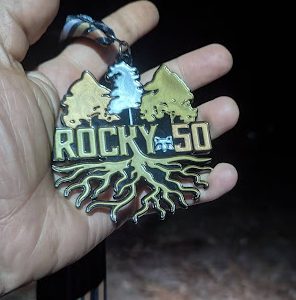
Vincent’s Rocky 50 ultramarathon finisher medal.
I Am An Ultramarathoner! (…and my body knows it!)
I crossed the finish line and high-fived the race director. Humorously, a kind volunteer reminded me to stop my watch: the Strava gods rejoiced! I was presented with a Rocky 50 finisher medal and put it around my neck. I just could not believe it: I had finished, I was an ultramarathoner. Then, with all the energy I could muster, I walked to our crew blanket and collapsed.
My wife, a superhero, packed our rental car with coolers, food, and race supplies as I laid on the ground totally exhausted. We picked up our drop bags and drove back to the hotel. Getting out of the car and limping to our hotel room felt like another ultramarathon, this one rewarded with a long, hot bath.
Post Race Reflections
That night, in the bathtub, I thought about the day’s events. I thought about the last four years of this difficult journey. I was filled with gratitude for my wife, the rock of our family, who kept me going. She made sure dinners were ready while I recovered from chemo, surgery, the difficult treatments, and the side effects of cancer.
The phrase “run the mile that you are in” became a deep understanding. Beyond what I had done during the race, it was what I had done through my entire cancer journey. It was what my wife was doing every day, coping with the constant stress of this horrible disease. It was what all my cancer friends were doing. Despite tough and awful situations, each of us was running the mile we were in: that was all any of us can do when facing seemingly impossible challenges. Over time, the miles–literally and metaphorically–carve a path through the dark forest of doubt and hopelessness. Tears ran down my face as I lay in the tub with sore and bleeding legs, this deep understanding washing over me.
Waffles at the hotel post race.
Our Cancer-Filled Ultramarathon
On Sunday, waiting for our flight back to D.C., I wrote a race report thanking everyone who donated to my Bladder Cancer Advocacy Network fundraiser. I was incredibly grateful for both their donations to BCAN, and the encouragement and belief they showed me. When the race seemed impossible, I persevered through the heat, pain, and endless miles to reach the finish line, fueled by their support.
I was also very thankful for this new ultrarunning community I found. From the aid station crews who encouraged me and opened my Skratch electrolyte packets when my fingers were too swollen, to Chris’s kindness in traveling to Huntsville to meet a stranger and race with him, and of course, my wife, who paced me. I know I would not have finished if she had not been there.
Final Thoughts and Transferable Takeaways
As I get ready for my next surgery and the continuation of my cancer-filled ultramarathon, I will remember this mantra. I will remember the support from the ultramarathon community and the Bladder Cancer Advocacy Network. And I suggest that when things get hard, when they feel impossible and you cannot take another step, you do your best, put one foot in front of the other, and run the mile you are in.
About Vincent
Vincent Rossi is a father, husband, cancer survivor, and newly minted ultramarathoner! Check out Vincent’s website and Instagram @gnocchi_dinner. He continues to fundraise for the Bladder Cancer Advocacy Network (BCAN). Take a look at Vincent’s BCAN fundraising page here.
This is part 3 of a multipart blog series about one Team RunRunner’s, Vincent Rossi, cancer-filled ultramarathon. Catch up on part 1 and part 2.
The physical startline of Vincent’s cancer-filled ultramarathon at the Rocky 50. PC: Let’s Wander Photography
The First Lap: A Challenge From Step One
Right from the start, this race was hard. My training leading up to the Rocky 50 had been entirely on the flat streets of Washington, D.C., and I had almost no trail running experience. Running with Chris the first five miles was invaluable. He taught me the power hike method for hills that I had read about, but never practiced.
Immediately, the hills took their toll, as did the heat. As a total newcomer to trail running, the most challenging part was the uneven ground and the tree roots. Oh, the tree roots. The Rocky Raccoon races are known for large pine tree roots on the trail: traps for tired runners. About 10 miles in, I tripped on a root and landed hard. The wind was knocked out of me. “Holy shit,” I thought. “Ok, my first fall.” I told myself iIt was part of the race, and then got up, brushed myself off, and started running again. It must have looked bad because runners around me stopped to check on me. “I’m good!” I yelled, stunned but not hurt.
Blood, Sweat, and Pee
Later in loop one, I stopped to pee and saw I was already peeing blood. It was a lot—my urine was dark red and thick. This blood was not from running; it began before the race: a sign that the cancer had spread to my kidneys. This, plus my abbreviated training build to this race, made understanding my fluid losses and hydration needs impossible. My right kidney ached: my cancer-filled ultramarathon continued. That was the area surgeons would soon inspect, and then possibly remove. I put thoughts of cancer aside and kept running.
Runner navigating lots of tree roots on the Rocky 50 ultramarathon course.
At the end of the first loop, I had run 16.7 miles. In training, 16 miles was normal for me. I had been running about 50 miles per week. But this was different. The heat, hills, and uneven ground left me completely exhausted. “Oh fuck,” I thought. Finishing felt impossible after that first lap. I had promised myself I would not quit. I would push myself as far as possible, no matter what.
Before the race, Chris, who seemed worried he had gotten me into a dangerous situation, said, “Hey man, if you feel like you are hurting yourself, it’s just not worth it.” With my cancer history and new diagnosis, I knew today was my only chance. My future was uncertain, so I would push hard. I thought, “Hell, to die during an ultra would be more badass than dying on fentanyl in a hospital bed.” I smiled at Chris and said, “I think I am ready to do hard things.” Chris smiled nervously back. Two more 16.7-mile loops to go.
Lap Two: “Run the Mile You Are In”
Lap two was brutal. I had told my coach I wanted to suffer, and there’s no doubt my wish was granted! Despite refilling my ice bandana at each aid station, the Texas heat meant it quickly became a wet rag. I fell two more times, each time so suddenly and hard I did not even catch myself. One moment I was running, the next I was on the ground.
I chose not to show my mileage on my running watch; ultramarathon math would not help me right now! I feared that constantly seeing how much distance was left—like 40, 30, or 20 miles to go—would make me lose the mental battle, which I knew was key to staying in the race.
On the flight to Texas, I listened to an ultrarunning audiobook. The author warned about the dangers of ultrarunning math, instead advising runners to simply “run the mile that you are in.” Thinking about running another 30 miles could have broken me easily. During the second lap, this advice came to mind and became my race mantra. I felt a large blister on my right foot from sand in my shoe, but I was too tired to stop and empty it. “Run the mile that you are in,” I thought. My quad muscles began to shake with intense pain. For a moment, I thought, “How can I keep going for another 30 miles?” The mantra returned: “Run the mile you are in.”
Cancer, Caution, and Crew Stations
By the end of the second lap, I reached my crew station where my wife had my race vest ready and waiting. She had packed it with gels, trail mix, salt tablets, and hydration powder for my final lap. The first two laps were so hot that I had opted to run with a belt instead of a vest.
As I approached, my wife immediately saw I was in trouble. Due to cancer treatments, I had lost the ability to sweat and control my body temperature. For me, 83 degrees Fahrenheit felt like 120! I walked up to the five-gallon ice bucket my wife had also prepared, and put my arms in the ice water, trying to recover from near heat stroke. Chris was there and decided to stop after two laps and about 55 miles, since his main race, the Umstead 100, was coming up. Wisely, he did not want to hurt his performance.
Rocky 50 ultramarathon aid station.
I was a zombie. Chris talked to me and gave advice, but I do not think I heard anything he said. I struggled to stand. From what I had read about ultras, I knew sitting down was not a good idea. Finishing the second lap meant I had officially run an ultramarathon–beyond the 26.2 mile (42K) marathon distance. But my goal was 50 miles, not 33.4.
As if Rocky 50 wasn’t already challenging enough, then the nausea hit. I removed a handful of gels from my vest, knowing that if I ate one more, I would throw up. From then on, I would only drink water. I managed to give Chris what might have looked like a smile, unable to speak, and a fist bump on my way out.
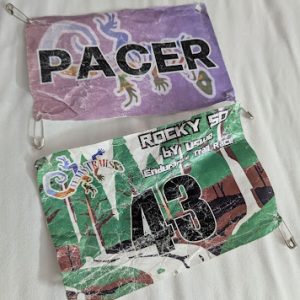
Rocky 50 race bibs: “43” for Vincent, “pacer” for his wife.
The Final Lap
The third lap started. I had no idea how I would get through the next 16.7 miles. As we began, some of the 50K finishers clapped as I went back on the course. Race rules allowed a pacer for the last lap, and my wife joined me—she was my savior. She did the ultramarathon math for me and tried her best to keep me moving at a pace to finish. Before the race, our plan was for me to speed up on the last lap, maybe run a 9:30-minute mile. Now in real time, the thought of running that fast would have been funny if I was not so scared. My wife ran far ahead, then looked back to see me limping. “Oh man, I am in trouble,” I thought.
At one point, I sat to tie my shoe. An abdominal muscle cramped so badly the pain was unbearable. I screamed, surprising myself. My wife looked at me, very worried, but I got up and kept going. She knew the plan: keep me moving no matter what. “Run the mile that you are in,” I thought again.
It’s Me Against the Clock
Near the end of the last lap, with four miles to go, I started to believe I could finish this cancer-filled ultramarathon. But I did not want to get too confident. If my pace slowed or I fell again, I could miss the cutoff time. As we walked up a steep hill, my wife checked her watch. She turned to me and said, “Okay, we need to pick it up now.” Her tone scared me, though not as much as the thought of a DNF (did not finish). I had come so far, endured so much: it was now or never.
I dug deep, trying my best to keep up with my wife. She was jogging at a slow 12-minute mile pace, but for me, it felt like a sprint. My legs were completely raw, and both my feet were bleeding. But for a moment, the thought of crossing that finish line gave me goosebumps. Despite the pain, I felt a fleeting giddiness. I smiled through this new kind of pain.
About Vincent
Vincent Rossi is a father, husband, cancer survivor, and newly minted ultramarathoner! Check out Vincent’s website and Instagram @gnocchi_dinner. He continues to fundraise for the Bladder Cancer Advocacy Network (BCAN). Take a look at Vincent’s BCAN fundraising page here.
Part 4 of My Cancer-Filled Ultramarathon will be released soon.
This is part 2 of a multipart blog series about one Team Runner’s, Vincent Rossi, cancer-filled ultramarathon. Catch up on part 1 here.
Vincent Rossi (white shirt) beginning the Rocky 50.
An Unexpected Turn
Only two weeks after my Philadelphia Marathon finish, and already planning to run 50 miles, I received unexpected news from a medical test. The result read: “Suspicious for high-grade urothelial carcinoma.” Despite being used to cancer stress by now, I felt awful. Surgery to check my kidneys for cancer was quickly scheduled.
This was a major setback, but after several dark days, I decided to rally. I texted my TRR Coach, Brant Stachel, to explain the situation, but mostly to ask how soon I could realistically attempt to finish an ultramarathon. He said I needed at least 12 weeks of specific, more intense training, the high [injury] risk, high reward type. I started training right away.
My original goal had been to complete the Crested Butte Ultra 50 mile in Colorado; a race taking place in September of 2025. However, with surgery on the horizon, I needed a race sooner, much sooner.
From Reddit to Rocky 50
Waiting until after the kidney surgery, or ureteroscopy, was not an option because I knew how fast things could get worse depending on the results. At that time, I had a false diagnosis of Stage 4 colorectal cancer, later found to be a return of my bladder cancer in the kidneys.
So, on impulse, I posted on the r/ultramarathon subreddit for help finding a suitable race. I wrote about my cancer’s return and my ultramarathon goal. As a first time poster, albeit a long-time consumer, I was surprised my Reddit post received the attention it did. Soon, I had over 100 responses from Redditors suggesting races across the U.S. and worldwide. I was amazed by the supportive messages, including several Redditors offering to race or pace with me. After reading many ultra stories, I thought, “This community is amazing.” A Redditor in San Antonio, Texas, recommended the Rocky 50-mile race taking place in Texas in February, 2025.
Rocky 50 course map.
Rocky 50: The Build-Up
My new Redditor friend, Chris from San Antonio, offered to do the race with me. “LFG go!” I replied on the r/ultramarathon thread. The plan was set for my cancer-filled ultramarathon: I would race the Rocky 50.
Rocky 50 was a course good for beginners: non-technical and, by trail running standards, pretty flat with only ~2,700 feet of elevation gain and equal loss. The course consisted of three identical 16.7-mile loops around a large lake in Huntsville, Texas, with a time cutoff of 14 hours and 30 minutes. My wife would crew me on every loop. I had no prior trail running, or trail aid station, experience, so frequent access to her crew station would be very helpful.
Past weather data for February in Huntsville predicted temperatures between 40-50 degrees Fahrenheit: perfect, I thought. My cancer treatments have made me very sensitive to heat, thus the cooler weather was a big reason I chose this event. Unfortunately, as the race date got closer, bad news came; weather reports predicted 83 degrees! I remembered running the Georgetown Half Marathon in 75-degree weather a few months before and almost passing out at the finish. “How can I run in 83-degree weather?” I thought. “And run 50 miles?!” All I could do was hope and pray that the weather would change at the last minute, but, alas, the forecasts held.
Chris texted that with this unusual heat, I might want to find another race. But my plane tickets were bought, hotel rooms booked, and the course researched. For me, this race was happening. With my surgery date scheduled, there was no Plan B. 83-degree temperatures or not, Rocky 50 was my race.
Vincent’s Rocky 50 drop bags.
Rocky 50: Race Day!
Fast forward to February 8th and race day was here! Having flown into San Antonio the day before, my wife and I prepared as well as we could within the confines of our hotel room. We carefully packed drop bags with gels, salt tablets, ice packs, ginger chews for nausea, and body lube. Early on race morning, we dropped these bags at the three aid stations and headed to the start.
It was 6:30 am and the temperature was already 73 degrees! My brow was sweating simply standing around, well before the race began. As we set up a small beach blanket, a cooler with ice, and a folding chair for my wife, I met Chris for the first time. We shook hands and introduced ourselves face-to-face. It was good to meet him. He was friendly and had gone to the effort of driving four hours from his home to the race venue. Through calls and texts, I knew Chris had been preparing. Now, in person, he gave me some last minute advice. “You ran a 4:18 marathon. You can finish this race,” Chris said. I was not so sure. The heat was already affecting me, and, as a result, I was very nervous.
About Vincent
Vincent Rossi is a father, husband, cancer survivor, and newly minted ultramarathoner! Check out Vincent’s website and Instagram @gnocchi_dinner. He continues to fundraise for the Bladder Cancer Advocacy Network (BCAN). Take a look at Vincent’s BCAN fundraising page here.
Part 3 of My Cancer-Filled Ultramarathon will be released soon.
This is part 1 of a multipart blog series about one Team Runner’s, Vincent Rossi, cancer-filled ultramarathon.
Vincent Rossi running the Philadelphia Marathon in 2024.
Setting the Stage: Not Your Typical Ultrarunner
I awoke to the sound of my cell phone’s alarm going off. I picked up my phone, and with blurry eyes, I saw that it was 4:00 a.m. As I slowly rose, I looked around the hotel room and reoriented myself. I was filled with excitement but also a huge amount of trepidation. “How do I get myself into these situations?” I thought to myself. I walked to the restroom, hopeful that I could take a dump. Emptying the bowels was essential to a successful race.
This particular morning, I was preparing to run the Rocky Raccoon 50-mile race. I had originally planned to take a full 12 months to train for an ultramarathon, but now found myself lining up to race far ahead of schedule. In November of 2024, I completed the Philadelphia Marathon in 4 hours and 18 minutes, and it was not long ago that this achievement would have been unthinkable in and of itself.
Far from your typical ultrarunner, my running journey did not begin until fairly recently, when I was 48 years old. My wife took up running during the pandemic, and I, mostly out of boredom, followed suit. If I am honest, the idea of me running felt novel and even a little absurd. Also absurd, at the time, would have been the thought that I had both colorectal and urothelial cancers.
When Running Met Cancer
During my first Bacillus Calmette-Guérin (BCG) treatment for bladder cancer—which involved having immunotherapy solution pumped into my bladder through a catheter while I was wide awake—my nurse had a picture of herself running the Rock ‘n’ Roll Washington DC Half Marathon hanging on her office wall. “Wow,” I thought, “running 13.1 miles, that seems impossible.” I then nervously braced for my first catheterization and bladder cancer treatment, not knowing there would be many more to come.
As with most runners, it started with several 5K races, then a few 10-milers, culminating in my wife and I running a half marathon in Colorado, as well as the Rock ‘n’ Roll DC Half Marathon. A full circle moment, inspired by my kind nurse at Sibley Memorial Hospital.
Coping with Cancer
From 2020 to 2024, I faced many surgeries. These included a right hemicolectomy for colon cancer. I also had multiple Transurethral Resection of Bladder Tumor (TURBT) surgeries and neobladder surgery, where my bladder was removed and replaced with a pouch of small intestine. Following four cases of sepsis, caused by scar tissue at the neobladder neck that stopped me from voiding, I had corrective surgery. Additionally, I received immunotherapy and three types of chemotherapy. I also dealt with small intestinal blockages from scar tissue. Despite countless days in the hospital, I kept running between and sometimes during treatments. Often, I could only do short distances, but I stayed consistent. Running became a form of meditation for me. It was my therapy and my coping mechanism for the constant challenges cancer brought.
Hiring a Running Coach and Joining Team RunRun
In 2024, having run 2:04:26 at the Rock ‘n’ Roll Washington DC Half Marathon that March, I prepared for my first full marathon. I had never run more than 16 miles. Years of not taking care of my body prior to starting running, alongside my cancer battles, had left me injury prone. I needed guidance, so I hired a running coach: TRR Coach Brant Stachel.
When we started working together, I was skeptical. I could not understand how I could run 26.2 miles when my longest run to date was only 16 miles. My coach asked me to trust his training plan, and, nervously, I followed.
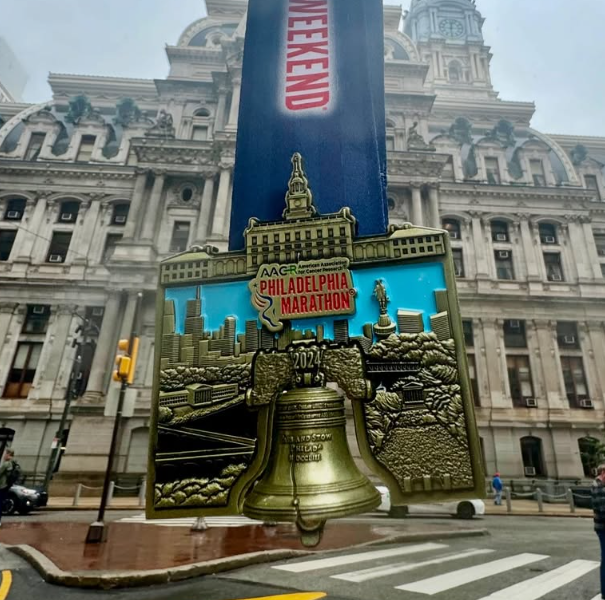
Philadelphia Marathon 2024 finisher’s medal.
Fast forward to marathon race day, almost four years since my double cancer diagnosis, and I did it! Crossing the finish line of the Philadelphia Marathon in 4 hours and 18 minutes, an average pace of ~9:50 minutes per mile, was overwhelming. I was surprised my aging, formerly cancer-ridden body could do this. Through working with Brant and trusting his training, in only 6 months I had basically run my half marathon pace for a full marathon!
A Coach’s Perspective
Here’s what his TRR Coach Brant Stachel had to say: “Vincent is a rockstar! While nervous at first, he bought into the training and asked questions. As his coach, I could tell from the start that he was keen to explore his limits, or so I thought. I later learned that Vincent is one of the few athletes I’ve met who almost doesn’t believe in limits. What he has gone through with cancer, while maintaining his running routine, alongside his dedication to his family and everything else he navigates in life is truly remarkable. As you’ll read, the Philadelphia Marathon was merely a stepping stone to an even bigger, and better accomplishment!”
Beyond the Marathon
After the marathon, I began to believe the cancer was behind me. I was a marathoner. My wife, my running partner, ran nearly every race with me. Together, we then aimed for a new goal I never thought possible: an ultramarathon, specifically, the Crested Butte Ultra 50 mile race in the Colorado mountains. My coach, Brant, made the training plan, which would take most of a year to complete. Little did I know, this was only the beginning of my cancer-filled ultramarathon.
About Vincent
Vincent Rossi is a father, husband, cancer survivor, and newly minted ultramarathoner! Check out Vincent’s website and Instagram @gnocchi_dinner. He continues to fundraise for the Bladder Cancer Advocacy Network (BCAN). Take a look at Vincent’s BCAN fundraising page here.
Part 2 of My Cancer-Filled Ultramarathon will be released soon.
Team RunRunner Stephan Zajac is on a quest to run a marathon on each of the seven continents. On June 1, he ticked off Oceania, running the Brisbane Marathon in a PR time of 3:47! However, as you’ll read, the PR is only a tiny fraction of what this race meant to him. These are Stephan’s words:
Far Beyond the Finish Time
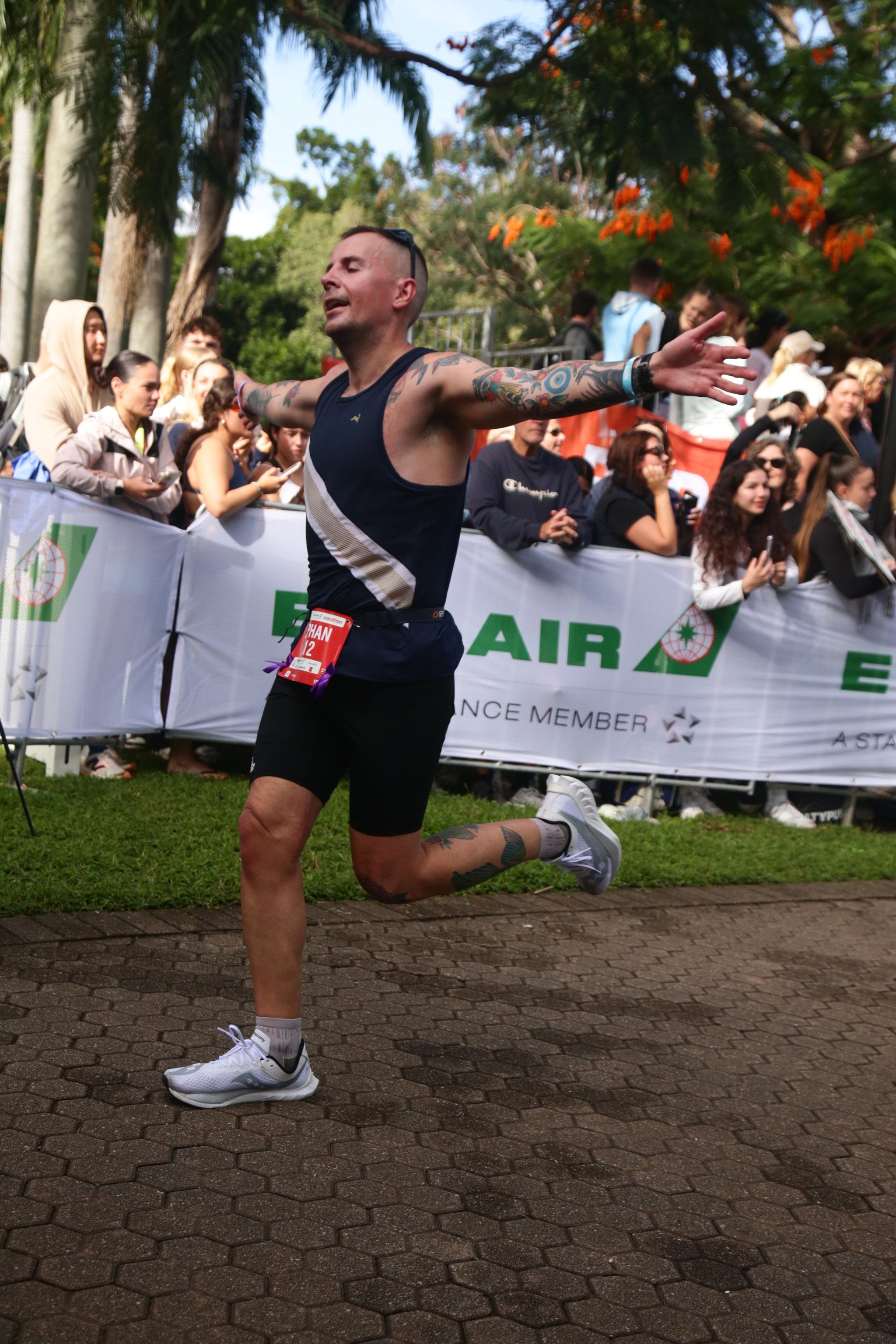
Team RunRunner Stephan Zajac completing the Brisbane Marathon, appreciating how much more there is to life than running.
At the heart of what I do, I’m a storyteller. Numbers alone — without context to scaffold and shape a narrative around them — don’t say much about what really happened from Point A to Point B. If I told you that I trained 6 months with TRR Coach Mike Sheehy only to shave a minute off my PR, you might not be very impressed. You might not think that flying all the way to Australia to run the Brisbane Marathon was worth the time or money I’d invested.
Well, there was a point when I thought earlier this year, even earlier this month, that I was never going to make it to Brisbane at all. Throughout this entire training season, I’ve had to really channel my inner resilience and strengthen my mindset to overcome a series of obstacles. But that is life. And, as Eliud Kipchoge says, “Marathon is life.”
Injury Lows and Learnings
Having incurred a series of ankle tendon injuries earlier this season, I feared my 2025 marathon journey might be over before it had even begun. It was an excruciatingly painful experience, both physically and mentally, that tested my resilience. Instead of quitting, I met with an amazing PT who taught me a whole new set of ways to better protect myself. Slowly and surely — through dedication to various stretches, lacrosse balls (a favorite on the calves), targeted foam rolling, posterior chain strengthening exercises, and other mobility work — I came back stronger, faster, and better prepared for the future than I was before. What I thought was a failure turned into a skill asset for not just this marathon season, but for seasons to come.
No Two Marathons Are Alike
From a geographical perspective, this race taught me that no two marathons are alike. My previous marathon was in Napa, California, during March. It was very cool, crisp, and overcast: perfect running conditions. There were no sharp twists or turns with hard banks. It was also a net downhill course: perfect for running fast.
Brisbane, on the other hand, was very challenging. My watch informed me that I trudged through nearly 6,000 feet of elevation gain. Numerous hills, cliffs, and bridge climbs made the views of this subtropical city so beautiful, but much more physically demanding to attain. Add to that heat, humidity, and the sun beating down on you after mile 20 while climbing uphill over and over again. Needless to say, the Brisbane Marathon was not conducive for setting PRs, but great for building mental strength!
There’s More to Life Than Running
Finally, this has been a very difficult year for our family. In late January, my partner’s dad, Greg, was diagnosed with pancreatic cancer. It has been a heartbreaking journey since. He passed away two weeks before the Brisbane Marathon, fighting strong until the very last minute. We were back in Iowa to celebrate a graduation, when the very next morning he quickly and unexpectedly passed in his home surrounded by loved ones.
I never thought I would be the one to perform CPR on someone I loved and cared about so deeply as we shared the last moments of his life together. It was a traumatic experience and one I will never forget. I truly didn’t imagine I would make it to Brisbane to see this through. That just wasn’t my priority at the time, there’s more to life than running, but his family encouraged me to see this through.
A Marathon With Greg
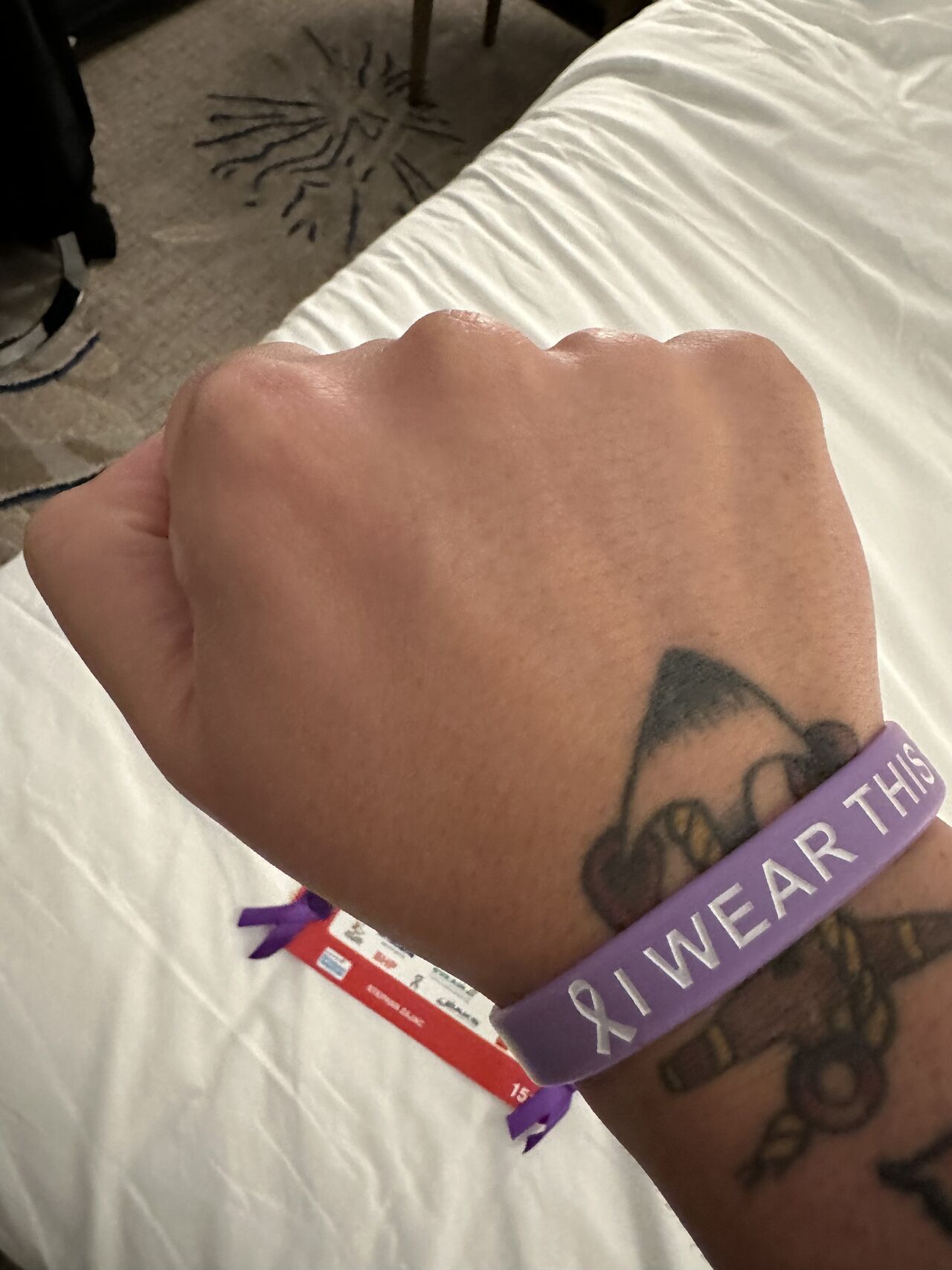
The purple wristband Stephan ran with to honor Greg during the marathon.
Greg was an important part of my journey, and he was always everyone’s biggest cheerleader. I was lucky just to be at any table with him, surrounded by his love. A runner himself when he was younger, Greg followed my training, excited to hear about my race in Australia. Before travelling, I remembered that my partner’s sister always wore a personalized purple wristband in support of their dad during his pancreatic cancer journey. I wanted to honor Greg by running with this wristband during the marathon.
And, when I crossed that finish line in Brisbane, Greg was with me. He was with me the whole time. I could hear his calming voice in my head telling me, “You’ve got this,” or, “You can’t quit now.” I cannot explain it. He was with me during the most challenging moments of the race, and he helped me to push through. And eventually it also became my voice. The power of [spoken] self-affirmation is extraordinary. I was not only running this race for me, but also for Greg. It was so very healing for me.
… and a Run for Many More
I was also running this marathon for The Stroke Foundation. With the generous support of so many loving friends, relatives, coworkers, teammates, and more, together we raised over $1,800 to help stroke survivors, and their caretakers, navigate the challenges of life after a stroke and connect them with critical resources for care. I lost my beautiful grandmother, who raised me with so much love and care in her own home, to a stroke 8 years ago: I ran this race for her too. I thank everyone who donated so generously to this cause.
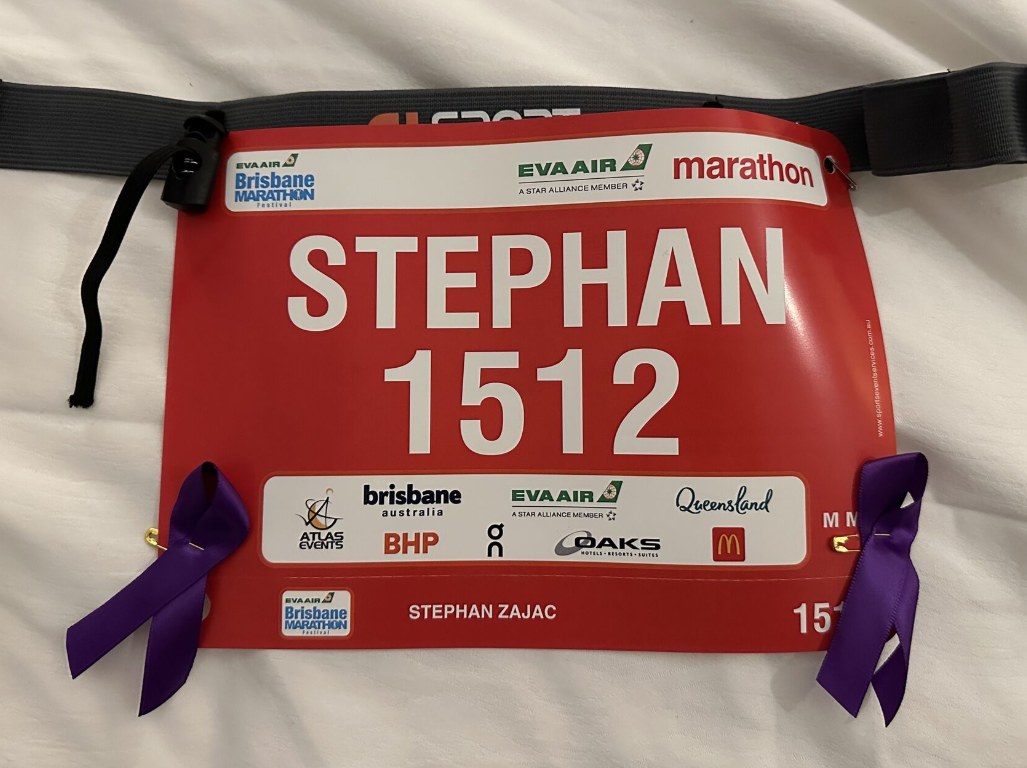
Stephan’s Brisbane Marathon race bib.
“Marathon Is Life.” – Eliud Kipchoge
So, long story short, I shaved 1 minute off of my prior marathon personal best. But there’s more to life than running. The real achievement was in completing such a challenging race during the most trying time of my life. It taught me invaluable lessons that I’ll always carry with me. I’m stronger today because of this journey I’ve been on. I look forward ahead to more marathon [life] journeys ahead.
The story of how one Team RunRunner, Jared Younger, is merging his love for running and fashion, with self-expression and creativity.
The first thing that probably springs to mind when you think of running gear is high-performance clothing, clothing designed for functionality rather than fashion. Jared Younger, founder of Museum of Distance Running (MODR), wasn’t satisfied. At the heart of MODR is a passion for self-expression and freedom, on the run and beyond. MODR is about more than fancy fabrics and stylish designs; it’s about using running gear to showcase one’s unique style. Jared has produced something genuinely original by fusing his personal passion for running, fashion, and art.
A t-shirt from Museum of Distance Running’s first product release in 2024, known as “Exhibit 001”.
MODR: Solving the Problem with Most Running Brands
The story of Museum of Distance Running begins with Jared’s personal running experience. Coming from a background in design, especially apparel and fashion, Jared was always aware of the power of self-expression through what you wear. But as he began his running journey, he quickly realized that most running brands didn’t speak to his personal taste. “The running gear available at the time was mostly performance-driven. You’d put on your Asics or Nikes, then change into ‘real’ clothes afterward. I didn’t feel natural wearing the ‘running uniform,’” he explains.
Determined to solve this issue for himself, he started experimenting with running in vintage tees, soft 50/50 blends, and retro mesh hats. Eventually, the gear he wore for runs became the gear he wore when he wasn’t running—at coffee shops, or just hanging out. And that’s how MODR was born. “I pulled in my fashion and design references, creating pieces I wanted to wear,” Jared says. He wasn’t afraid for MODR to stand out, in fact, he welcomed the brand feeling “ left of center from mainstream running apparel”.
The name “Museum of Distance Running (MODR)” was born during Jared’s trip to Sweden visiting the Moderna Museet with his girlfriend in 2023. One painting in particular had “this infinite, cyclical quality that felt very reminiscent of life and my relationship to running” Jared recalls. “And that got the ball rolling in terms of using art references to make a [clothing] brand that lives in the world of design and art” in collaboration with what he felt was lacking in the running apparel space.
Unsurprisingly, running and MODR are inexplicably intertwined, both being vehicles for freedom and self-expression. For Jared, “Running gives me space, and it frees me up, which is exactly what I want MODR to do. Like running, MODR has a casual tone that gives you space to lean into who you really are.”
The act of simply putting one foot in front of another offers him mental space to let his ideas flow freely, which often leads to new inspiration for his work. “Sometimes, that leads to ideas that go straight into the projects I’m working on. Other times, it’s just a way to clear my mind and let my thoughts wander.”
Early Wins and 1st Birthday Celebrations
As MODR celebrates its 1st birthday, Jared reflects on the brand’s high points so far and its immediate impact. “We launched in March 2024 with a collaboration with The Speed Project. The hats and shirts we did for them sold out in a day,” Jared recalls. “Nobody had even heard of us before, so that was extremely unexpected and exciting.”
This staging accessory shows how every aspect of MODR is intentional and well-thought through.
But even beyond the early success, Jared is simply grateful for the opportunity to create something that resonates with people, while staying completely true to himself. “I feel lucky that I get to do this,” he says. “When someone connects with what we’re doing, it’s such a rewarding feeling.”
The Difficulties of Establishing a Brand on Your Own
It’s never simple to build a brand, especially without a team or financial backing, but Jared is far from naive to the challenge. Jared and his business partner, Lucie Beatrix, are Museum of Distance Running, crafting the brand from scratch alongside their regular day jobs. “It’s a passion project for sure,” Jared acknowledges. “We aren’t in this to try to sell anybody anything. We don’t do marketing, which is convenient because we don’t even know how. But we are trying to create a world and perspective and find the people that relate to it.”
The focus on quality over quantity and staying true to their core values shines. Jared shares, “we’ve turned down a few collaboration opportunities because we are still building our world. We are looking for something that can stand on its own before trying to muddle our messaging.”
As idealistic as that sounds, the difficulties are real for these two young, emerging entrepreneurs. From clothing and web design, to managing taxes and accounting, the pair wear many hats. But Jared wouldn’t want it any other way. “Not having a boss and instead getting to build your own vision is a privilege. And when we see success, it makes it that much sweeter. Every person that wears MODR is greatly appreciated. We ship the orders out ourselves. We see your names, and we write notes to all our customers. The small scale makes everything very personal.”
Why Museum of Distance Running is Not a Performance Gear Brand
Establishing a running apparel brand isn’t an original idea; as running has exploded since the pandemic, many startups and indie brands have flocked to the space, hoping to capitalize on the growing trend. What sets MODR apart and, I believe, gives them staying power, is the depth of their vision and values. They’re not trying to sell to everyone or compete with the giants like Nike, and MODR proudly is not a performance brand.
Here’s Jared again: “Right now, with this running boom we have, we see a lot of emphasis on performance. We have amateurs training like pros. The science on nutrition, training methods, shoes, etc is readily accessible to all. We love this stuff, too. But we appreciate that running is also an expressive act. It’s performance art as much as performance. It’s a raw, gritty, and bold experience. So MODR is more interested in expressing that individuality and offering the freedom to do running your way, with a sense of personal style at the same time.”
Jared works to “create pieces that extend this perspective off the roads, letting you express this side of yourself whether you are running or going to a coffee shop. There are a ton of brands doing performance gear really well. And we cheer them on. But adding to that category isn’t what we are interested in. We are looking for a lifestyle expression.”
Team RunRun and the MODR Experience
Jared highlights how “the Team RunRun newsletter is filled with inspiring personal stories. All of us are doing this for our own reasons, and each person does running their own way. There are no rules to this. So those stories give me optimism that people are being intentional about how they are existing in the world, with goals and purpose. And I hope that everyone is doing it their way, embracing their uniqueness.” It is this spirit of running, the individual experiences each of us bond over, that MODR looks to embody in every piece they produce.
MODR’s Exhibit 003 long sleeve tee
When it comes down to it, Jared’s goal for MODR is simple: he wants people to feel confident, free, and excited when they wear the brand. Jared hopes MODR inspires others “to go against the grain and encourage them to find ways to express themselves.”
Upcoming Releases and Connecting with Museum of Distance Running
Extending the museum metaphor further, every collection release is an “exhibit”. Museum of Distance Running’s Exhibit 004 is in the works, alongside another special project that Jared is extremely excited about. Each exhibit is completely original with limited quantities, with sales run entirely through their website. Once it’s gone, it’s gone. No restocks. (Though hopefully the next exhibit is on the horizon!) There are still a few pieces from Exhibit 003 available here. Jared is kindly offering the Team RunRun community 10% off with code “TRR10”.
To ensure you don’t miss the release of Exhibit 004, and to get early access to new drops, consider subscribing to their email list on their website. And of course, give them a follow on Instagram @museumofdistancerunning to see MODR’s latest releases and more unique content.
by Ruby Wyles
This article is not sponsored by Museum of Distance Running (MODR) or compensated in any way by the brand. Instead, we wanted to share how one Team RunRunner, Jared Younger, is merging his love for running and fashion, with self-expression and creativity. He invites you to do the same.
Historically, the term pedestrian referred to anyone traveling by foot, either walking or running. It was not uncommon for even Olympic level runners to be referred to as pedestrians. Now we tend to utilize this term as an insult. Like many things in our culture, we often confuse basic simplicity for lacking depth. This irony should not be lost on runners and endurance athletes.
Those of us who run and walk for exercise know deeply the level of knowledge, respect, study, and appreciation a person has to possess to truly accomplish the title, “Pedestrian.” It was upon hearing someone insult someone else’s idea as pedestrian that my lovely wife, Holly, pointed out the need to reclaim this term. She pointed out that we have dedicated our lives as spouses, friends, therapists, and spiritual seekers to the simple and everyday. The foundation of our lives together is rooted in a form of ordinary living. We are pridefully pedestrian.
Reclaiming the Pedestrian
My spiritual life is the one thing which influences every aspect of my identity. I am a Buddhist practitioner as a husband, friend, therapist and athlete. This dedication to living a life as a seeker has inevitably found its way to my study of movement. I always want to be able to find the mystery in any movement and a way to live the questions created by this embodiment. To deepen this process, I dedicated myself to developing the idea of the pedestrian mystic. Reclaiming the Pedestrian requires you to be a seeker of movement, connoisseur of cadence, and a practitioner of the novel.
Here, we are not only attempting to reclaim the pedestrian as any of us moving our feet. We will also access pedestrian mysticism as a way to find the profound in the mundane. Anyone with a background in endurance knows the divine connection found in the repetition of one foot in front of another. In this way, pedestrian mysticism becomes our dedication to learning and maintaining a beginner’s mind.
Simple but not easy
We can take the simplicity of running and turn it into our Zen practice, our contemplative prayer, and our offering to mother nature. We create our own rituals and creations that honor the universe both inside of us and outside of us. Pedestrian mysticism teaches us that movement reduces duality. We become one with everything around us by simply committing to the pedestrian.
I implore you to look at the austere parables of Zen Buddhism, among other wisdom traditions, which teach us to stay curious and still while connecting to our embodied experience. Fear not if you are unfamiliar with these traditions. Finding yourself in the discussion of having a body is forever deeper than finding yourself in the traditions. For your intuition, connection to experience, and exploratory nature which led you to a pedestrian mystic life will forever show you more than anything outside of you ever could. I am thankful to seek alongside you.
by long-term Team RunRunner Chaz Franke. In his words: “I know more about being a Buddhist and being a therapist than I do about being a runner, but I love looking for overlap between spirituality and movement.” Stay tuned for more of his writing.
Race: Bubba’s Backyard Ultra Beer Mile – The race report Team RunRun didn’t know we were missing!
Runner: Chris Manwaring
Chris hitting the peak athletic pose while chugging his last beer during the beer mile.
Race Date: 10/06/2024
Location: Conway, NH
Result: 12 minutes 54 seconds
3 Bests – What aspects of the race did you like the most?
Beer! The offering was Lawson’s Little Sip, a 6.2% IPA, graciously left in the sun all day to improve consumability.
Participants: There was a solid group of competitors in the mix, including folks crewing the ultra racers (like me), folks just in town for the day, and a few ultra racers that had dropped out earlier in the day but wanted to squeeze a little more torture into their weekend!
Spectators: We drew a very decent crowd, mostly consisting of ultra race volunteers and racer crew members that wanted to see what all the noise was about.
Not so much – Aspects of the race that didn’t do it for you
Hearing all the vomit stories after the mile had finished, but I guess I signed up for this too!
Weird factor – What’s the weirdest thing about this race?
I mean, it’s a beer mile… I think having to dodge around puke spots on the course while trying not to acknowledge that it’s puke because then your stomach might turn against you?
Highlights of your race – What did you do well and enjoy about your race in particular?
Just being out there and running with friends old and new is always enjoyable. Extra camaraderie comes from patting each other on the back to free a stuck burp. One highlight was talking a little trash around lap 3 when you know everyone feels awful. My race prep worked, which consisted of drinking lots of water that morning beforehand and stopping eating of food about 2 hours before the race to keep an empty-ish stomach. However, as can be expected, four beers on an empty stomach hit hard after I was done!
Lots of camaraderie at Bubba’s Backyard Ultra Beer Mile!
Lessons for others – Share your pro-tips on the race to help the next runner
Walk the last dozen or so steps into the end of the laps. You want your heart rate and breathing rate especially to settle a little bit before chugging to avoid feeling like you’re waterboarding yourself. Also, warm beer goes down easier than cold beer! Lastly, get some good burps in right before you run!
Lessons you learned that will help you next time around
I burp better while running than when I am standing still (who knew?!). I wasted a little time on the first lap trying to force a burp before running.
Most important course specific knowledge to know about the race
Bubba’s Backyard Ultra Beer Mile had two different laps, each run twice to make up the 1 mile distance. The odd and even laps are different routes and distances. The even laps are like .15 and the odd laps are like .35. It’s a cross country course all on trail and field, very New England single track.
Aesthetics – Is it a pretty course?
Gorgeous course! (And the weather was perfect too!)
Difficulty – Is it a tough course?
Depends on how much you like chugging beer and listening to people dry heave around you!
Organized and well run – Did it feel like a well-oiled machine or were they flying by the seat of their pants?
Bubba’s Backyard Ultra Beer Mile was about as well organized as a beer mile can get!
Chris Manwaring ahead of Bubba’s Backyard Ultra Beer Mile.
Competition – Is there a strong field?
For a beer mile, the field was strong! The winner run 7:40 (yep, that’s 1 mile plus chugging 4 beers in under 8 minutes!) and there were lots of strong chuggers overall.
Logistics – Does it require a special handshake, registration a year in advance, hotels all booked? Give us the low down on the nuts and bolts of making the race happen.
It’s easy to register through UltraSignup link under the Bubba’s Backyard Ultra page.
Aid Stations – Standard fare or anything special to know about the aid stations in terms of what’s available or when?
Alcoholic beer options, nonalcoholic beer options and seltzers also available.
Weather and typical race conditions
Rest assured, Bubba’s Backyard Ultra Beer Mile will be held rain or shine! So be prepared for all course conditions from dry to muddy and everywhere in between.
Gear – Did you need anything special or is there anything you’d recommend for the next runner?
Just a strong stomach, a decent pair of trail shoes and good time intentions. Unless you’re planning on being there until sunset, a designate driver is also a must!
Spectators – Is this a friendly course for your friends?
Absolutely! Perfect spots available to watch everyone attempt to keep the beers down! This race also happens during lap 28 of the backyard ultra race, which makes for a great excuse for everyone to hang out before and afterwards cheering on the ultra competitors as they race against the clock. A good number of the participants were involved in the ultra in some fashion, either as a crew, volunteer or racer. There were also plenty of opportunities to get out before or after the beer mile (if you’re like me and want to try running hammered) and run a loop of the ultra course as well.
How’s the Swag?
Swag choices were a pick between either a roll of the infamous Bubba’s pink duck tape or a bag of freshly ground White Mountain Ski Company coffee. Obviously, I picked the duck tape.
The Overall Score – How many stars do you give this race and do you recommend that others run it?
5 out of 5 stars! I will certainly do this race again, probably aim for a sub 10?! Might have to practice a bit first.
by Chris Manwaring
Interested in tackling the mile distance (with or without the beer)? Check out” Tips for Running a Mile“.
3 Bests – What aspects of the race did you like the most?
Scenery – the mountain vistas, meadows of spring flowers; the area makes me want to leave the city and retire there!
Trail conditions – generally pretty easy trails without too many roots or rocks. The course is singletrack trail for most of the race, with some wider sections.
Aid stations – while they could be better by having consistent items at each aid station and publishing precise lists of what to expect ahead of time, the aid stations were well staffed, well stocked, and full of friendly race support. Having drop bags at each aid station made it so that I could changes socks often, change shoes for road and trail sections, carry less food and water with me, have my specific preferred fuel – so kudos to the race folks on organizing these well and getting everything right here.
Weather – it was pretty wild at altitude, which made things harder, but it was cool and generally good running weather… plus the hail certainly made for a good story!
Not so much – Aspects of the race that didn’t do it for you
Overall race organization – the organizers of the Sun Mountain 50K and the weekend’s other races changed the course after months of my (and probably many other folks) emailing them to understand what the course was, which meant I didn’t know what I was training for. Eventually they added 10 miles of pavement – which I had mixed feelings about personally given I was expecting a trail race. I’m so used to road running and was looking forward to the added challenge, but those extra pavement miles made the race much more doable for me in the end. I could see this being very annoying for other folks set on a trail run too.
Weather – I got hailed on at altitude for about 6-7 miles, which in fairness we were warned about. In the end, it was actually kind of fun, but I can see how this isn’t everyone’s cup of tea. You also can’t control for that though.
Weird factor – What’s the weirdest thing about this race?
Definitely the weather! There is always a huge variation based on altitude primarily, and May is also shoulder season so it could be hotter or cooler depending on the year. For me, on the day it went from sideways hail to light/heavy rain to sunny and baking sun: basically all four seasons in one day!
Highlights of your race – What did you do well and enjoy about your race in particular?
Finishing – I’d DNF-ed at a 50K 7 years prior, so for me this was a grand f-u to the universe and I’m stoked to have finished! Spite is the best motivator! The scenery was also a highlight, as I mentioned about. The town of Winthrop had a really nice vibe to it as well.
Lessons for others – Share your pro-tips on the race to help the next runner
Use the drop bags and carry less stuff! And for me, using poles was a good tool to take a ton of weight off my legs and made it possible to finish, so others could consider that too.
Lessons you learned that will help you next time around
I think I left a fair bit of energy on the table. I ran the last mile or so quite fast in the end, so I really should have sped up more on the road downhill at a bare minimum. I’d say the same for the gentle trail downhills: I should have pushed harder on those.
Also, my watch was in a mode that auto-paused the workout while I was at one of the aid stations for a good 7-8 minutes, resulting in a difference between chip time and my watch’s timing. I need to turn that feature off for races.
Most important course specific knowledge to know about the race
The course is mostly single track trail, but, based on permitting difficulties, it looks like road sections may continue to be a part of this race in the future. While for the 50K or 50M this isn’t such a big deal, it is a bit of a downer for the 25K if you end up running 10 miles of road and only 5-6 miles of trail. Be mindful that the aid stations are well spaced out, so use them. And remember that the weather can vary a lot based on altitude and luck of the draw!
Aesthetics – Is it a pretty course?
Very much so, one of the nicest courses I can remember!
Difficulty – Is it a tough course?
I didn’t think the Sun Mountain 50K course was super difficult, but there was a moderate amount of elevation for the distance. The singletrack trail meant you had to pay attention somewhat. There were very few steep sections, and even those were relatively mild.
Organized and well run – Did it feel like a well-oiled machine or were they flying by the seat of their pants?
Yes – except for the months leading up to the race with the permitting and course mess.
Competition – Is there a strong field?
I’m at the back of the pack here so I have no idea!
Logistics – Does it require a special handshake, registration a year in advance, hotels all booked? Give us the low down on the nuts and bolts of making the race happen.
Hotels and Airbnb’s probably fill up quite quickly, so book early.
Aid Stations – Standard fare or anything special to know about the aid stations in terms of what’s available or when?
Good on the whole, but they could be improved by publishing precisely what will be at aid stations ahead of time and sticking to it. I did discover peanut butter and pickle wraps, which were weird and delicious!
Weather and typical race conditions
As you’ve read above, expect widely varying weather! There could be snow and hail at the higher altitudes, and rain is very likely at some point.
Gear – Did you need anything special or is there anything you’d recommend for the next runner?
Poles are good but not really necessary. And I feel like pretty much everyone was running in the Hoka Mafates, so perhaps a shoe worth checking out for this race.
Spectators – Is this a friendly course for your friends?
Not this year based on the big changes to the course, and there was no racer crew support. This was a huge bummer.
How’s the Swag?
Not great. T-shirts were available for purchase but I didn’t buy one.
The Overall Score – How many stars do you give this race and do you recommend that others run it?
I’d give the Sun Mountain 50K 4 out of 5. It could be 5 with better organization.
A few weeks back, we received a race report from Team RunRunner Rebecca Walker that said something along the lines of: ‘I hopped in a 200 mile race, it was fun, wasn’t my fastest or my slowest’. Rebecca’s nonchalance suggested that running super long distances was a relatively common affair for her, and I had to learn more!
Rebecca wading through a creek during the Cocodona 250. PC: Anastasia Wilde
Meet Team RunRunner Rebecca Walker and Coach Greg Ottinger
Coached by accomplished ultrarunner and Team RunRun Coach Greg Ottinger, the pair have been working together for two and a half years and counting. As mentioned, coach Greg is no stranger to 200 mile races or back-to-back ultras, himself targeting the Triple Crown of 200s this summer, which involves running three 200-mile races over four consecutive months! With over 200 Team RunRun coaches to choose from, it’s no coincidence Rebecca and Greg seem to have the perfect coach-athlete match.
According to UltraSignup, in little more than 10 years, Rebecca Walker has 82 ultras to her name, including seven 200+ mile races, which had her running for up to 5 days at a time! Yep, 5 whole days, over 121 hours to be precise! Interviewing Rebecca, I thought I’d start with the obvious question I’m sure we’re all wondering: why? What draws you to these super long events, and why do you keep going back for more?!
Rebecca: “Historically, I chose my races based on places I wanted to visit. My first 200 mile run was the Tahoe 200, which I remember seeing advertised and thought I would like to do it someday. At the time, you had to have completed a mountain 100 mile qualifier race beforehand, so I wasn’t able to enter Tahoe 200 until the prerequisites were met. After completing that one successfully, I realized how much I appreciated the variability of these events, as well as the slower pace – being a slower runner, this was important to me!”
Balancing ultra training with life
As superhuman as Rebecca’s ultrarunning exploits seem, she isn’t a full time runner focused solely on the eat-sleep-train priority triplet that many professional athletes are. Instead, Rebecca balances a full time job in the legal field with family life as a wife, mom to an active teenage girl, plus two cats and dog too! Not your typical husband-and-wife duo, the pair bond over their love of ultras, and actually ran the Moab 240 together for their honeymoon!
So what’s Rebecca’s secret? How can she possibly excel at these ultra ultra distances with so much other life to balance?
Rebbeca: “Greg [Ottinger, her TRR coach] has been AWESOME working with my schedule, and we’re flexible with moving workouts around. My husband typically runs with me on the weekends, but the weekday stuff is all me.”
“Training for 200 milers is not too much different than 100 mile training. Under Greg’s guidance I now run 5 days a week (vs the 3-4 I used to do): 3 runs are usually Z2, easy training; 1 day is typically speedwork and/or hills depending on whatever race I have coming up; and the other day is a long run. Saturdays are always my long days, involving either a progression run if I’m training for something flat, but usually I go on a time-based adventure run in the foothills/mountains.”
Add to that Rebecca’s one day per week of strength training, and training for 200 milers seems almost manageable…?! Rebecca adds: “I just do what I’m told”, not overcomplicating her running, and leaving the X’s and O’s of training science to her coach Greg, a job he readily accepts.
Greg: “As a coach, navigating Rebecca’s race calendar is akin to orchestrating a symphony of commitments, aspirations, and relentless determination. Hailing from the frosty climes of a region that could freeze a San Diegan’s bones, Rebecca juggles the roles of a dedicated runner, nurturing mother, driven professional, and even a devoted dog mom. It’s a balancing act that requires precision planning and adaptability, a task I undertake with both awe and admiration.”
As a runner with a coach myself, I believe this is one of Rebecca’s, and most athletes’, secrets to success: enjoy your running, don’t overthink it, and outsource the programming to an expert, like our band of Team RunRun coaches!
If you want further proof of Rebecca’s mortal and measured approach to training, consider that when the weather is close to freezing she simply doesn’t run. Instead of toughing it out in miserable conditions, or making up mind-numbing miles on the treadmill, Rebecca opts for extra recovery over trying to prove her toughness in training, a fallacy that almost always backfires. Despite preparing to race through all hours of day and night, in all kinds of sleep-deprived, underfueled,and fatigued states, again Rebecca doesn’t make training harder than it needs to be, not losing sight of the fact that running should be (at least most of the time) enjoyable!
Rebecca: “I don’t night run [in training], but I do vary the terrain and elevation, running on dirt roads and trails near my house in Colorado.”
Greg: “Preparing for the rigors of ultrarunning demands a holistic approach that transcends mere mileage. Rebecca’s training regimen revolves around building a robust aerobic base, with 90% of her workouts dedicated to aerobic efforts, Heart Rate Zone II. We prioritize consistency, honing her ability to endure the relentless demands of multi-day races.”
Rebecca’s year-round race schedule means that she is constantly in training mode, save for a taper week prior and recovery week post race.
Greg: “When it comes to setting race goals, Rebecca is quite candid. Whether she’s eyeing a podium finish, leisurely adventure with friends, or simply seeking the joy of crossing the finish line, each race serves a distinct purpose. If it’s a “fun 50,” we integrate it into her routine without the customary taper, allowing her to enjoy the experience without compromising her overall progress or risking injury.”
Without big swings in her mileage, plus her incredible ability to endurance and recover from these long distances, Rebecca maintains an impressive baseline fitness that allows her to race frequently and avoid injury. She reminds us all that the key to any and all running success is consistency, not hero workouts or huge increases in mileage leading into race day; Rebecca, with help from her TRR coach Greg, has found a sustainable level of training for her body and life demands, that she is able to repeat year-round. Now that is the not-so-sexy secret to success!
Running fundamentals: fueling, sleep, and recovery
Fueling, a critical element of any ultrarunner’s performance, is another of Rebecca’s strengths, and she is gifted with an iron stomach that allows her to “eat whatever is available at aid stations”. She jokingly refers to herself as a “trash panda”, recognizing that she is “in the minority of folks who don’t have issues with fueling”. During long training and race days, Rebecca fuels consistently, always carrying extra snacks to ensure she’s never running close to empty.
It’s not just fueling that Rebecca’s dialed in, running through extreme fatigue and sleep deprivation appears to be another one of her skills. Whether honed through parenthood, a highly caffeinated lifestyle, or a rare genetic ‘I-will-run-on-no-sleep’ predisposition, if the princess and the pea is on one extreme, Rebecca is on the far other!
Rebecca: “I can get through night one fine without sleep now that I have nailed down a good caffeine plan. After that first night though, I tend to have issues falling asleep, but taking some time off my feet at aid stations even when I can’t sleep helps. Over time [as Rebecca gets further and further into a race, becoming more and more fatigued] I can usually get about an hour’s sleep at an aid station, as well as 5-10 minute trail naps! If the terrain permits, I’ll just lie on the side of the trail, or sit up against a tree; other times, just closing my mind will usually be enough to keep me going for a few more hours.”
Much to my surprise, and in part credited to great nutrition and smart training, alongside honest communication with her coach, Rebecca isn’t bed-bound for weeks following her epic adventures, and instead is an advocate for the ‘motion-is-lotion’, ‘movement-is-medicine’ paradigm.
Rebecca: “Hydration and sleep are so important, and I aim for 8-10 hours a night the first few days after a big race. I am a huge fan of active recovery. I still take my dog for walks (usually a few miles at a time) and I have a treadmill desk that I walk on while working.”
Greg: “Navigating the aftermath of ultramarathons requires a keen understanding of the body’s signals and rhythms. Listening to her body becomes an art form, as we interpret its subtle cues and adjust our approach accordingly. Rebecca is always clear with her progress and we adjust each week accordingly.”
Rebecca during her Tahoe 200 “honeymoon”.
Ultra racing: highs, lows, and 200-mile memories
A seasoned ultrarunner with over 100 results to her name, I asked Rebecca a very difficult question: what her favorite race has been so far.
Rebecca: “Tahoe 200 will always be very special to me. I ran when it [the course] was still a loop around the lake, and it was just so surreal to be going for this huge, unknown distance. Cocodona 250 was also a wonderful event with very diverse environments” as runners traverse from the desert and cacti in Phoenix up to the mountain town of Flagstaff, with its fir trees and cooler temperatures.
Full of positive regard for these super long races, I imagined there must also be significant challenges and low points that are just par for the course. Yet again, I was surprised and in awe of Rebecca’s response.
Rebecca: “I don’t typically encounter many issues in training, unless it’s weather related or to do with personal things going on outside of running. I am, and always have been, a slower and low mileage runner, but that doesn’t derail me or make me “get in my head.”
That said, races can be a stressful experience for Rebecca, with race cutoffs never far from her mind. Even in the face of uncertainty, she remains remarkably undeterred, reminding us all to continue to chase big goals no matter how unlikely they may seem!
Rebecca: “I know I can complete these distances, but am I fast enough to make cutoffs? Sometimes yes, sometimes no, still I never regret going for big goals.”
Working such an ambitious and motivated athlete comes with its own set of challenges, as Greg attests to, but he, like Rebecca, sees them in a very positive light.
Greg: “Coaching Rebecca is a rollercoaster of exhilaration and anticipation, characterized by the electrifying unpredictability of her ambitions. From impromptu 100 mile races, to last-minute decisions to pace a friend across unforgiving terrain, Rebecca’s spontaneity keeps me on my toes. Yet, amidst the whirlwind of uncertainty, her commitment to the process remains a true inspiration.
The ease of coaching Rebecca lies in her work ethic—a pursuit of excellence that leaves no room for excuses or shortcuts. She embraces each challenge with resolve, transforming obstacles into opportunities for growth.”
I finished off digging deeper into her race highlights, and again, the pure joy she has for running –running very long distances at that– shone through.
Rebecca: “All my ultras are victories! Tahoe 200 being my first; Moab 240 [Rebecca’s ‘honeymoon’] for not pushing my new husband off a cliff (haha, just kidding!); Bigfoot 200 for being the most technical and challenging of any 200 I’ve done; Cocodona 250 – I was a DNF the first time around, then went back for redemption in 2023 and had an awesome experience; and, most recently, the Southern States 200, a race I completed without crew or pacers, barely recognizing anyone on the start list, made for a fun and novel challenge in and of itself!”
At the finish of her most recent 200 mile race that inspired this piece, the Southern States 200.
Top races for new ultrarunners from Team RunRunner Rebecca Walker:
100K (62 miles) distance
Rebecca recommends the Black Canyons 100Kfor its non-technical nature, great organization, and community spirit. In her words: “it’s large enough that you’ll never be alone on the trail”.
100 miles distance
The Lean Horse Ultra in South Dakota and the Javelina Hundred in Arizona come top of Rebecca’s list. The two race courses are non-technical, runnable trails, and the events as a whole are a lot of fun for both runners and crew!
200+ miles distance
“Amazing in different ways”, according to Rebecca, these long ultras are so varied. Cocodona 250, a race that takes runners from Phoenix to Flagstaff, AZ, has quickly become one of the most highly rated and popular events.
Another great beginner-friendly ultra is the Cowboy 200 in Nebraska. Rebecca highlights its “flatter and less technical nature”, and a course that is very crew accessible with good phone service throughout.
Advice for new ultrarunners from Team RunRun Coach Greg Ottinger:
I asked seasoned ultrarunner and TRR coach Greg Ottinger to share some words of wisdom for ultra-curious folk, and what I received was something quite prophetic, not to mention poetic! (Greg, if you fancy a career change, or get bored of running 200-milers, I’d take you on as a TRR staff writer in a heartbeat!).
Greg: “To aspiring ultrarunners, I offer a simple advice: dare to dream, but do so with deliberation and respect for the journey ahead. Embrace the unknown, but temper enthusiasm with wisdom and experience. Seek guidance from seasoned veterans, whether it be through mentorship or the counsel of a trusted coach. And above all, trust in the resilience of the human spirit—to endure, to overcome, and to transcend the limits of what is deemed possible.”
What’s next for Rebecca and Greg?
Unsurprisingly, Rebecca’s mind and body are already preparing for the next challenge: a relatively achievable –only by Rebecca’s standard that is!– series of 100 mile races this summer. Fear not, Rebecca’s 200+ mile days are far from behind her! In fact, Rebecca has her sights set on the Arizona Monster 300, a 309 mile run through the desert of Arizona. And before you ask, yes, I’m equally confused by the race director’s dishonesty: I mean, if runners are already covering 300 miles, why keep the extra 9 miles a secret?!
As for coach Greg, he’s in the thick of training for the Triple Crown of 200s, running three 200-mile races in so many months this Summer, along the way inspiring more runners to give ultras a try!
If you’re curious about ultrarunning and the training it takes to run long distances, check out our group of Team RunRun coaches and filter for ultra and trail specialists.
Ruby is a runner, triathlete, and passionate coach, who is most fulfilled by helping athletes overcome limiting beliefs with joy. She is also a proud science nerd, and advocate for athletes’ mental and physical health.