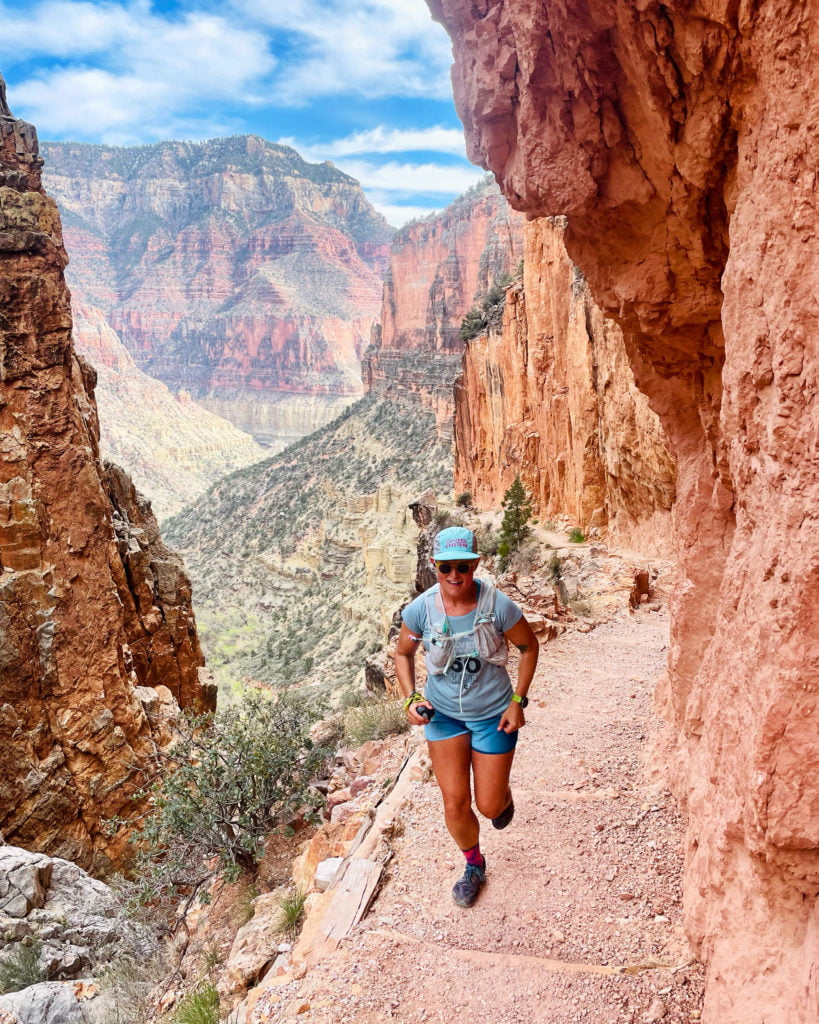
Grand Canyon: Rim to Rim to Rim with Coach Natalie Collar

Grand Canyon: Rim to Rim to Rim with Coach Natalie Collar

Runner: Coach Natalie Collar

Trip: Grand Canyon: Rim to Rim to Rim

Date: 04/04/2022

Time to complete: 16 hours

Location: Grand Canyon, Arizona

Strava Activity Link: https://www.strava.com/activities/6933486256

Gear – What did you bring?

  • Ultimate Direction Ultra Vesta
  • 1.5L hydration bladder
  • 500mL soft flask
  • Katadyn 1L water bottle filter
  • Altra Superior shoes
  • t-shirt
  • shorts
  • light windbreaker jacket
  • Coros Apex Pro Watch
  • Trail Sisters trucker hat

Fuel – What did you consume and/or not consume?

  • Spring Energy Awesomesauce (5)
  • Honey Stinger Waffles (2)
  • Honey Stinger Chews (3)
  • Jolly Ranchers
  • dried mango
  • peanut butter-filled pretzels
  • chocolates
  • Spring Energy Electroride (1L total)
  • drank almost 10L of water

Logistics – What kind of planning was involved for both prep and implementation?

At this time of year, the North Rim is still closed, so no parking or services are available there, which left two options for starting at the South Rim. You can either take the South Kaibab Trail or Bright Angel Trail down to connect it with the North Kaibab Trail. Since I didn’t have anyone to give me a ride in the morning or pick me afterwards, I opted for the Bright Angel Trailhead, because parking is right next to the trail, whereas South Kaibab Trailhead is a couple miles away from the parking. Distance-wise, South Kaibab is a little shorter than Bright Angel, but if you have to cover the extra distance on foot to the parking lot, it basically evens out.

I was staying in Flagstaff which was less than a two-hour drive from the trailhead, so I’d recommend staying here if you’re not staying in the Grand Canyon village.
There are water sources along the way at the various campgrounds along the route, but researching this information was difficult and unclear. When I did the route, the water sources were turned on at: Indian Gardens, Phantom Ranch, Manzanita, and this was just enough to stay hydrated throughout the day. My strategy was to fill up with as much water as possible when I came to a water source, especially as the temperatures warmed up.

Where to find the info on this

I found the route details on the Trail Run Project website and Strava. I recently found a Facebook Group for Rim to Rim to Rim info, including up-to-date water access info, and the name of the group is: Grand Canyon R2R2R Run! https://www.facebook.com/groups/grandcanyonr2r2rrun

What went “right” or at least how you expected it to go?

Route finding was pretty simple as I expected. There were more public restrooms than I expected, which is always nice for a long day on the trail, too. Nutrition and fueling went well, too. No upset stomachs, no dehydration, no falls or blisters (yay!), and STUNNING views along the way. The weather was also perfect, and even though it got up to 75-80 at the peak of the day, there were maybe 1-2 moments where I actually felt too hot. In fact, until 10 am, we weren’t even in direct sunlight, which was awesome (We started just before sunrise at 5:30am).

What went “wrong” or completely unexpected that you had to deal with?

My legs were actually pretty gassed after the initial descent of 6-7 miles, even though I was taking it easy, so dealing with the unexpected fatigue from so early on was a little challenging. I wouldn’t say I had the best day physically or mentally and almost nothing felt easy, but I definitely enjoyed being on the trail.

Lessons learned for either the next trip or another’s first trip?

  • I ran out of water once, just due to being stubborn and ready to be done at the end. I passed through Indian Gardens, which is just under 5 miles from the top of the South Rim, and I thought I had 500mL left, but only had a couple sips. Luckily, I was with a friend who had a bit more water left, so we shared. It was also dark and temps weren’t too high.
  • Another lesson for me was that 48 self-supported miles was just a tad too long for me. I’ve done several 20-30-mile self-supported runs, as well as many 50-mile+ races, so I wasn’t expecting this to be too different, but it definitely was! After 35 miles or so, I really just wanted warm food and an aid station, and would’ve paid so much money for a burger or ramen.
  • Finally, this is definitely a route I will only be running once, but there are so many other adventure routes in the Grand Canyon that I’d love to put together a shorter one and continue exploring this beauty.

Everything else!

  • This was a bucket list adventure run for me–48 miles, 11k of up and down–so I feel incredibly proud to have completed it! I had been to the North Rim once before, but only hiked down a mile or so, so almost the whole route was completely new to me. It was such a treat to see such gorgeous and unique views throughout the whole route. We had ideal weather and trail conditions, too, so I highly recommend this route at this time of year before it gets too hot. I did heat train for this run, by hitting the sauna and hot yoga a couple of times, but I was totally unaffected by the heat.
  • We saw quite a few other parties of runners along the route, either completing the full double crossing or some other variation. We also saw many hikers and one party of mules, so although it was a long self-supported adventure, it definitely wasn’t a remote alpine-esque route where there are only a handful of people on the trail.
  • I think I will remember the feeling of being so small compared to the canyon walls the most. You look up, and you can’t even see the top of the walls. While you’re up higher in the canyon, and you look down, you can’t even see the bottom. I don’t think there is a name better and more fitting than the Grand Canyon. It was unlike any feeling I’ve had while running in the Colorado mountains.
  • Finally, my recovery from this run has been pretty ideal. The initial day or two of soreness, fatigue, and stiffness where there, but after a day in the car and an epsom salt bath, most of the soreness has dissipated, and it feels like I will be back running soon!

Natalie is a coach with Team RunRun. To learn more about her or work with her, check out her coaching page.

Additional Trip Photos:

Crown King Scramble Race Report – Georgia Porter

Race: Crown King Scramble

Runner: Coach Georgia Porter

Race Date: 03/26/2022

Location: Crown King, Arizona

Results: 1st Female, 5th Overall

3 Bests – What aspects of the race did you like the most?

  1. I really enjoyed the beautiful desert running and the epic views of Lake Pleasant. The race starts down at Lake Pleasant and climbs about 6,500ft in 50k to reach Crown King. So there are plenty of spots to turn around and take in the views.
  2. I also liked the climbing! If your strength is uphill, this might be the race for you.
  3. The race finishes at a saloon in the very remote and VERY small town of Crown King, it’s a great celebration scene afterwards!

Not so much – Aspects of the race that didn’t do it for you

This race is on a rough 4×4 road and although this was the first year that Aravaipa had the road closed, there were plenty of ATVs that disregarded the road closure and kicked up a lot of dust.

Weird factor – What’s the weirdest thing about this race?

You get to see a lot of asses! Donkeys that is.

Highlights of your race – What did you do well and enjoy about your race in particular?

Because the race is on a 4×4 road there is plenty of room to run with people. I ran the first 22 miles with a good friend and it was so much fun.

Lessons for others – Share your pro-tips on the race to help the next runner

Although the course profile makes it appear that this race is all uphill, there is a lot of rolling terrain the first 20 miles or so. Definitely train for the uphill, but know that there will be some downhill sections as well.

Lessons you learned that will help you next time around

Because I thought the course was going to be ALL uphill, I was a little more conservative than I probably needed to be for the first 20-22 miles. Next time I’ll know I can push it a little more.

Most important course specific knowledge to know about the race

Mile 26-29 is the most sustained and steep uphill portion of the race. Be prepared to grind!

Aesthetics – Is it a pretty course?

This is a beautiful desert course with some great views.

Difficulty – Is it a tough course?

There is some solid climbing which can make this course tough. But the terrain is very runnable with only a few, short technical sections.

Organized and well run – Did it feel like a well-oiled machine or were they flying by the seat of their pants?

Aravaipa always does an amazing job at organizing races. The aid stations were full of amazing people who were so helpful and encouraging.

Competition – Is there a strong field?

There is usually a fairly competitive field.

Logistics – Does it require a special handshake, registration a year in advance, hotels all booked? Give us the low down on the nuts and bolts of making the race happen.

Standard signup/registration process. It is also possible to book camping at the start (Lake Pleasant).

Aid Stations – Standard fare or anything special to know about the aid stations in terms of what’s available or when?

Standard fare at the aid stations but extra amazing volunteers out there.

Weather and typical race conditions

It was warm and dry. Temps got up to the low 70s which is a little warmer than normal.

Gear – Did you need anything special or is there anything you’d recommend for the next runner?

I found a vest very useful. It was hot and there was a lot of exposure later in the race so having a lot of water really helped.

Spectators – Is this a friendly course for your friends?

This course is very remote making in not spectator friendly. Friends and family can watch the start then drive 1:30-2 hours (mostly on a dirt road) to the finish at Crown King.

How’s the Swag?

Long sleeve cotton shirt with a well designed logo.

The Overall Score – How many stars do you give this race and do you recommend that others run it?

All 5 stars for this one!

Georgia Porter is a coach with Team RunRun. To learn more about her or to work with Coach Georgia, check out her coaching page.

Grand Canyon Half Marathon Race Report – Shannon Porter

Race: Grand Canyon Half Marathon

Runner: Coach Shannon Porter

Race Date: 11/06/2021

Location: Grand Canyon Village

Results: First Place Woman

3 Bests – What aspects of the race did you like the most?

  1. Before you begin the race there is a pancake breakfast feed and it’s included in the cost of the race. Also two free beers afterwards.
  2. This race is on trail only, but surprisingly not that technical. They have ribbons and arrows marking the entire route.
  3. Run Tucson puts on an amazing event, great energy and prize money is offered to the top three individuals with a bonus for breaking the course record!

Not so much – Aspects of the race that didn’t do it for you

The start times can be a little confusing. There is a “trickle start” beginning at 7:30 am for those who plan on not competing for prize money, but the finish line wasn’t set up for those who finished before 9am, which I think is an improvement they could make.

Weird factor – What’s the weirdest thing about this race?

The race is a bit of a misnomer, you actually don’t see the Grand Canyon once during the race. But the good news here is you also don’t have to pay the fee to get into the national park. I would suggest visiting after the race if that is on your bucket list. Also I saw two tarantulas out on the course.

Highlights of your race – What did you do well and enjoy about your race in particular?

The trail through the high desert forest was absolutely beautiful, and with it being so well marked I didn’t have to worry about making a wrong turn so I was free to enjoy my surroundings. Also Randy Accetta, the race director, is as nice as it gets and will help you with any questions.

Lessons for others – Share your pro-tips on the race to help the next runner

Start slow, there is quite a bit of elevation so I ran this more like a hard long run effort instead of an all out race. Pacing will help you finish with more energy later on.

Most important course specific knowledge to know about the race

Know that it is a challenging course, don’t go out and expect a personal best on this one.

Aesthetics – Is it a pretty course?

It is a beautiful course. Mostly you run through the forest near the canyon where you experience the high dessert.

Difficulty – Is it a tough course?

Yes, this course is a difficult one. There is elevation gain as well as loose gravely area of trail on some parts. But that is expected with a trail half.

Organized and well run – Did it feel like a well-oiled machine or were they flying by the seat of their pants?

The Grand Canyon Half Marathon is very well organized. Run Tucson does a phenomenal job making sure things run smoothly.

Competition – Is there a strong field?

This race is still in its infancy so it is a smaller crowd of elite runners. But I have no doubt it will pick up in the next few years.

Logistics – Does it require a special handshake, registration a year in advance, hotels all booked? Give us the low down on the nuts and bolts of making the race happen.

This race as an easy in to get into, again Randy is a great director and Run Tucson sends out information well in advance on logistics for race weekend. There was ample information about hotels, parking, and what to do while visiting the area.

Aid Stations – Standard fare or anything special to know about the aid stations in terms of what’s available or when?

Every four miles there is a water station.

Weather and typical race conditions

This year was a typical weather scenario for the canyon, starts out colder but by the start of the elite race it warms up to tank top weather. Not a lot of wind either and the course is mostly shaded.

Gear – Did you need anything special or is there anything you’d recommend for the next runner?

I only raced with one gu packet. With the water aid stations I felt that it was enough for the thirteen miles and it felt right for me. If you are planning on being out on the course for additional time I would plan for more fuel during.

Spectators – Is this a friendly course for your friends?

Not super spectator friendly besides the start and the finish.

How’s the Swag?

Amazing swag. Long sleeve technical shirt, finishers medal that doubles as a coaster. Free pancake breakfast and two beers afterwards.

The Overall Score for The Grand Canyon Half Marathon – How many stars do you give this race and do you recommend that others run it?
Five stars. Overall this is a great race to compete at!

Shannon Porter is a coach with Team RunRun. To learn more about her or to work with Coach Shannon, check out her coaching page.

Aravaipa Insomniac Virtual – Adrenaline Series Race Report – Nathan McBride

Race: Aravaipa Insomniac Virtual – Adrenaline Series (6k, 10k, 15k, 25k, 50k)

Runner: Nathan McBride

Race Date: 5/17/2021

Location: Stow, MA (But it’s globally virtual)

Results: 25:45, 44:22, 1:06, 1:55:20, 4:46:26

3 Bests – What aspects of the race did you like the most?

1 – I get to do all of the races starting from my driveway
2 – I started the series with my weakest link, the 25k, and rocked it so got that out of the way early
3 – They are using Ultrasignup now for results submission which makes life much easier

Not so much – Aspects of the race that didn’t do it for you

Racing alone is always difficult but it helps that I’m basically running against myself from last year’s series – otherwise there is nothing to complain about since I get to pick all of my own courses!

Weird factor – What’s the weirdest thing about this race?

The pollen season just kicked off in New England…no escaping it so your best chance of running hard is very early in the morning when the world is still dewy.

Highlights of your race – What did you do well and enjoy about your race in particular?

Compared to the Adrenaline series last year, I pr’ed four out of five races and dropped my cumulative time by an hour and 6 minutes. Totally stoked about that.

Lessons for others – Share your pro-tips on the race to help the next runner

When your coach says rest, rest. I also did a lot of longer warm down runs this week which paid off.

Lessons you learned that will help you next time around

Don’t do a half marathon race on the Sunday before your race series week!

Most important course specific knowledge to know about the race

Well I kept the elevation moderate this week, about 1800 feet over the 68 miles, so that helped things but since I designed all of my courses there is not much else to say.

Aesthetics – Is it a pretty course?

Only my 50k was a scenic course, the rest were all road grinders.

Difficulty – Is it a tough course?

The hardest of the five races was the 25k course – I did about 1.3 mile start and then 7 2-mile loops for some mental time before finishing up.

Organized and well run – Did it feel like a well-oiled machine or were they flying by the seat of their pants?

Aravaipa does a great job with this series. The rest is up to the runner!

Competition – Is there a strong field?

It looks like this specific series has a pretty deep field so I won’t know how I did until all of the results are in.

Logistics – Does it require a special handshake, registration a year in advance, hotels all booked? Give us the low down on the nuts and bolts of making the race happen.

Nope! Just register online and you can do the remaining four series!

Aid Stations – Standard fare or anything special to know about the aid stations in terms of what’s available or when?

I just run with a credit card and either a beer or tailwind or both depending on the distance.

Weather and typical race conditions

Every day this week was hot and dry but because I run in the early am I also get a relatively decent air quality condition.

Gear – Did you need anything special or is there anything you’d recommend for the next runner?

I love my Naked Belt…can’t live without it.

Spectators – Is this a friendly course for your friends?

Oh yeah – if any of my friends cared enough to come watch. 🙂

How’s the Swag?

Aravaipa does a great job with the swag and they send you the shirts and hats as part of your race fee. Love the trucker hats!

The Overall Score – How many stars do you give this race and do you recommend that others run it?
Five out of five. If you have the desire and drive to run your butt off by yourself, this series is for you.

insomniac virtual sinister series race report

Aravaipa Insomniac Virtual – Sinister Series Race Report – Nate McBride

Race: Aravaipa Insomniac Virtual – Sinister Series (5k, 9k, 18k, 27k, 54k)

Runner: Nate McBride

Race Date: 04/19/2021

Location: Stow, MA (But it’s globally virtual)

Results: I did very well compared to last year (dropped 1hr4m overall)

Strava Activity Link: https://www.strava.com/athletes/7460077

insomniac virtual sinister series race report
Photo: Nathan McBride

3 Bests – What aspects of the race did you like the most?

If you live in Arizona, you may know that Aravaipa hosts the Insomniac Trail Series every year across the length of summer. Last year they also virtualized the entire thing. It’s 6 individual weeks of racing dispersed over 17 weeks. Each week has 5 or 6 races and you can either sign up for as few or as many of the races as you want and then you compete against people over the globe. If you sign up for the Dawnbreaker challenge, you have to do every single race for the week within the week (Monday-Sunday). So last year I signed up for the Dawnbreaker challenge for all 6 weeks so that meant I was competing not only at the individual race level, I was competing at the weekly aggregate level and the entire season aggregate level. This is what I love most about the race series. It’s a war of attrition and you may have to sacrifice a PR in a 10k so that you can run a harder 55k later in the same week. So I signed up again this year for Dawnbreaker for every series. April 19th was the first week of the series and it’s called “Sinister”. The selected distances were 5k, 9k, 18k, 27k and 54k and you could do them in any order. So I did it like this: 5k and 9k back to back on Monday morning, the 18k on Tuesday morning, the 27k on Thursday morning (day after my 2nd shot of Pfizer) and the 54k on Saturday morning. As much as I hate running at top speed, I liked the challenge of a back to back all-out 5k and 9k with only about 30 min rest and the weather was perfect this week for this series.

Not so much – Aspects of the race that didn’t do it for you

There is very little not to like about this series since you are entirely in control of your destiny. You get to pick the course and the order of races over the 7 days. So if you pick a really hard course and suffer a lot, that is all on you. Likewise, if you pick a simple out and back, you may not feel like you gave it your all. If there is anything unfun about this is, unless you have willing friends, you are doing all of the runs solo. It is hard sometimes to go all out when it is just yourself so it’s good to have a time goal in mind or some other motivational trick for yourself.

Weird factor – What’s the weirdest thing about this race?

For every week I will have one sucky race. I don’t really know which one it’s going to be but it seems that there is always one race that I just completely blow up. This week, unfortunately, it was the 54k.

Highlights of your race – What did you do well and enjoy about your race in particular?

Compared to last year’s Sinister week, I improved my times in 3 of the races and was slower in the other 2. Overall, I PR’ed the aggregate by 64 minutes (9:53:08) so that will be a huge payoff in the end of the entire season. Good to have that in the bank!
5k – 21:51
9k – 38:55
18k – 1:25:21
27k – 2:00:05
54k – 5:26:56

Lessons for others – Share your pro-tips on the race to help the next runner

If you are looking for a seasonal training motivator, you can’t beat this entire race series. I am actively training for other longer ultras at the end of summer and this series fits in well with my training plan and keeps me motivated. If I was just grinding it out all summer I would not nearly be having as good of a time. Strategically speaking, the entire series will be 454 miles of racing so every mile counts. You have to be able to run hard in your strengths and hold on for dear life in your weaknesses (mine are anything between 20 and 35k).

Lessons you learned that will help you next time around

Don’t kill yourself on the first race of the week. 🙂

Most important course specific knowledge to know about the race

Well since it’s a design your own course model, the best thing to know is the runnable places around you. I design my courses to be a hybrid of trails and road and that are rolling enough to use all of my muscles.

Aesthetics – Is it a pretty course?

Mine are. 🙂

Difficulty – Is it a tough course?

Some of mine are 🙂

Organized and well run – Did it feel like a well-oiled machine or were they flying by the seat of their pants?

They are very organized and the swag is awesome for the entire series – you definitely get your money’s worth. I like the fact that there is a huge Aravaipa community on Discord and Strava and everyone is always talking smack to each other during the series (in a fun way).

Competition – Is there a strong field?

There are lots of pros that do this as well as lots of rookies and everything in between. It’s awesome to hear some of the great first timer success stories that come out of this series.

Logistics – Does it require a special handshake, registration a year in advance, hotels all booked? Give us the low down on the nuts and bolts of making the race happen.

No registration cap and its all online so its super easy.

Aid Stations – Standard fare or anything special to know about the aid stations in terms of what’s available or when?

So I run self supported on all of my runs (or with a credit card). For the 5k, 9k and 18k I didn’t carry anything, just chugged some Tailwind and then headed out the door for warmup and then the race. For the 27k I ate a pack of sports beans about midway through the race. For the 54k I carried two Narragansett beers and a bottle of tailwind plus 4 Oreos and some Swedish Fish. I had the first Narragansett at the 28k along with the Oreos, had the second Narragansett at the 43k with the Swedish Fish and then sipped on the tailwind for the last 10k.

Weather and typical race conditions

April in New England so…since of all of my races were early morning, I generally had temps starting in the low 40’s. Clear week though in terms of rain and snow.

Gear – Did you need anything special or is there anything you’d recommend for the next runner?

I live and die by my Naked Belt and I wear an Orange Mud Double Barrel to hold my beer/tailwind. I wear Bose Sports Buds for the longer runs and my go to shoes are Hoka Cliftons (since the Clifton 3 came out). I also have been a Feetures sock wearer since about 2010.

Spectators – Is this a friendly course for your friends?

All depends on which course you pick and how much your friends care to watch you suffer.

How’s the Swag?

Awesome…they hook you up with medals, bibs, shirts, hats, socks…you name it.

The Overall Score – How many stars do you give this race and do you recommend that others run it?

One hundred out of one hundred. Even if you don’t want to run all of the races, you can run ANY of the races and it’s a good time to do something that is part of a large community.

insomniac virtual sinister series race report

mesquite canyon 50k race report

Mesquite Canyon 50k Race Report – Tyler Sprague

Race: 2021 Mesquite Canyon 50k

Runner: Tyler Sprague

Race Date: 03/06/2021

Location: White Tank Mountain Regional Park, Maricopa County, AZ (metro PHX)

Results: 1st OA, 50k

Strava Activity Link: https://www.strava.com/activities/4902061779/overview

mesquite canyon 50k race report
Photo: @trailwhisperer

3 Bests – What aspects of the race did you like the most?

1. Course – Beautiful, unique, challenging, and far-removed enough from the city center to feel like it was its own thing.
2. People – I met some great folks and made a few new friends.
3. Operation – Well-managed race, good post-race vibe and scene despite lacking the usual beer garden.

Not so much – Aspects of the race that didn’t do it for you

The only sticky spot I had was with one of the aid stations, and to be fair, it was the one where all the water and supplies needed to be hiked up a 1.8 mile trail by volunteers! So while I’m grateful it was there, they were oddly short on gels, the most basic and fundamental fuel for many ultra runners, especially those in front trying to run fast and light on the supplies. I had to grab a bag of pretzels at one point because the other options weren’t vegan. This is easy to avoid, especially in 2021 with all the snack options out there, so hopefully that improves. Unfortunately due to restrictions, the typical fare like bowls of chips, candy, pickles, etc. wasn’t available.

Weird factor – What’s the weirdest thing about this race?

Definitely the Ford Canyon section. Both the 50k and 50M courses go through this section where you drop into a canyon after a descent, and then spend a couple miles running in a wash (basically a sandy dry riverbed). The course is roughly marked and you just have to find your own most efficient way through. The whole section is a gentle descent, until the end, when you start running over the smooth, white rock formations that are the namesake of the park, when it becomes more dramatic. Towards the end, you exit to the right of the canyon back onto a rocky, technical trail hugging the south wall of the canyon before dropping down onto essentially flat ground and running about two miles quickly, if you can.Another thing is that with so many people on the trail and all the meeting and passing going on, you have to make room and give people a heads-up. It felt like I said “on your left,” “coming up behind,” “thanks,” and “good job” a million times during the race, and it must’ve accounted for at least part of my shortness of breath on the Goat Camp climb. But better than being alone on the trail trying to run an FKT or something!

Highlights of your race – What did you do well and enjoy about your race in particular?

The best part was crossing the finish line – I’ve worked hard for a long time and it was nice to finally win an ultra. I also enjoyed the beginning, with cool temps, good conversation and company. There was tons of passing people, both from behind and head-on, so you’re never alone for too long, which can be nice.

Lessons for others – Share your pro-tips on the race to help the next runner

Be prepared for those longer stretches between aid stations – I underestimated that and paid the price (just barely, fortunately). There is loose rock/shale at the top of Goat camp trail. Ford Canyon involves lots of sand and some rock-hopping. Save energy for it! Also take it easier in general until most of the climbing is done around mile 18.5.

Lessons you learned that will help you next time around

Have a little more water capacity, start the race with some gels in my pockets, and be prepared for lots of trail traffic and longer stretches between a couple of the aid stations.

Most important course specific knowledge to know about the race

Study the map and your route, many different distances are running at once and though the signage is really good, it helps to know where you are spatially as that can help you estimate and visualize where you are and how far until the next AS, when the climb will be over, etc.

Aesthetics – Is it a pretty course?

Yes, lots of saguaros and not a bad sunrise either, although you’re mostly running away from it, there are plenty of turns and chances to look around. Ford Wash has it’s own beauty, and though I didn’t see any, there are typically supposed to be lots of wildflowers this time of year.

Difficulty – Is it a tough course?

It’s quite technical and rocky in parts, and there’s a good amount of vertical gain. The sand in Ford Canyon is tough, especially late in the race. It’s pretty exposed to the sun, so keep that in mind, especially if running the 50 mile.

Organized and well run – Did it feel like a well-oiled machine or were they flying by the seat of their pants?

A+. Really well done. Plenty of porta-potties at the start, plenty of parking, PA start/finish line announcements. Might have liked more food, but that should be returning to normal soon.

Competition – Is there a strong field?

The winning time looks to have been historically pretty swift, although I don’t think there’s too much competition or a particularly deep field. This year was a bit thicker up front; frequent local winner took 3rd in the 50k behind myself and another young guy. That said, most runners will have plenty of people around them to race. The 30k seemed to be pretty competitive this year. The 50 mile has only been running for a couple years so keep an eye on that one! The 50k is the classic premier distance for this race, and being one of the very first Aravaipa events it has lots of history and sentimental value to the directors.

Logistics – Does it require a special handshake, registration a year in advance, hotels all booked? Give us the low down on the nuts and bolts of making the race happen.

I signed up two weeks prior, I believe. There is a time-based price scale, but you should have no trouble if you keep an eye on this and place it on your calendar for next year.

Aid Stations – Standard fare or anything special to know about the aid stations in terms of what’s available or when?

See above – but most of the aid stations were great. Well-staffed, good selection, and efficient. Although, for what it’s worth, I’m usually pretty out-of-it mentally from running hard, and rarely spend more than 30 seconds at one, at least in a 50k, so take that with a grain of salt.

Weather and typical race conditions

It’s late in the winter, and in Phoenix, so it can get warm. I’m not a Valley local, but I think the weather we saw was typical. It got up into the low 70s by the time I finished before 11, and the high for that day was low 80s. Clear skies though, and a couple clouds during the morning which helped shield the sun.

Gear – Did you need anything special or is there anything you’d recommend for the next runner?

Plan on carrying a little extra water – there are two stretches between aid stations of close to 9 miles. I carried one 500mL soft flask in my Naked Band, and it wasn’t quite enough at times. Many people I saw had two hand bottles, and probably did fine, and many also carried packs. I would probably pack up for the 50M; I like to drink a lot. Otherwise just lube up and wear a regular trail shoe, nothing extra or fancy required in my opinion.

Spectators – Is this a friendly course for your friends?

It’s no walk in the park, but the trails are open to the public and there were lots of hikers and photographers out there, so a motivated person would have no trouble seeing you a few times. Just make sure to read the rules and don’t give aid in the wrong places or where it’s expressly prohibited.

How’s the Swag?

Great! I got a sweet full-color beer glass, and also a laser-engraved bighorn sheep (or antelope?) wooden trophy for first place.

The Overall Score – How many stars do you give this race and do you recommend that others run it?

5 stars! You couldn’t ask for much more, especially given the circumstances. Hats off to Aravaipa for putting on great events when they are so scarce most other places lately.

Tyler Sprague is a coach with Team RunRun. To learn more about him or to work with Coach Tyler, check out his coaching page.

coldwater rumble aravaipa

Coldwater Rumble 52 Mile Race Report – Steven Ovah

Race: Coldwater Rumble 52 miler

Runner: Coach Steven Ovah

Race Date: 01/16/2021

Location: Goodyear, Arizona

Results: 3rd Place Overall

Strava Activity Link: https://www.strava.com/activities/4632404162

coldwater rumble aravaipa
Photo: Aravaipa Running

3 Bests – What aspects of the race did you like the most?

I enjoyed the looped course, two 20 mile loops and one 12 mile loop for the 52 mile. I enjoyed encouraging other runners, getting encouragement from others and seeing everyone out there pushing themselves. I also enjoyed the competitive aspect of all of the aravaipa running events. People come to these races for a hard run with some friendly competition. I also did enjoy this race having so many race distances to choose from and everyone being out on the course together. These are the race distances: 4 miles, 20k, 20 mi, 52k, 52 mile, 100 mi. There were some fast runners out there from the shorter distances that pulled me along at times and got me through some rough patches.

Weird factor – What’s the weirdest thing about this race?

The weirdest thing about this race for me was how quickly it went by for me. I didn’t know the miles between aid stations and that helped me not focus too much about how many miles I was running. I didn’t know that I had past 50k or that the first 20 mile loops was over that quick. First time running this event and I didn’t study the mileage points “not something I advise as a coach”. But ignorance about mileage and course helped me this time.

Highlights of your race – What did you do well and enjoy about your race in particular?

The highlight of the race was coming through each lap and having my parents there to greet me every time. I understood that rough patches come but, they usually pass if I can just maintain a good attitude and I believe I did a good job of staying positive through the rough times. Keeping my emotions in check when I felt like I was slowing down.

Lessons for others – Share your pro-tips on the race to help the next runner

Helping the next runner by encouragement and positive words helps take the focus off of me and my misery during the rough times. Keep a good attitude and finding joy even through the suffering and pain is when big breakthroughs in my races seems to happen. I eventually get out of the funk I’m in and I find myself feeling strong and confident again. Help encourage others and be nice to your crew.

Lessons you learned that will help you next time around

Do not take too long during the aid stations. I find that I only need a brief stop to refill my bottles, grab a quick bit and fuel up before I am ready to roll again. When I sit down for a few minutes I get tight really quick and I become more and more reluctant to get up out of the chair. I cool down really quick.

Most important course specific knowledge to know about the race

The few miles have the steepest climbing. Not too crazy of a climb but the most on the course. The rest of the course is rolling with rocks all over the trail, Two twenty mile loops and one twelve mile loop. The heat kicks in around midday, keep electrolytes and hydration levels topped off.

Aesthetics – Is it a pretty course?

It’s a very scenic course. Cacti, mountains, washes, and the course is away from the big city and feels remote. Nice sunset right as you’re climbing is done and the sun is coming up.

Difficulty – Is it a tough course?

It’s not the hardest course I’ve ever run but it is a bit technical at some areas and does have some small climbs and gradual climbs. The rocks on the trail are always the challenge for me. Some of the trail is smooth and really runable. I’d give it about a 6.5 out of 10 on the course difficulty scale.

Organized and well run – Did it feel like a well-oiled machine or were they flying by the seat of their pants?

Aravaipa events are always well organized and have a good atmosphere. Aid stations are always set up and stocked by the time you get there and there are various types of goodies there.

Competition – Is there a strong field?

Competition is always there at the aravaipa events. All races have a good amount of runners who come to run hard and drop the hammer.

Logistics – Does it require a special handshake, registration a year in advance, hotels all booked? Give us the low down on the nuts and bolts of making the race happen.

Coldwater Rumble is held at Estrella Mountain Regional Park in Goodyear, Arizona. The 52 mile was not hard to get into and I registered somewhat close to race day. Camping was available at race site but I always prefer to book a room. There are plenty of good hotels in the surrounding areas of Avondale, Tolleson and even Phoenix. Race site is about a 30 minute drive from Pheonix area.

Aid Stations – Standard fare or anything special to know about the aid stations in terms of what’s available or when?

GU gels were available upon request. Had pancakes, pb &j’s, bean burritos, snacks, and salt caps were all available at each aid station.
Weather and typical race conditions

Perfect cool weather in the morning and hot mid-day. The 52 mile started at 6:45 and was cool but not cold. The heat hits hardest around 1-4pm.

Gear – Did you need anything special or is there anything you’d recommend for the next runner?

Headlamp is a must if you’re running the 52 or 100 miler. Those distances start first and sunrise is not until 7:30am. I am glad that I always pack a headlamp with my race gear.

Spectators – Is this a friendly course for your friends?

If you know the area, there are a few spots toward the beginning where family members can park and go see you run. My Dad was able to drive to a nearby rodeo arena and watch me during the first 2-3 miles from headquarters.

How’s the Swag?

  • Awards to the top 3 male & female finishers at each distance.
  • All finishers will receive a finisher pint glass.
  • Points earned in the Desert Runner Trail Series.
  • 52 Milers will receive a unique award from Aravaipa Artworx.
  • Buckles to 100 mile finishers!

Steven Ovah is a coach with Team RunRun. To learn more about him or to work with Coach Steven, check out his coaching page.

mesquite canyon race report

Mesquite Canyon 50K Race Report – Andrew O’Connor

mesquite canyon race report

Race: Mesquite Canyon 50K

Runner: Andrew O’Connor

Race Date: 03/06/2020

Location: White Tank Mountain Regional Park — Waddell, AZ

Results: 5th overall – 5:34

Strava Activity Link: https://www.strava.com/activities/3163884763

3 Bests – What aspects of the race did you like the most?

  1. The scenery and terrain is simply amazing. The desert has always fascinated me, and as a runner from Seattle it was a real treat to run through 30+ miles of desert mountains. Huge open views, massive saguaro cactus, and rugged trails make this a special race.
  2. The organization and race direction was spot on. Aravaipa Running puts on races all over Arizona, and I have always wanted to run one of their races. Race director Jamil Curry is very involved in the trail running community and I know his races are loved by many. From pre-race emails, course marking, to the post race party, everything was 1st class.
  3. The climbs. There are 2 big climbs in the race, both are 1,800 ft and they fall before the 20 mile mark. The first is longer, but more runnable while the 2nd climb is steeper and more technical. While the climbs were tough, they weren’t obnoxiously so, and they made for an awesome but manageable challenge.

Not so much – Aspects of the race that didn’t do it for you

The event has several other races held at the same time, utilizing some of the same trails so there are sections of the course that you end up passing by quite a few other runners. While it never felt too congested, there are sections of the race where you are navigating narrow single track with lots of runners headed the opposite direction.

Weird factor – What’s the weirdest thing about this race?

Weird, but cool! There is a 2 mile section of the course where you run through a dry creek wash out. It is about 200 ft wide and you make your own choice as to the direct route you want to take. There is flagging so you won’t get lost (and you have big walls on either side of you so you can’t really go out of the wash on accident), but there is no established trail. You end up jumping or sliding down HUGE boulders, running through lots of brush and loose gravel as you make your way down the dry creek.

Highlights of your race – What did you do well and enjoy about your race in particular?

I was very happy with my climbing. I felt relaxed and strong and was able to settle into a nice rhythm on both of the climbs. The first climb was runnable the whole way, while the second definitely had a lot of power hiking. I was also really happy with my mental strength. I had a rough spot between miles 20-28, but managed to stay calm and focused on the task at hand. I had really, really wanted to be top 3 in this race, and as I hit my rough spot I knew that wasn’t going to happen. I decided to focus on the beauty that surrounded me, and to just keep moving the best I could, reminding myself that ultimately the place I got didn’t matter. What really mattered was the whole training process leading up to the race, and having the ability to still move 30 miles through the mountains, regardless of pace.

Lessons for others – Share your pro-tips on the race to help the next runner

Hot, exposed, and technical. The race is held at the beginning of March, but it is just outside of Phoenix so it can still get hot! The high the day of the race this year was 79, which is no joke having been in the Pacific Northwest all winter. Linked to the heat is the fact that it is exposed! There were sections in the first half of the race where the sun was still low enough in the sky that you could hit some sections of shadows, and after the first 90 min or so, I don’t think there were any sections of shade.

There are sections of this course that are very technical. Lots and lots of loose rocks ranging from pebble size up to softball size make up the trail. Most of this is encountered in the middle section of the race, between mile 11 and 26.

Lessons you learned that will help you next time around

I really have to continually practice my downhill technical running. We have a 1 year old daughter, so getting to the technical trails outside of the city has been tougher over the last year. My fitness felt excellent going into the race, but I could tell that I just didn’t feel as confident and fluid on steep rocky descents. This is a skill that needs routine practice and polishing. I felt rusty in my downhill skills.

Most important course specific knowledge to know about the race

Be ready for miles 10 – 19. This is where you drop 1,800 ft down to the valley floor to an aid station, then turn around and head right back up this climb. I think this is the toughest section of the race, in terms of technicality of the trail and steepness of the descents/climbs. This is also the busiest section in terms of the amount of runners on trail running the other distances.

Aesthetics – Is it a pretty course?

OMG… yes!!! It is truly spectacular! You get to pass through different desert ecosystems, drop into deep canyons, run ridge tops. It is gorgeous.

Difficulty – Is it a tough course?

Tough, but doable. Like I touched on before, the climbs are tough, but not over the top. It’s hot, but not unbearable. Technical, but very runnable on a lot of the course.

Organized and well run – Did it feel like a well-oiled machine or were they flying by the seat of their pants?

Extremely well run. Aravaipa Running puts on top notch events, and this one was no different. There was plenty of parking, race morning packet pickup went smoothly, course was marked very well. The whole event flawless.

Competition – Is there a strong field?

There were runners from 17 states and Canada. It draws people from all over the country, but it is not a super competitive race.

Logistics – Does it require a special handshake, registration a year in advance, hotels all booked? Give us the low down on the nuts and bolts of making the race happen.

Registration was easy and on Ultrasignup. I don’t believe it sold out this year. The race is about 45-60 min from the Phoenix airport, so travel was easy. Securing accommodations was a little bit pricier and tougher to find than I had expected because both spring training for professional baseball and a Nascar race were both happening the same weekend. We ended up getting an Airbnb about 25 min from the start. I started looking for a place to stay about 8 weeks before the race, and options were pretty limited by that point.

Aid Stations – Standard fare or anything special to know about the aid stations in terms of what’s available or when?

You have 5 aid stations over the 50K. However, there are two stretches of the race that are about 8-9 miles between stations, so you do need to carry a good amount of water. The aid stations all had the typical ultra food choices. Chips, potatoes, fruit, soda, Gu’s, M&Ms were available at all the aid stations.

Weather and typical race conditions

The average high for that day in Phoenix is 78 and a low of 54. Clear blue sky, dry trails, and lots of sun!

Gear – Did you need anything special or is there anything you’d recommend for the next runner?

I think it is beneficial to really nail down what you are going to use for hydration. With the two sections that are a little longer between aid stations, water is crucial. I used two 17-ounce soft flasks in my vest, and one hand held 20-ounce bottle for these sections. I never ran out of water, but it felt great knowing that I had enough.

Spectators – Is this a friendly course for your friends?

I believe that there is one option for your crew to see you at 14.5 miles, I think you can drive to that aid station. But other than that, the course is rather rugged and remote without a chance for friends or family to see you.

How’s the Swag?

They have really nicely made race shirt.

The Overall Score – How many stars do you give this race and do you recommend that others run it?
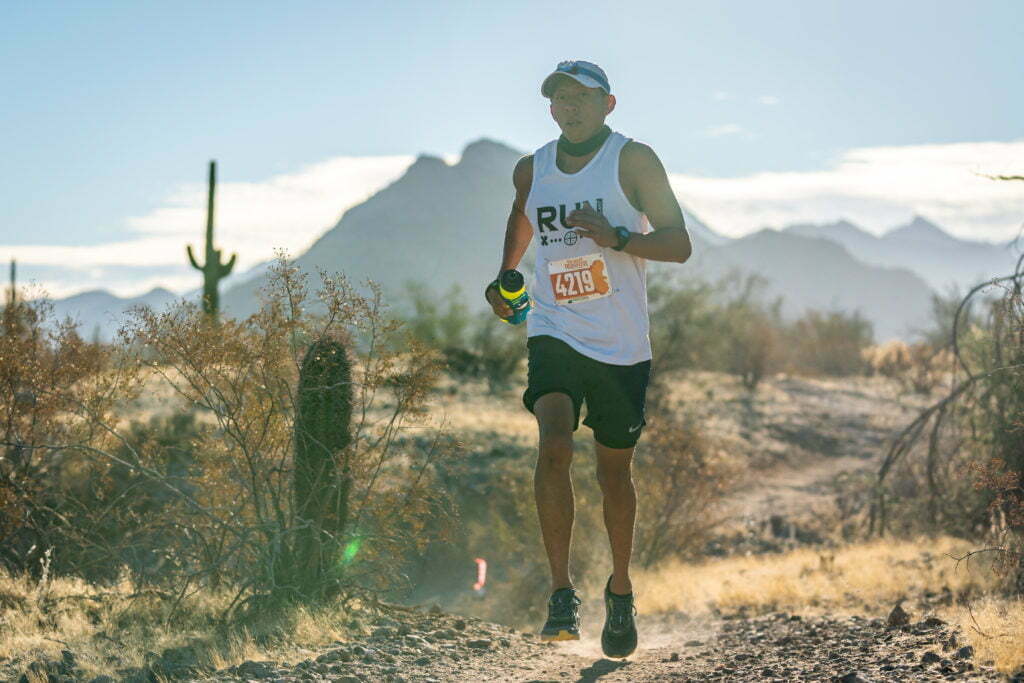
5 out of 5 stars. I would absolutely recommend this race for someone if they are interested or excited about desert mountain running.

Andrew O’Connor is a coach with Team RunRun. To learn more about him or to work with Coach Andrew, check out his coaching page.

mesquite canyon race report

Black Canyon 100k Race Report – Chase P

Race: Black Canyon 100k

Runner: Chase P

Race Date: 02/15/2020

Location: Black Canyon Trail, Arizona

Results: DNF – 46mi, 11 hours

Strava Activity Link: https://www.strava.com/activities/3103483880/overview

3 Bests – What aspects of the race did you like the most?

THE ORGANIZATION: Aravaipa has a reputation for being world-class…they are more than that. This was the most well-oiled event, from the expo to the DNF, that I’ve ever experienced. I couldn’t imagine being responsible for 1,000 runners in the desert, but they had it down. The crowded aid stations didn’t seem crowded. The volunteers knew what was up. The medics knew what was up. Everyone kept it moving and kept the runners happy and on their way.

THE PEOPLE: This wasn’t the “Arizona vs. the World” race that I thought it would be. I met a plethora of runners from all over the nation, which helped me feel better about being a tourist. All of us out-of-towners were in the hot desert hell together!

THE VIEWS: The views….and the views…and the views. The semi-green desert expanded for miiiiiiiiiles – what a beautiful sight.

Not so much – Aspects of the race that didn’t do it for you

ROCKS: sniper rocks, they come out of nowhere with the sole purpose of wrecking your life. I rolled my ankle on one at mile 5 and pushed through the pain another 40+ miles until the DNF. Ugh.

HARD PACK: The desert doesn’t afford the same forgiveness as the PNW cush. Every step was brutal on the entire body and the feet. Not sure how to prepare for this other than smashing more pavement, which I did quite a bit of leading up to the race. It’s just tough and different!

HEAT/EXPOSURE: I would estimate there was approximately 2% shade on the course until the sun went down. Full exposure, even without crazy hot temps, sucks. The temp got up to about 70-75*, and even hotter down in the canyons. That was plenty to suck the life out of this Seattle boy!

Highlights of your race – What did you do well and enjoy about your race in particular?

I kept my major muscle groups in check. I didn’t pound the downs (thank you, rolled ankle!) and kept myself in check the entire day. The heat ended up getting to me and I couldn’t eat or drink anything. Nausea and heat sickness set in and that was all she wrote.

Lessons you learned that will help you next time around

Prepare for the heat and exposure better. It will be a HUGE factor if the weather is right.

Most important course specific knowledge to know about the race

Miles 31-46 are nothing like the first 31. Be ready!

Aesthetics – Is it a pretty course?

Extreme beauty.

Difficulty – Is it a tough course?

Extremely different type of challenge than the PNW.

Organized and well run – Did it feel like a well-oiled machine or were they flying by the seat of their pants?

Extremely well run and organized. 100/10.

Competition – Is there a strong field?

VERY! So many crushers out there! The middle/back of the pack did NOT feel like the middle/back of the pack. This is a world-class event with world-class crushers. Not too many people out there biting off more than they know they can chew.

Logistics – Does it require a special handshake, registration a year in advance, hotels all booked? Give us the low down on the nuts and bolts of making the race happen.

A little pricey, but a great experience!

Gear – Did you need anything special or is there anything you’d recommend for the next runner?

Sunscreen and SNB! Then do it all again!

Spectators – Is this a friendly course for your friends?

Pretty accessible, all things considered!

How’s the Swag?

Got a drop bag and a 1/4 zip – pretty swaggy!

The Overall Score – How many stars do you give this race and do you recommend that others run it?

10/10 – highly recommended for an A-race. BE PREPARED!

Black Canyon 60k Race Report – Deserae Clarke

Race: Black Canyon 60k

Runner: Deserae Clarke

Race Date: 02/15/2020

Location: Mayer, AZ

Results: 6:19, 8th female, 16th OA

black canyon 60k race report

3 Bests – What aspects of the race did you like the most?

This is one of the most beautiful courses out there, and the addition of a 60k to the established 100k makes it accessible to even more runners.

The 100k is a golden ticket race so you get to see some really fast people.

Aravaipa does a great job with the experience around the event, from the expo the day before through the aid station at an actual ranch to the finish line.

Not so much – Aspects of the race that didn’t do it for you

Honestly can’t think of any.

Weird factor – What’s the weirdest thing about this race?

The races are point to point and have 2 different finishes. They’ve put a lot of thought into it and this is the best setup logistically, but it can be a little weird as the 60k finish is also a 100k aid station. You also have to drive down then to see the 100k finish. They honestly do a pretty good job balancing all of this.

Highlights of your race – What did you do well and enjoy about your race in particular?

This was my first ultra since July, and while I had some places where I struggled I think it was a solid B effort, which I was happy with given where I am in my training. I also managed to rally and finish strong on the uphills near the end.

Lessons for others – Share your pro-tips on the race to help the next runner

This course is net downhill, however a lot of the drop is near the start and a lot of the uphill is near the middle to end. Every year people go out too fast, trash their quads on the downhill and struggle at the end. Running a smart, controlled race at the beginning will definitely help.

Lessons you learned that will help you next time around

I need to remember that I can push more during the low points because they will eventually come around.

Aesthetics – Is it a pretty course?

GORGEOUS!

Organized and well run – Did it feel like a well-oiled machine or were they flying by the seat of their pants?

As with just about every Aravaipa event this is a well-oiled machine. In fact, they are so experienced that even when things go wrong the runners rarely know.

Competition – Is there a strong field?

Yes, since the 100k is a Golden Ticket race, even the 60k draws a strong field.

Logistics – Does it require a special handshake, registration a year in advance, hotels all booked? Give us the low down on the nuts and bolts of making the race happen.

The 60k stays open longer than the 100k. There’s camping at various pints of the course and shuttles to the start, I honestly think they make it as easy as possible for the runners.

Aid Stations – Standard fare or anything special to know about the aid stations in terms of what’s available or when?

In addition to the standard fare Aravaipa does an excellent job of catering to a variety of special dietary. They also do a good job of having at least one experienced person at each aid station to help runners problem solve or handle emergencies.

Weather and typical race conditions

That’s a loaded question for this race. Weather in Arizona is February is not always predictable. This year was gorgeous. 2018 was hot. 2017 and 2019 rained so hard the course was unsafe and a large section was converted to an out and back on road and jeep road. The good news is, they have permits in place going forward that allow for an alternate rain course that still stay on trail but doesn’t require river crossings.

Spectators – Is this a friendly course for your friends?

For the 60k crew can access Bumble Bee Ranch and the finish. Both have plenty of parking and are easy to access. There is also a great atmosphere nth place. As an added bonus, you can buy Freak Brothers pizza made in their portable wood fired oven at the finish.

How’s the Swag?

Everyone got long-sleeved 3/4 zip tech shirts, a dry bag , a sticker and a poster. Additional race gear is available for purchase. The finishers awards for the 60k were wooden medals hand made by Aravaipa Artworks.

The Overall Score – How many stars do you give this race and do you recommend that others run it?

If we’re talking 5 stars, it gets a 5. I cannot recommend it enough.

Deserae Clarke is a coach with Team RunRun. To learn more about her or to work with Coach Deserae, check out her coaching page.

Running with the Bulls 5K Race Report – Julia G

Race: Running with the Bulls 5K

Runner: Julia G

Race Date: 1/11/2020

Location: Mesa, AZ

Results: 31:08

3 Bests – What aspects of the race did you like the most?

Cool weather, loved the high schoolers! Cute kids. And The High school Drummers!!!

Not so much – Aspects of the race that didn’t do it for you

Not a great route. That last bit along the canal was long and boring

Weird factor – What’s the weirdest thing about this race?

Did not like the Valley girl women talking loudly….but it motivated to run faster.

Highlights of your race – What did you do well and enjoy about your race in particular?

I didn’t feel like I did well …but I made good time

Lessons for others – Share your pro-tips on the race to help the next runner

It’s fun to do high school related runs…Kids that age are a blast

Lessons you learned that will help you next time around

“potty first…both kinds”

How’s the Swag?

Great stuff

The Overall Score – How many stars do you give this race and do you recommend that others run it?

3.4*

Jackass Night Trail 31k – Stacey N

Race: Jackass Night Trail 31k Wave 2

Runner: Stacey N

Race Date: 10/26/2019

Location: Fountain Hills, AZ

Results: 3:52:33, 13th place

3 Bests – What aspects of the race did you like the most?

1. Location: It is a beautiful area and travel logistics are simple for a destination race. Fountain Hills and Scottsdale are both great places to stay and are close to the race start. The weather is warm and sunny, great way to get some Vit. D before gray season starts here in the PNW! This race starts at sunset, so get ready to stargaze a bit and listen for those coyotes! Even in the dark it is beautiful and the desert energy is still riding high!
2. Fun to do just one loop! The 31k is a great way to get a taste of the vibe of the race if you are curious about signing up for the 100k or 100m. Many folks that signed up were crewing and just wanted to get their legs moving.
3. It is a well oiled machine. The Aravaipa folks just put on good events. They are well organized and fun.

Highlights of your race – What did you do well and enjoy about your race in particular?

– It was fun to be out and cheer on all the folks doing the longer distances.
– I loved looking at the stars and hearing the coyotes!

Lessons for others – Share your pro-tips on the race to help the next runner

– Finding parking can take some time and you may have to walk quite a bit to the start/finish/check-in area. Give yourself extra time to land a spot and take all your stuff that you will need for before, during, after while checking in. We were allowed to put a bag in the drop bag area.
– Remember you are starting while 100k and 100m folks have been out for a long time already and may be on the struggle bus. It is a washing machine style looped race, so you will be having runners running both ways on the trail. Be kind while passing and give these folks the right of way. Don’t be “that person”. This distance was added as a “fun run” and is supposed to bring fresh energy to those going for the long haul.

Most important course specific knowledge to know about the race

Cacti are pokey, snakes are sneaky, and tarantulas are out and about. Be careful while passing or taking a pit stop at night!

Aesthetics – Is it a pretty course?

Beautiful!

Difficulty – Is it a tough course?

Very runnable! Parts of the course are quite dusty, especially with so many folks out there. It can make visibility a lil tough at night.

Organized and well run – Did it feel like a well-oiled machine or were they flying by the seat of their pants?

Well oiled machine!

Competition – Is there a strong field?

The 31k is more of a fun run. There was not so much competition in the second wave. There were some speedier folks in the first wave.

Logistics – Does it require a special handshake, registration a year in advance, hotels all booked? Give us the low down on the nuts and bolts of making the race happen.

It was super easy logistically! I signed up last minute on the Sunday before the race as there were a few spots left and I was wanting a training run with some sun and desert love. I was able to book affordable airfare from Sea-Tac to Phoenix, get a rental car, and hotel 15-20 min from the start in Scottsdale.

Aid Stations – Standard fare or anything special to know about the aid stations in terms of what’s available or when?

Standard aid station set-up!

Weather and typical race conditions

Weather is usually warm to hot during the day and it can cool off quickly at night after the sun sets. Usually dry.

Gear – Did you need anything special or is there anything you’d recommend for the next guy?

Maybe don’t bring your brightest sunshine headlamp given it is washing machine style, you do not want to blind the 100k/100m folks.

Spectators – Is this a friendly course for your friends?

Spectators can hang out at the start/finish only. It is a fun and dynamic place to people watch and hang out.

How’s the Swag?

Festive and fun, lots of glow in the dark stuff to wear while running.

The Overall Score – How many stars do you give this race and do you recommend that others run it?

10! A one loop fun run in the desert at night fall was a blast and a great way to get some training miles in!

javelina jundred 100 race report

Barbara R’s Review – Javelina Jundred Race Report (2019)

In this Javelina Jundred runner review, Barbara R. shares her experience of the 2019 100 mile race. Read on for what she loved, what challenged her, and what she recommends for you!

“This was my best executed race I’ve ever run! I went out super slow on lap 1 and did not get caught up in runners passing me or letting my adrenaline take me away. I stayed super chill and I think that helped every lap after that. I’m also pretty sure I may have negative splitted by running the last lap the fastest! I ran almost the entire course – I only hiked a very tiny amount. The looped style is so much easier mentally. I could really just focus on my running and nutrition and not have to think about big climbs or water crossings or super technical parts. I’m just really proud of this entire race.”

What is a runner review of a race?

At Team RunRun, we know that working towards a race is a great motivation for running. However, not all running events are created equal. Our athletes report back on their experiences so that you can figure out which race is right for you. Read on for an honest runner review of the Javelina Jundred!

Barbara R’s Full Runner Review of the Javelina Jundred (2019)

Race: Javelina Jundred 100 Mile

Runner: Barbara R

Race Date: 10/26/2019

Location: Fountain Hills, AZ

Results: https://ultrasignup.com/results_event.aspx?did=63015

Strava Activity Link: https://www.strava.com/activities/2821488956/overview

Barbara R reviews the Javelina Jundred run

Review the 3 Bests – What aspects of the Javelina Jundred did you like the most?

1. The Course: It’s looped and beautiful and super runnable!
2. The Weather: Holy crap did we luck out with amazing weather! It only got in the 80’s and I never felt overheated!
3. The Volunteers: Super helpful and wonderful!

Was there anything about the Javelina Jundred that didn’t work for you?

Honestly, there’s nothing I can really say here. This race was perfect in my books!

Weird factor – What’s the weirdest thing about this race?

The epic dance floor at Jackass Junction! And all the people who were brave/ballsy enough to run the entire race in costumes.

Highlights of your race – What did you do well and enjoy about your race in particular?

This was my best executed race I’ve ever run! I went out super slow on lap 1 and did not get caught up in runners passing me or letting my adrenaline take me away. I stayed super chill and I think that helped every lap after that. I’m also pretty sure I may have negative splitted by running the last lap the fastest! I ran almost the entire course – I only hiked a very tiny amount. The looped style is so much easier mentally. I could really just focus on my running and nutrition and not have to think about big climbs or water crossings or super technical parts. I’m just really proud of this entire race.

Lessons for others – Share your pro-tips on the Javelina 100 mile to help the next runner

GO SLOW ON LAP 1! I promise it will save you! When I went out for lap 2, people were already hiking! And so many people DNF’ed because they killed themselves on lap 1. Go slow, take it easy, and don’t let your adrenaline take over. I was amazed at how many runners were struggling on lap 2.
Also, USE ALL THE ICE! Once I started on lap 2, I iced my body for the next 40 miles. I used UV arm sleeves, white calf sleeves, a bandana, a bucket hat, and pocket shorts (from Oiselle) and shoved ice everywhere. And used the ice bucket sponges to soak my sleeves and body. Keeping my body cool kept my mentality cool and I never worried about overheating ever.

Lessons you learned that will help you next time around

I learned that I can run a lot of miles! And I will push myself on future races! Because I know I can do it.

Most important course specific knowledge to know about the Javelina 100 mile

It’s looped and each loop starts with a climb for about 9ish miles and then a downhill for the rest of the way. The downhill isn’t just downhill though, there is still little ups and downs and flats on the way down. The climbing is nothing steep but definitely wears you down in the later laps. Lap 1 will get you if you go too fast.

And it will get toasty so use ice!

Aesthetics – Is the Javelina Jundred a pretty course?

Oh my gosh yes! I’m a desert runner so I’m used to this scenery and it’s still so beautiful. I loved every minute of it.

Barbara on the 100 mile loop

Difficulty – Is the Javelina Jundred a tough course?

Doing 100 miles will always be tough. That being said, this course is very runnable. There’s not big climbs or super technical parts. But you need to run this course intelligently if you don’t want that DNF.

Organized and well run – Did it feel like a well-oiled machine or were they flying by the seat of their pants?

Aravaipa Running does an incredible job with this race! I can’t say enough about how well run this race is; they rock it!

Review the competition – Is it a strong field?

This year most definitely! This race usually attracts some elite runners. It was super cool seeing Patrick Reagan and Kaci Lickteig crushing the race! Along with Camelia Mayfield, Sally McRae, and Mallory Richard, just to name a few! For the women’s field, 8 runners went faster than 19:40! That’s flying! I was able to get 10th overall female so I think that’s pretty cool.

Logistics – Does it require a special handshake, registration a year in advance, hotels all booked? Give us the low down on the nuts and bolts of making the race happen.

Don’t wait on registering for this race, it will sell out. If you want to set up a canopy and/or tent, get to the headquarters as early as possible to grab a good spot. We didn’t use our tent, but we did use the pop up. I stayed at my mom’s which was about an hour away. I think it would be easier to get a hotel or airbnb closer to the race so we wouldn’t have to wake up so early and spend an hour in the car before and after the race.

Aid Stations – Standard fare or anything special to know about the aid stations in terms of what’s available or when?

Aid stations were incredible! They had everything and anything you could think of. And my favorite part: so many vegan options! Vegan quesadillas, bean roll ups, sandwiches (like legit full on sammies, not just pb&j), broth, and ramen just to name a few! I have never had so many food options to choose from at an aid station. They also had sunscreen areas and icing areas…and dancing areas.

The Javelina Jundred course (featuring Barbara R)

Weather and typical race conditions

Sunny and toasty with temps dropping when the sun goes down. I don’t think it got too hot this year but I’m also used to running in the desert, so I preemptively used ice and cold water to keep my core temperature down. I didn’t have to add extra layers when the sun went down, but once I finished the race I felt the cold. As long as I was moving, the drop in temp didn’t bother me.

Gear – Did you need anything special or is there anything you’d recommend for the next guy?

UV arm sleeves
White calf sleeves
Bucket hat
Pocketed short

Basically, wear anything you can shove ice into.

Spectators – Is this a friendly course for your friends?

The one area that family and friends can see their runner and help with aid is the main aid station, Javelina Jeadquarters. It’s a huge party and tons of fun, so you’ll never get bored even though it’ll take 4+ hours for your runner to return.

How’s the Swag?

Amazing! Super soft rabbit shirt? Um, yes please. And a sweet Hoka backpack? Stop it.

The Overall Review – How many stars do you give this race and do you recommend it to other runners?

All the stars!! Yes I highly recommend this race if you don’t mind getting loopy in the desert. 🙂

Barbara R at the Javelina Jundred finish line

Check out more runner reviews of the Javelina Jundred (going back to 2017):

Reviews of the Javelina Jundred

canyon de chelly 55k ultra race report

Canyon de Chelly Ultra 55K Race Report – Christopher G

Race: Canyon de Chelly Ultra 55K

Runner: Christopher G

Race Date: 10/12/2019

Location: Chinle, Arizona

Results: 8:25

canyon de chelly ultras 55k race report

3 Bests – What aspects of the race did you like the most?

– Being able to run the canyon trails without a guide. The trails for the race are normally off-limits to non-Navajo.
– The intimate feeling of the race environment. There was a maximum of 150 runners, so it felt like an extended family. Locals were cheering everyone on and the volunteer support from the community was great. Shaun Martin and his family were basically doing it all and given it all for the race weekend (from setup of the course, start line, making the finish line food)
– The scenery was incredible. Even though the deepest part of the canyon we were in was only about 1200 feet (not on the scale of the Grand Canyon), it was still amazing to be running next to the sheer canyon walls.

Not so much – Aspects of the race that didn’t do it for you

The race itself was run very well. My comments are more about the aspects not related directly to the race.
– Depending on where you fly into, it takes time to get to Chinle, Arizona (6.5 hours from Tucson, 5 hours from Phoenix, 4 hours from Albuquerque, 6.5 hours from Las Vegas)
– Restaurant choices are limited in the Chinle area (mostly fast food). There is a good sized grocery store in Chinle (Bashas’ Diné Market) with a good selection. The restaurant at the Holiday Inn was slammed the night before the race. So, just be prepared.

Weird factor – What’s the weirdest thing about this race?

Being encouraged to yell in the canyon, as a form of celebration, and then hearing other people yell with you.

Highlights of your race – What did you do well and enjoy about your race in particular?

Getting into Chinle a few days before the race and trying to acclimatize and figure out where everything was, cut down on the stress level for me. I enjoyed the pre-race meeting and learning about the canyon and the Navajo culture – made it more meaningful than just running another ultra in my mind. The route was an out and back: 17 miles from the start line to the Bat Canyon turnaround. After the sandy part through the wash, it was mostly hard pack roads / trails with the occasional dry stream crossing / rocky sections. The turn to Bat Canyon was just past Spider Rock (amazing to see a sandstone spire over 700 feet tall). Climbing up Bat Canyon was the only real technical portion of the race, but it was short (1200 feet of climbing for about a mile). Even though we went back out the same way we came in, the canyon looked completely different. Also, the finish line food options were pretty good (all the fry bread and mutton (or veggie) stew that we could eat).

Lessons for others – Share your pro-tips on the race to help the next runner

– It could be cold at the start: it was in the mid 20’s this year.
– Be prepared for running (or more like slogging) through 3 – 4 miles of sand at the start (and the same at the end of the race). I used standard trail running gaiters to keep the big rocks out, but my shoes filled up with the fine sand particles.
– There were some crusty parts, but they gave way pretty easily. This year, it was dry, but in past years it has been wet in the canyon. If it is a wet year, be prepared for water running through the canyon and getting wet in the stream crossings.
– Stay on top of your hydration: cooler and high elevation, it was easy to get dehydrated.
– Limited cell reception at the start to pretty much nothing in the middle of the canyon.
– GPS reception was mixed: depending on your device, you might be able to get enough satellites in view for a fairly accurate location / distance information. But everyone seemed to have different distances.

Lessons you learned that will help you next time around

Now that I know about the limited restaurant / food options, I would more likely bring food for race day.

Most important course specific knowledge to know about the race

– The course is pretty flat for 16 miles (minimal elevation gain) before the Bat Canyon climb.
– Being mentally ready for slogging through sand at the beginning, a few spots in the middle, and at the end of the race. Running on sand is probably less than 25% of the distance, but it can be a challenge (like a steep climb).
– The climb up Bat Canyon trail involved going over / around rocks (basketball sized to car sized boulders) before you get to a smoother section, and then the last scramble up a sandstone ledge (helpful to use hands to just get tactile feel on the rock).
– This year, the jeep roads and trails were hard packed and dry, so it was easy to cruise, but my legs took a pounding.

Aesthetics – Is it a pretty course?

Yes, it was incredibly beautiful running on the canyon floor. Going around the corners and seeing something new or popping in / out of the cottonwood trees was great. The view at the top of Bat Canyon was breathtaking. I was stopping multiple times to take pictures.

Difficulty – Is it a tough course?

Not really. Flat course with gradual elevation gain until the climb before the turnaround. The weather was great: no rain, cool at the start, but warm (60’s) at the end, so that was not much of a factor.

Organized and well run – Did it feel like a well-oiled machine or were they flying by the seat of their pants?

This was the seventh year of the event, so it was pretty well organized. Shaun Martin is basically running the show with support from his family (and the community). It also helped to go with the flow and not get stressed out about things running on “rez” time,

Competition – Is there a strong field?

There was a group of strong runners (mostly local) that were vying to win (or win their age group). Otherwise, there was a mix of first time ultra runners, first time runners in the canyon, and experience canyon runners.

Logistics – Does it require a special handshake, registration a year in advance, hotels all booked? Give us the low down on the nuts and bolts of making the race happen.

There is now a lottery to get into the race (before the lottery system, I heard that signup caused the Ultrasignup website to crash). Here’s how it basically worked: you signed up on Ultrasignup in Feb, for the race October. After the lottery closed, all the names were printed out and cut into strips. The strips were then placed into Shaun Martin’s Mom’s stew pot. Then Shaun did a live drawing on Facebook. Anyone not getting a bib, was put on the wait list (not sure how that order was established) which was about 650 people deep. Seemed like there are decent hotel options (Holiday Inn, Thunderbird Lodge, Best Western, and Cottonwood Campground), but it would be smart to book as soon as possible.

Aid Stations – Standard fare or anything special to know about the aid stations in terms of what’s available or when?

Three aid stations (two you stop at on the way in and out and one at the turnaround). They were spaced out every 5 – 7 miles (White House, Bubble Man, and Bat Canyon). Drop bags were available at the turnaround.
Pretty standard fare: salty snacks (chips, pretzels), fruit (watermelon, bananas, oranges), peanut butter and jelly sandwiches, candy, Tailwind, and water, pickles, and energy gels.

Weather and typical race conditions

This year, it was pretty cold before the start of the race (mid-20’s, so a puffy, insulated jacket was good to have). Weather during the day was very sunny and warm (mid-60’s), but if you were in the shade in the canyon, it could be cool. Since it was dry, it was dusty.

Gear – Did you need anything special or is there anything you’d recommend for the next guy?

Nothing special needed. If you don’t like your shoes filling up with sand, you can try using those desert trail running gaiters. Definitely have a camera.

Spectators – Is this a friendly course for your friends?

Not really many points to spectate on the course. Since access to the canyon is restricted, the only good place to see / meet people is at the aid station at the White House Ruins (the one trail you are allowed to go down without a Navajo guide or National Park Service ranger). It is also possible to take a jeep tour and possibly see runners.

How’s the Swag?

Unique: all finishers get a hand beaded necklace (from one of the local families). The stone for first year runners is turquoise. They also had event stickers.

The Overall Score – How many stars do you give this race and do you recommend that others run it?

5 out of 5. If you can get in, it will be an experience that you will not forget.

canyon de chelly 55k ultra race report

stagecoach 100 mile ultra race report

Stagecoach 100 Race Report – Jayme H

Race: Stagecoach 100

Runner: Jayme H

Race Date: 09/21/2019

Location: Flagstaff, AZ

Results: 29:10:00

Strava Activity Link: https://strava.app.link/iCr4mJrjT0

3 Bests – What aspects of the race did you like the most?

  • Scenery
  • Buttery trail and all runnable
  • Great community

Not so much – Aspects of the race that didn’t do it for you

Lack of pre-race briefing the day prior. What I loved about the race and disliked about this race were essentially the same thing. It was all about the pure running experience and not about any sort of hype. There was no real place to ask questions of the race director or time to do it. Pre-race check-in was “here’s your bib, see ya tomorrow” sort of affair. And the pre-race orientation 5 minutes before the start was sort of like, “um we marked the course, stay on it, and we have awesome sponsors and volunteers”.

Weird factor – What’s the weirdest thing about this race?

I was the weird factor. I was scheming to get Jim Walmsley to sign my hat or something and ended up just having him draw numbers on my leg. It was awkward. Sorry dude, I’m sure you get weird shit from fans all the time.

Highlights of your race – What did you do well and enjoy about your race in particular?

I really had minimal lows. The scenery, the buttery trail, the amazing aid stations, the people all kept me mostly on stoke mode the whole race. Running through awesome aspens in the first 50k made a third of the race pass by in a blink. Being wowed by an insane sun blasted high desert with Pinion Pine to Ponderosa to grasslands kept me occupied until sunset. Then moo cows sprinting across the sunset horizon brought me to night. I kept eating food nearly every 15-30 minutes. Drained nearly 2L of water between every aid station.

Lessons for others – Share your pro-tips on the race to help the next runner

Not sure about the medical wisdom of this but I did take two doses of anti-diarrhea meds in the late evening and night to slow my bowel movements. After sundown I had 4-5 BM’s and feared it turning in to a “looser” experience. My last race the same thing had happened so I had pills in baggies at each drop bag location along with TUMs. Like my last race at Fat Dog 70 packing fresh shoes in 3-4 different drop-bag aid stations was key. Fresh shoes and socks and full change of clothing options kept my spirits high.

Ice-bandanas saved me kept me cool in the intense high-desert sun. Temps were moderate, in the 60s and 70s F, but the sun made it feel like 80-90 at times when there was no wind.

Lessons you learned that will help you next time around

I was still spending too much time in some aid stations and not using my time there efficiently. I need to work on efficiency in early aid stations to buy time for later when I may want to rest more.

Most important course specific knowledge to know about the race

The course is exposed. While trees occupy 60-70% of the terrain they are spaced out and I’d estimate the race route was only 30-40% shaded. The most exposure occurred during the highest most exposed part of the race between 9am and 2pm. In other words most runners will spend the warmest, highest parts of this race in the middle of the day.

Aesthetics – Is it a pretty course?

This race is a sleeper. It’ll be a classic, just nobody knows it yet.

Difficulty – Is it a tough course?

The terrain is easy. The exposure to sun, wind, and cold (at night) can be very easily underestimated. Dehydration and other exposure related issues make the run more difficult than it looks on paper.

Organized and well run – Did it feel like a well-oiled machine or were they flying by the seat of their pants?

During the race, everything was expertly managed, professional, friendly, and awesome. Everything pre-race felt ad-hoc and unorganized. This is a race you need to come to well-prepared. The race guide is extremely thorough, the maps and turnbook on point. Study the maps and info in the guide and you’ll be fine. If you expect in-person help and beta at pre-race events prepare to be underprepared. Follow the race-guide directions to aid stations if you are crew. Google Maps can get you very lost on national forest roads.

Competition – Is there a strong field?

Who knows, who cares? This is pure trail running event so far, and unlikely to stay that way given the cashe of the community that occupies Flagstaff. Olympic caliber runners of every type are everywhere you walk. Coconino cowboys fan-girls/boys are everywhere too 🙂

Logistics – Does it require a special handshake, registration a year in advance, hotels all booked? Give us the low down on the nuts and bolts of making the race happen.

Plenty of places to stay in the general area. Hotels book up everywhere because Flagstaff, Grand Canyon, Sedona are all in high tourist season mode. Temps are cool, it’s still hot in PHX, so it’s weekend madness in the outdoors….meaning all the in-town tourist traps and chalk full of weekend warriors. Plenty of airBnB and the like everywhere. Running stores abound, REI has a foothold so you’re good if you forget stuff too.

Aid Stations – Standard fare or anything special to know about the aid stations in terms of what’s available or when?

Read the race guide for specifics. Standard ultra fare.

Weather and typical race conditions

Mild days and cold nights. 70s in the day. 30s at night. Race started at 28 degrees and clear. This is usually dry season for the region but monsoons can be crazy if they do form. Downpours, lightening, snow!, and actual tornadoes were all spotted in the region the day after the race ended. Your drop bags and/or crew should include lots of weather protection gear despite the likelihood of perfect conditions.

Gear – Did you need anything special or is there anything you’d recommend for the next guy?

Poles are pointless. Don’t do it. I lugged the suckers for most of the race. I generally do like poles in most long mountain races. I wished frequently I didn’t bring them on this one.

Spectators – Is this a friendly course for your friends?

Tons of public access points at approved crew stations. Rough forest service roads…AWD and high clearance vehicles are highly suggested.

How’s the Swag?

Nice cotton t-shirt. Not much. Terrible swag unless you finish the hundo under 31 hours. Then that buckle is AMAZING!!!! There’s enough metal there to melt down and sell to fund your next 10 ultra races.

The Overall Score – How many stars do you give this race and do you recommend that others run it?

10/10. Hopefully the lack of consumer friendly pre-race hype keeps the McMansion elite euro UTMB worshipping wannabes from ever setting foot on Arizona soil. On the other hand the amount of beer being brewed by friendly locals is hard for anyone to resist. And I don’t even drink.

stagecoach 100 mile ultra race report

Thinking about running your first ultra? Check out our 7 steps towards your first ultra!

Javelina Jangover Night Runs Race Info


Date

9/28/19

Location

Fountain Hills, AZ

Avg Temps f.

93/70

Gain/Loss in ft

800ft per 25k

ft/mile gain

51.6

Highest Elev.

~2500ft

Start

7:00PM – 75K

7:15PM – 50K

Surface

Trail

Time Limit

7:00am general cutoff

Sunrise/set

6:15pm/6:20am

Furthest Aid

~8.5miles


Summary: Another popular Aaravaipa race in McDowell Mountain Regional Park, offering several distances, including 75k, 50k, 25k, 15k, and 7k, running on rolling desert single track trails with faster, smooth sections, some rocky sections, and old jeep trails. Races are stagger started, with the 75k starting first at 7pm. Races are multiples of the 25k Pemberton Trail Loop, with about 800 feet of elevation gain and loss per 25K loop. Runners switch directions each loop.

Lessons Learned from Race Reports

  • Have a good headlamp (that’s completely charged!) considering your entire race will be in the dark. Seems like a no-brainer, but lots of race reports talk about headlamp issues. Have a backup at the start/finish.
  • It’s a gradual climb up to the aid station in the middle of the loop and is enough of a climb to be noticeable but still runnable, especially if you’re running more than one loop
  • Some sections are smooth but others are quite rocky, enough to easily fall if you’re not paying attention
  • Considering it’s all in the dark, be mindful of course markings, especially if you’ve never run the course before
  • Expect temps to still be in the 80s even after the sun goes down
  • If it rains, once it stops, it’s likely to be very humid
  • Likely to see snakes, scorpions, spiders, etc and hear coyotes
  • Leave plenty of energy for loops 2 and 3 if you’re running more than the 25k
  • The hills will seem bigger and bigger on each ensuing loop as you get more tired and the longer you run in the dark
  • Be careful not to linger too long in aid stations – they have great aid stations with lots of food options, but the time can also add up!

Elevation

Total gain/loss: 800 ft gain/loss per 25k loop

Ft/mile gain: 51.6

Total climbs: Each loop consists of one main climb and one main descent of ~700 feet

Course Map/Elevation profile (CalTopo of 25k loop)

Aid stations

Total aid stations: 2 per loop, one at the start/finish and one about 8.5 miles in for loops 1 and 3 (75k), around mile 21 for loop 2 (50k and 75k).

Furthest distance apart:  ~8.5miles

What’s available: Standard aid station fare, along with plenty of ice given warm conditions are likely – water, ice, electrolyte drinks, salty and sweet snacks, fruit, pb&j, hot foods and more.

Crew access

Access Locations: At start/finish only at the Pemberton Trailhead Staging Area

Pacers

For 75k race only on loop 3

Race qualifiers

50K & 75K distances – 2 UTMB points.

Race reports

http://running.teamwoodall.com/races/2016-2/javelina-jangover/

http://delsalt.blogspot.com/2016/09/javelina-jangover-50km-night-race.html

http://christarzanclemens.com/2014/09/running-through-a-jangover/

Strava activities and GPX files

https://www.strava.com/activities/1876042264

Race Website

https://www.aravaiparunning.com/insomniac/jangover/

Vertigo Night Run Race Info

Summary (from the race website): All races are held on the 6.5 mile (10.4 kilometer) Sonoran Competitive track loop. The 31K runners will complete 3 loops, while the 52K ultra division will complete 5 loops, passing through the start/finish line after each lap! The Sonoran Loop offers a variety of obstacles to test runners skills. The track consists of steep inclines, swooping turns, technical descents, and rugged terrain.

Lessons Learned from Race Reports

  • Cupless event – bring your own bottles
  • Have cash for the parking fee in the park
  • Though it’s not a lot of ft/mile gain, the course looks like it’s never flat, with one really steep ascent of ~175 feet on each loop
  • Expect hot temps even after the sun has set, likely in the 80’s
  • With it being a loop course, have a strong mental game because it’s so easy to quit since you pass the start/finish so often
  • Course is a big mix of runnable, faster sections, short and steep ascents and descents, sandy washes, and technical sections. Be ready to adapt and try to avoid being frustrated if you can’t find a good “flow”

Elevation

Total gain/loss: 1197/1197

Ft/mile gain: 62

Course Map/Elevation profile

Aid stations

One remote aid station on each loop (~4.15 miles into course) in addition to the start/finish line (every 6.5 miles). The Far Side Aid & main aid stations will be stocked with water, ice, electrolyte drinks (Gnarly & Gatorade), salty and sweet snacks, fruit, pb&j, bean rollups, hot food (quesadillas, grilled cheese), and more.

Crew access

Allowed at start/finish of each loop (every 6.5 miles)

Pacers

None for 31k race

Race reports

http://koreykonga.blogspot.com/2014/08/vertigo-night-runs-31k-race-report.html

Strava activities and GPX files

https://www.strava.com/activities/1121346815

Race Website

https://www.aravaiparunning.com/insomniac/vertigo/

across the years race report

Across the Years 48 Hour Race Report – Jonny G

across the years race reportRace: Across The Years – 48 Hour Race

Runner: Jonathan G

Race Date: 12/28/2018

Location: Phoenix, AZ

Results: 102.881 miles; placing TBD – currently 18th male (of 58)

3 Bests – What aspects of the race did you like the most?

  1. Aravaipa make it really easy to focus on the running and not logistics. They make sleeping options, bathrooms, showers, food (including three full meals each day) all readily available.
  2. The camaraderie. Most of the participants seemed to be repeat racers and the friendly rapport along the course and between the race director, volunteers and runners was palpable.
  3. It was a totally new experience (for me). Running, sleeping, running, sleeping, was utterly bizarre and also rather wonderful.

Not so much – Aspects of the race that didn’t do it for you

N/A – it really was a magnificently executed event.

Weird factor – What’s the weirdest thing about this race?

Running round and around a 1 mile loop has the potential to send you batty. Surprisingly, I found myself totally unaffected by it but I am sure it could present a challenge.
The repeat runners in the crowd like to dress up and have a good time while running around so be ready for some outlandish and outrageous costumes.

Highlights of your race – What did you do well and enjoy about your race in particular?

Biggest highlight was capturing my first 100 mile buckle.

The second half of my first day was a struggle physically and mentally and I finished the day on a real low with my feet banged up, blistered and sore. Starting in the cold and dark the next morning was actually the reset that I needed and the second day went much better as I found my grove to manage my soreness while maintaining a good pace.

Lessons for others – Share your pro-tips on the race to help the next runner

Changing shoes and socks every couple of hours was key for me, as was taking a short break every couple hours with my feet elevated to alleviate some of the suffering.

Lessons you learned that will help you next time around

I lean toward wearing ultra-light shoes for both road, trail, training and racing – I have found repeatedly in the past that heavier shoes pull on my heel and aggravate my achilles tendon – but even though I had three pairs of shoes with me, all three were on the lighter end of whats available. Potentially investing in a more cushioned pair of shoes and a larger size to accommodate foot swelling could help.

Most important course specific knowledge to know about the race

Nada – it’s a flat 1.0498 mile loop, one half is slightly winding and narrower through the pristine practice fields of the Dodgers and White Sox, while the other half is wider and straighter, all told, it’s pretty straightforward.

Aesthetics – Is it a pretty course?

Tricky question. Yes and overwhelmingly no.

Yes – the open vista of Arizona allow for great sunrises and sunsets, moonlight and stars. The immaculate training fields of the MLB teams are cool to see up close and there is a pretty water feature and waterfall in the middle of the park. It also has some amazing signage saying things like: Beware of flying balls and bats

No – running around any course dozens of times will mean it starts to wear a little thin.

across the years race report

Organized and well run – Did it feel like a well-oiled machine or were they flying by the seat of their pants?

Yes, extremely well run. They have this one dialed in completely. The only modest niggle was when they turn on some portable lights during the evening to illuminate sections away from the MLB practice areas, this sometimes resulted in total darkness as lights were connected, but I am really nitpicking.

24/7 volunteers manning the warming tent, first aid, food tent, as well as race directors at the start/finish line all day and night. This final point may have come as the result of some attempted cheating last year, to combat this they also added a second chip mat on the far side of the course.

Competition – Is there a strong field?

Yes, I believe some heavy weights in the multi-day and even 24-hour event show up every year.

Logistics – Does it require a special handshake, registration a year in advance, hotels all booked? Give us the low down on the nuts and bolts of making the race happen.

No special handshake, like most of Aravaipa’s events registration and booking are super smooth. They do have discounts with some local hotels but I didn’t use those, there are plenty of cheaper options around Phoenix. For less than $30 you can get a tent and cot at the race event, I brought my own sleeping bag and other comforts.

Aid Stations – Standard fare or anything special to know about the aid stations in terms of what’s available or when?

There is one primary aid station which has all the usual race fare plus a few extras: M&Ms, pickles, nuts, cookies, PB&J sandwiches, water, gatorade, tea, coffee, hot water and tea bags, gummy worms. As well as salt tablets and other things but I paid little attention to those.

They also serve three square meals a day, these were pancakes or oatmeal for breakfast, chili and bread for lunch, hot dogs and grilled cheese sandwiches for dinner. They had vegetarian and vegan options for all meals. While these were fairly light in quantity, the quality was good and they provided a welcome caloric increase. Adjacent to the aid station was a warming tent with chairs and tables where some people sat to eat or warm up late in the night, as well as a first aid tent that offered some blister help and general support.

On the far side of the loop there was a water only aid station too.

Weather and typical race conditions

Can vary quite widely. I read reports of it hitting 70+ degrees during the day in past years and sub-zero temps at night, as well as torrential rains. I was fortunate that I enjoyed low 60s and sun during the day and it stayed in high 30s overnight, so nothing too challenging to deal with. I did see that on the third day (after I was done) there were some heavy rains.

I went ready for anything since I had a tent to store everything in.

Spectators – Is this a friendly course for your friends?

Yes, very. My family came to visit on numerous occasions, bringing doughnuts and other treats with them. There were a fair number of people who hailed from closer that brought RVs or other mobile homes with them and families and friends in tow.

How’s the Swag?

Fairly standard. A long sleeved baseball-style tee, understandable given the venue, an enormous beer mug and different style buckles for every multiple of 100 miles finished, so 100 mile finishers got plain metal, 200 a bronze, 300 something shiny on a buckle, you get the idea.

The Overall Score – How many stars do you give this race and do you recommend that others run it?

5/5 – highly recommend if you’re looking for something challenging and different.

across the years race report

Rock n Roll Arizona Marathon Race Info

Lessons Learned from Race Reports

  • Temps are cool to start but be prepared for a sunny race
  • Because the course doesn’t share the same route with the half marathoners, it doesn’t feel super crowded and may even get a little lonely in the later miles
  • Out and back portion from mile ~12.7-20 can be a little boring in terms of scenery and course entertainment, especially because the first half is more interesting and fewer spectators are on this section
  • A couple of race reports indicating the race running out of gels and fruit, so be sure to have backup fuel on you for either stretches of miles without fuel or if they run out
  • Easy to take the light rail to the start of the race since the start/finish is in different places
  • Have a change of clothes at the end or at least something warm to put on, as you will get chilly standing around
  • Know where the gel stations are going to be, as it may not be signed and past years had just a few people handing them out
  • The hill around miles 23-24 is going to feel fairly brutal being that late in the race. Know that a downhill to the finish is coming afterwards

Course

Type: Point to Point with an out and back in the middle

Start/Finish Info: Starts in Phoenix, finishes outside of Tempe. See Transport page for info on shuttles/parking

Hills: 300 feet gradual gain from mile 1.2-12, downhill/slightly rolling until mile 23, uphill 23-24,then rolling until the finish on a slight downhill

Course Map/Elevation Profile

Aid stations

Locations of aid stations: Frequency is every ~2 miles. Difficult to see the locations on the course map markers.

Electrolyte offered: Water, Gatorade Endurance (Lemon-Lime) and SiS gels (variety of flavors)

Spectator access

Access Locations: See information on Road Closures. Other races happening the same weekend, so be aware of those races and road closures.

Boston qualifier?

Yes

Race reports

https://www.bibrave.com/races/rock-n-roll-arizona-reviews

http://www.johnbiel.com/blog/2017/1/19/race-review-rock-n-roll-arizona-full-meh-rathon

http://confessionsofanamateurathlete.blogspot.com/2014/01/rock-and-roll-arizona-race-review.html

http://alyssagodesky.com/2015/01/two-girls-one-marathon-a-rocknroll-arizona-race-report/

Strava links

https://www.strava.com/running-races/2018-arizona-rock-n’-roll-marathon

Race Website

https://www.runrocknroll.com/en/events/arizona

mcdowell mountain frenzy

McDowell Mountain Frenzy 50 Mile Race Report – Keith Laverty

Race: McDowell Mountain Frenzy 50-Mile

Runner: Keith Laverty

Race Date: 12/01/2018

Location: Fountain Hills, AZ

Results: 1st, 6:57:31 (CR)

Strava Activity Link: https://www.strava.com/activities/2003384489

mcdowell mountain frenzy
Photo: Jamil Coury

3 Bests – What aspects of the race did you like the most?

  1. Running through the desert and mostly very runnable trails
  2. The monster climb smack-dab in the middle of the race was very challenging but kept things interesting
  3. Extremely well-marked even with numerous “Critical Turns Ahead” signs to make you become more alert

Highlights of your race – What did you do well and enjoy about your race in particular?

Patience, pacing and preparation. I think I finally nailed my pacing strategy for a 50-mile race (while also putting in more preparation). I stayed very relaxed over the first two hours and tucked in behind the leaders. It seemed to pay off and never felt stronger heading into the 2nd half of a 50-miler. My legs were still feeling peppy and ready to run harder going into the last 15 miles. I was also on top of taking enough gels/aid station snacks every 30 minutes.

Lessons for others – Share your pro-tips on the race to help the next runner

With the steep long climb at about Mile 28, it seems like a great strategy to not only stay patient in the first half of the race, but to also save your legs for this climb. After that, it’s mostly all downhill and flat running from there. There will be several more little rollers but there are no big climbs after Thompson Peak.

Most important course specific knowledge to know about the race

Most of the course is very runnable but there are also some longer stretches of more technical/rocky terrain and tons of twists/turns to look out for. There were also several times that I had to avoid stepping on cactus chollas – stepping on one may result in a yelp.

Aesthetics – Is it a pretty course?

Yes! Running through a serene, cactus-filled desert, views of the mountains all around and an epic sunrise was memorable. Seeing a long-eared jackrabbit and a gigantic spider on the trails were exciting creatures to discover.

Difficulty – Is it a tough course?

In context to the other courses I’ve raced, it felt much easier but certainly still very challenging too. The toughest part was likely the long and steep ascent to the top of Thompson Peak. It felt like a much longer version of Powerline (see Orcas Island course) but more paved. In total, my Strava calculated about 5,000′ of gain for the course.

Organized and well run – Did it feel like a well-oiled machine or were they flying by the seat of their pants?

Aravaipa Running did a fantastic job… clearly not their first rodeo. With the exception of one course marking sign that was inaccurate, that issue was caught and fixed very quickly by the race director. Otherwise, extremely well-oiled and well marked with a course that offered five distance options.

Competition – Is there a strong field?

Typically not a strong field but more competitive this year due to the TNF 50 cancellation. A few folks toward the front were also planning to race TNF 50.

Logistics – Does it require a special handshake, registration a year in advance, hotels all booked? Give us the low down on the nuts and bolts of making the race happen.

This race has been steadily growing over the past several years with their biggest participant turnout this year. With that said, there were still plenty of spots open the week of the event.

Aid Stations – Standard fare or anything special to know about the aid stations in terms of what’s available or when?

Each aid station had ice cubes which felt amazing to use toward the latter half of the race.

Weather and typical race conditions

Idyllic weather – started in the high 40s and stayed within the mid to high 50s. Clear skies and sunny. It never felt uncomfortably warm.

Gear – Did you need anything special or is there anything you’d recommend for the next guy?

Gear pro-tip for the 50-mile runners: There’s only one crew-access aid station at Mile 42 – late into the race! So plan to bring enough gear to be self-sufficient with either utilizing the drop bags at the earlier aid stations or wearing a waist-pack (like I did) or hydration pack.

Spectators – Is this a friendly course for your friends?

Not particularly as they can only stay at the start/finish area, which is also the mile 42 check-in. Your friends can track their runner’s progress on ultracast.tv though.

The Overall Score – How many stars do you give this race and do you recommend that others run it?

A full hand – 5 stars.

Keith Laverty is a coach with Team RunRun. To learn more about him or to work with Coach Keith, check out his coaching page.

mcdowell mountain frenzy