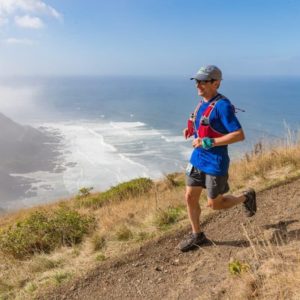
Mountain Lakes 100 Race Report – Roey P

mountain lakes 100 race report

Mountain Lakes 100 Race Report – Roey P

“Lessons for others: Lights – My 150 Lumen Petzl, fine for the Burke Gilman, didn’t stand a chance against the fog and darkness of the wilderness. I lost a couple of places at night because I couldn’t see where I was going too well. Smile and enjoy the run. Things will go wrong, or unexpectedly. Work around them.”

Race: Mountain Lakes 100

Runner: Roey P

Race Date: 09/22/2018

Location: Ollie Lake, Oregon

Results: 22:52:29

mountain lakes 100 race report

3 Bests – What aspects of the race did you like the most?

  1. The Course – Beautiful PNW Forest that winds through mountains, and around lakes. The scenery is mesmerizing.
  2. The Aid Stations – Friendly, helpful, fun volunteers that were encouraging! My crew missed me (more than once, but more on that later) at the 55 mile mark, and one of the volunteers paced me for 15 miles!
  3. The Community – The Facebook group was a friendly, chatty place even before the race started. It spilled over onto race day, and the race itself. Great group of people all around this race!

Not so much – Aspects of the race that didn’t do it for you

  • Could use a few more markers. I am always nervous that I missed a turn, or got off the trail. It was always a little longer than I am comfortable with between markers.
  • Crew Location – With 16 aid stations, it was sometimes 25 or more miles between crew locations.
  • My Crew – I had to wait 35 minutes for them at the Aid Station at mile 26. I would have just ran off, but I needed my warmer gear, as it would be nightfall before I saw them again.
  • Then at Mile 55, they were late again. I took off with aforementioned volunteer runner.

Weird factor – What’s the weirdest thing about this race?

Nothing really too weird.

Highlights of your race – What did you do well and enjoy about your race in particular?

I fueled early and often. I took in about 300-400 calories every hour. I made sure to drink water. I paced it out nicely. Hiked the uphills, ran the flats and downhills. Sub 24 hours for my first 100 was well beyond what I expected.

Lessons for others – Share your pro-tips on the race to help the next runner

  • Lights – My 150 Lumen Petzl, fine for the Burke Gilman, didn’t stand a chance against the fog and darkness of the wilderness. I lost a couple of places at night because I couldn’t see where I was going too well.
  • Smile and enjoy the run. Things will go wrong, or unexpectedly. Work around them.

Lessons you learned that will help you next time around

Smile. Smile. Smile. Roll with the punches. Keep putting one foot in front of the other. Be mindful, be grateful.

Most important course specific knowledge to know about the race

It’s really runnable. However, the last 30 miles has some sustained ascents.

Aesthetics – Is it a pretty course?

Absolutely gorgeous. Mountains, Lakes, Streams, Forests! What more could you ask for.

Difficulty – Is it a tough course?

I don’t believe so. Only ~11000 feet of elevation gain, and an incredibly cushy terrain.

Organized and well run – Did it feel like a well-oiled machine or were they flying by the seat of their pants?

Very well. Crew directions were a little weird, so if you get a chance, have them drive the course the day before.

Competition – Is there a strong field?

It’s a WS Qualifier, so probably.

Logistics – Does it require a special handshake, registration a year in advance, hotels all booked? Give us the low down on the nuts and bolts of making the race happen.

Registration fills up really quickly. Book your hotels early. We were lucky to get a great Airbnb about an hour away.

Aid Stations – Standard fare or anything special to know about the aid stations in terms of what’s available or when?

Fully Stocked. All the usual stuff and then some! Perogis at two Aid Stations were an amazing experience!

Weather and typical race conditions

Cold, Rainy. It has snowed a little in previous years. It was 54 when we started, and dropped to 27 through the night.

Gear – Did you need anything special or is there anything you’d recommend for the next guy?

Bright headlamp. It gets DARK in the middle of the forest at night.

Spectators – Is this a friendly course for your friends?

There were 7 Stations were crew can be. However, it was recommended that they not try to find the Dam Station, as it was difficult to get to.

How’s the Swag?

Amazing! A pair of Nike Trail Shoes, Finisher Buckle, and a drinking glass!

The Overall Score – How many stars do you give this race and do you recommend that others run it?

5 out of 5. A must run for first timers!

mountain lakes 100 race report

seattle run consultation

Tillamook Burn 50k Race Report – Elizabeth Carey

seattle run consultation
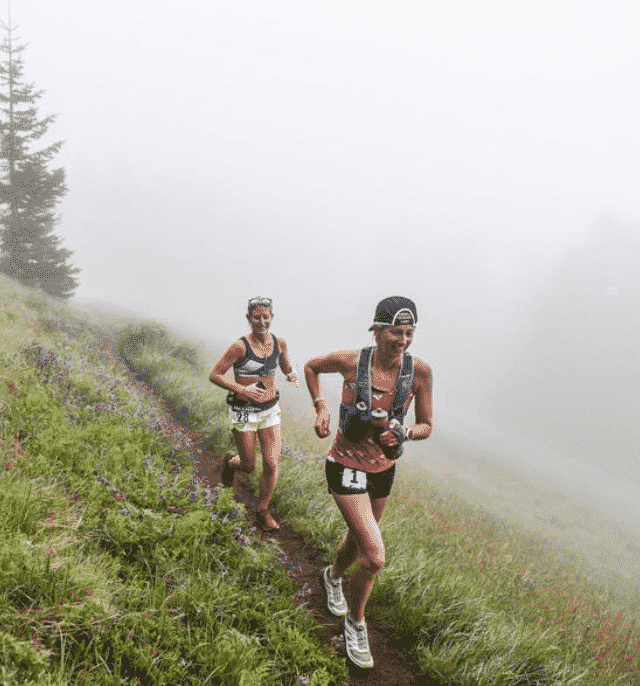
Photo: Pursuit Films

Race: Tillamook Burn 50k

Runner: Elizabeth Carey

Race Date: 04/28/2018

Location: Tillamook State Forest, Oregon

Results: 2nd F / 8th OA

Strava Activity Link: https://www.strava.com/activities/1537935844

3 Bests – What aspects of the race did you like the most?

  1. Beautiful forest. The out-and-back course runs up and down along a river to a striking waterfall, and through lush groves of trees, ferns, burns and a bajillion shades of green.
  2. Amazing community. The turnout included a bunch of very nice humans who were fun to share this adventure with.
  3. Start/finish area. At Reehers Camp, they set up a campfire, kombucha and beer taps, a catchy folky-bluegrass band, plus a killer Mexican food truck. There were also lots of very cute doggos at the finish line, which lifted spirits.

Not so much – Aspects of the race that didn’t do it for you

Per usual, Daybreak Racing crushed it, so there’s nothing to complain about other than how I competed.

Weird factor – What’s the weirdest thing about this race?

It’s half-way between Portland and the Oregon Coast, off Highway 26, on trails I’d never run before despite growing up in Portland. This race opened my eyes to Oregon’s hidden gems and deep network of breath-taking natural areas.

Highlights of your race – What did you do well and enjoy about your race in particular?

I paced myself, staying patient in the first half, in order to finish strong. In the second half, I was able to reel in a handful of people who’d passed me 8 miles in. I dug deep to chase down the front-runner but lost her on the last climb.

Lessons for others – Share your pro-tips on the race to help the next runner

This course is full of fun rollers and poppers, thanks to a handful of water crossings, which surprised me. I prepared for the big climbs but not the consistently undulating terrain.

Lessons you learned that will help you next time around

The final climb comes at a hard time in the race but leads to a steep descent to the finish. I could be better prepared to fly down the switchbacks.

Most important course specific knowledge to know about the race

This course is well-supported and runnable, but not without sneaky and sustained hills alike. It’s an out-and-back on single track, so you’ll be able to see who’s in front of and behind you at the turn-around.

Aesthetics – Is it a pretty course?

As you run into and through the forest you’ll see a range of vegetation, waterfalls, and all sorts of features. There aren’t a lot of sweeping vistas, but there’s plenty of beauty to behold.

Difficulty – Is it a tough course?

Depending on what you’re used to, I’d say this course is moderately hard. The trails range from technical (roots, rocks) to hero dirt (soft, pine-needly dirt), so some foot skills are required — but there’s no crazy exposure or scrambling, so it’s ideal for a range of runners. A few sustained climbs made me power-hike and overall Strava reported nearly 7k ft of climbing.

Organized and well run – Did it feel like a well-oiled machine or were they flying by the seat of their pants?

Daybreak Racing, per usual, put on a wonderful, well-organized event.

Competition – Is there a strong field?

A decent field showed up, with the top women beating the previous course record. I expect this race to continue to draw more talent in the years to come.

Logistics – Does it require a special handshake, registration a year in advance, hotels all booked? Give us the low down on the nuts and bolts of making the race happen.

  • Registration was simple through Ultrasignup.
  • Logistics vary, dependent on whether you want to stay in Portland, near the race (camping is an option), or at the Coast. I stayed with family in Portland (easy) and then at the Coast after the race (easy and fun). After a fun night in Oceanside, we returned early in the morning to the race site for a friend to run the 20-miler. Commendably, a few people did the double.
  • Count on at least an hour drive from Portland and longer from the Coast to get to the start/finish area. Note: there’s little to no service at the start/finish area.

Aid Stations – Standard fare or anything special to know about the aid stations in terms of what’s available or when?

The most remarkable aid station featured — wait for it — people in tuxedos serving soft drinks in flutes on platters. A wide range of ultra food and drink was available at all the aid stations.

Weather and typical race conditions

We lucked out with mild weather for spring in Oregon. We had a chilly, misty start and then sun through the day. Prepare for precipitation.

Gear – Did you need anything special or is there anything you’d recommend for the next guy?

I didn’t need anything special for this race outside of my normal longer-run trail-running kit.

Spectators – Is this a friendly course for your friends?

There are only a few locations where spectators can see you on the course outside of the start/finish area, but they work. The start/finish area is fabulous, so either way they’ll be entertained.

How’s the Swag?

Awesome; the awards are unique wood-cut sculptures and finishers receive very cool glasses.

The Overall Score – How many stars do you give this race and do you recommend that others run it?

5 stars. This race embodies what’s awesome about trail running and I highly recommend it.

mountain lakes 100

Mountain Lakes 100 Race Info

Summary: One of the more scenic 100 milers in a remote area in Central Oregon (Olallie Lake), this race is mainly an out and back course with a 26 mile loop at the start and a 15 mile loop at the furthest point out. Along with featuring 60 miles of the Pacific Crest Trail, the course is a mix of singletrack (87.7 miles), jeep roads (12 miles) and pavement (.2 miles), along with a gain of ~10,800 feet. 2017 was a different course due to wildfires, so the gain was ~2,000 feet more, and at least 8 inches of recent snow made for a very challenging race.

Lessons Learned from Race Reports

  • All aid stations are cupless
  • Unlikely to have cell service at the race, so if you are meeting people or pacers and/or crew are coming, have a plan for meeting without needing cell service
  • The area in general has not much more than campsites, so come with all the supplies you need, plenty of gas and food, and give yourself enough time to drive there with really slow, pot-holed roads
  • First loop has some of the more technical trails
  • PCT miles are traditionally more runnable, but don’t expect them to be non-technical
  • Have warm layers for when the sun goes down, as it will be chilly at night
  • Roads for crew are fairly rough and tough to navigate, especially at night. Make sure your crew knows this going in.
  • Course is very well marked
  • Rocks are slick in the morning at the start and the next morning from morning dew or if it’s rained – be careful not to slip
  • Have a change of clothes in a drop bag for changeover from night to day so you stay warm with the big temperature swings
  • Likely running through the entire night, so have a backup headlamp and/or backup batteries, as it’s about 12 hours of nighttime

Elevation

Total gain/loss: 10,800/10,800

Ft/mile gain: 108

Total climbs: 1×2000, 1×1700, 4×500, 3x~750-1000

Course Map / Elevation profile

Caltopo Map (loads faster than PDF course map)

Aid stations

Total aid stations: 16

Furthest distance apart: 10

Locations: Miles 5, 11, 21, 26, 30, 37, 45, 50, 55, 61, 66, 70, 75, 81, 88, 96

What’s available: Typical ultra food (i.e. chips, PBJ, fruit, cookies, crackers, candy), in addition to S-Caps, water, GU Hydration, and GU gels. There is also warm food available during the night.

Crew access

Access Locations:

Aid Station #2/Powerline (mile 11.4)
Aid Station #4/Olallie Lake (mile 26)
Aid Station #5 & 16/Olallie Meadows (mile 30 & mile 96)
Aid Station #9 & 12/Clackamas Ranger Station (mile 55 & mile 70)
Aid Station #11/Timothy Lake Dam (mile 66)

Crew instructions/directions (pdf), also on website

Pacers

Allowed starting at mile 55 or 70 (Clackamas Ranger station) and runners age 60 or over are allowed a pacer starting at mile 26.

Race qualifiers

Western States 100

6 UTMB Points

Race reports

Christy S’s 2019 Race Report

Roey P’s 2018 Race Report

Daisy C’s 2016 Race Report

https://ultrarunning.com/featured/mountain-lakes-100-smoke-and-fire-turns-to-ice-and-snow/

https://donnerpartymountainrunners.com/2016/09/28/picking-the-right-100-miler-mountain-lakes-100-race-report/

https://runforyourlife.live/2016/10/04/mountain-lakes-100-a-lesson-learned/

Strava activities and GPX files

https://www.strava.com/activities/726061984?hl=en-GB

Race Website

https://gobeyondracing.com/races/mountain-lakes-100/

Prepping for an ultra? Check out our 7 Steps Towards Running your First Ultra!

mt hood 50 race report

Mt. Hood 50 Mile Race Report – Delaney H

mt hood 50 race report

Race: Mt Hood 50 Mile

Runner: Delaney H

Race Date: 07/14/2018

Location: Clackamas Lake Ranger Station, OR

Results: http://ultrasignup.com/results_event.aspx?did=49876

3 Bests – What aspects of the race did you like the most?

The course is unbelievably beautiful, which is very well marked. It is also very well run and super well supported. The volunteers are AMAZING.

Not so much – Aspects of the race that didn’t do it for you

This is a double out-and-back course, so if you’re not in the right head space, it could be easy to drop at mile 28 when you pass through the start/finish area.

Weird factor – What’s the weirdest thing about this race?

Elvis was working at an aid station. It was awesome.

Highlights of your race – What did you do well and enjoy about your race in particular?

I love pretty much everything about this race! The course is not super technical and very runnable. Aid stations were well stocked and the volunteers absolutely made me feel like a rockstar. The aid stations are well placed, so it’s never that far to the next one. It was hot and there were ice sponge baths available at the start/finish/mile 28. I met so many truly wonderful people, won a raffle prize (massage ball), and basically had a spectacular experience!

Lessons for others – Share your pro-tips on the race to help the next runner

Pace yourself! It’s easy to get caught up in the magic of the course as there’s a beautiful view and trail that is soft and runable. It’s easy to get going too fast. The harder stuff comes in the last 20 miles or so when the day is hotter. Save something for the back half. The last 5 miles or so is downhill (except the very end), so if your legs have anything left, you can fly.

Lessons you learned that will help you next time around

Fuel and hydrate early and often.

Most important course specific knowledge to know about the race

It gets pretty hot, though most of it is shaded. It’s not uncommon to encounter bees. You’ll also come across lots of hikers as this is on the PCT. Save something for the last 20 miles. It’s easy to get carried away in the first 30.

Aesthetics – Is it a pretty course?

So pretty!!!

Difficulty – Is it a tough course?

Not particularly tough. I think about 5300 ft of vert. Not very technical. Very runnable.

Organized and well run – Did it feel like a well-oiled machine or were they flying by the seat of their pants?

This event is very well organized. The RDs are amazing and they have thought of all the details. I would recommend any Go Beyond event.

Competition – Is there a strong field?

The short answer is yes. However, this race is a lottery so the level of competition kind of varies from year to year.

Logistics – Does it require a special handshake, registration a year in advance, hotels all booked? Give us the low down on the nuts and bolts of making the race happen.

It’s a lottery. The lottery opens in January or February and I believe they draw 150 names and there’s a waitlist. It’s about 1.5-2 hours from Portland, so no problem finding a place to stay. There are also some smaller but closer towns in which to stay. Carpooling is encouraged and incentivized. There is no cell reception at the race, so download or print out what you need ahead of time.

Aid Stations – Standard fare or anything special to know about the aid stations in terms of what’s available or when?

Fully stocked at each one with a full range of salty and sweet. I cannot speak highly enough of the volunteers. They were all SO fantastic!

Weather and typical race conditions

Hot.

Gear – Did you need anything special or is there anything you’d recommend for the next guy?

Stay hydrated. I would suggest a pack or handheld.

Spectators – Is this a friendly course for your friends?

There are not tons of places for spectators, but the start/finish area is also an aid station, so that’s where you can catch your runner.

How’s the Swag?

T-shirts are offered for sale. They have cool stickers and raffle prizes. Finishers get a pint glass…and glory. There is beer and cider at the finish. There’s also a hearty meal.

The Overall Score – How many stars do you give this race and do you recommend that others run it?

Five stars (out of 5). I highly recommend this race. It would be just a perfect first timer’s 50 miler.

bridge of the gods run

Bridge of the Gods Run Race Info (5k)

Date: 8/12/18

Location: Cascade Locks, OR

Start Time: 8:30am

Avg Temps (f): 83/54

Time Limit: 5 hours (10k and Half Marathon being run at the same time)

Lessons Learned from Race Reports

  • Smaller size field of runners, so doesn’t feel too crowded at the start or throughout
  • Don’t expect a flat course, especially if you train on flat, as it’s rollers throughout
  • Likely to be chilly at the start but warm up quickly, so dress accordingly
  • Mostly shaded course, but if it’s sunny, any spots not in the shade can feel quite warm, and the last mile is known to be more exposed
  • Arrive early to the start, as it can take awhile to find parking and to get on the shuttle
  • Lots of runners talk about how creepy it is to cross the bridge and see the river under your feet

Course

Type: Point to Point with a small out and back in the middle

Start/Finish Info: Starts on the Washington side of the Bridge of the Gods and finishes in Cascade Locks, OR. Shuttle to the start recommended, as you can walk the bridge to the start, but there is a lot of vehicle traffic still on the bridge.

Hills: 150ft hill in the beginning of the race, then about 4 smaller hills of 40-50ft throughout.

Map/Elevation

Aid stations

Locations of aid stations: Miles 1 and 2 (part of the 10k and Half Marathon course as well)

Spectator access

Access Locations: See the Course Maps. Family and friends could see runners when they cross over the bridge to the Oregon side, then see them at the finish.

Race reports

Check out the previous years’ photos to get an idea of past weather, conditions, and to see the path runners take.

https://www.bibrave.com/races/bridge-of-the-gods-run-reviews#.W0Azq4gvw2w

https://anothermotherrunner.com/2014/08/13/half-marathon-race-report-bridge-of-the-gods-2014/

https://runoregonblog.com/2015/09/28/race-recap-2015-bridge-of-the-gods-half-marathon-8162015/

http://silverstrider.com/bridge-of-the-gods-half-marathon/


Race Website

https://bridgeofthegodsrun.com/

Siskiyou Out and Back (SOB) 50 Mile Race Info

Summary: Affectionately known as the SOB, this race is basically an out and back, starting and finishing at the Mt. Ashland Lodge, Oregon, with many miles on the Pacific Crest Trail, and a couple sections where runners take a slightly different trail back than on the way out, covering both trails and dirt roads. With a starting elevation of around 6500 feet, the course has 4 big climbs and descents throughout, with a high point of over 7,000 feet, and boasts fantastic views of Mt. Shasta, the Marble Mountains, and Mt. Eddy. Other distances offered are 15k, 50k, and 100k. The overall gain is ~7,000 feet, with average temperatures hovering in the 50s for the low and nearing 90 for the high, so it’s likely to be warm!

Lessons Learned from Race Reports

  • Warm temps in the past, along with exposed sections, which can mean it gets harder to eat – take advantage of the ice at the aid stations to cool down and cool down the core temperature
  • With a starting altitude of 6500, you’re likely to feel some altitude effects coming from sea level, especially with several 1000ft + climbs
  • Mile 22 to the turnaround is mainly uphill – tough mentally for a lot of runners to go uphill to the turnaround
  • Practice power hiking – very likely you’ll hike the hills in the second half the race, at the least
  • Likely cool at the start, but warms up quickly
  • Be conservative the first half, especially with it being an out and back course, it makes coming back the same way that much harder if you’re pooped at the halfway point

Elevation

Total gain/loss: 7,000/7,000

Ft/mile gain: 140

Total climbs: 4 major of about 1000-1400 feet

Longest climb: From miles ~8-15, gain ~1300 feet, and from ~27-33, gain ~1500 feet

Steepest climb: From miles ~21-24, gain ~1400 feet

Course map/Elevation profile

Aid stations

Total aid stations: 13 total, 9 full, 4 water only

Furthest distance apart: 7.5 miles (there is water between)

Locations: Miles 4.9, 9.1, 12.5 (water only), 14.5, 19.1 (water only), 22, 25, 28, 30.1 (water only), 35.5, 37.5 (water only), 40.9, 45.1

What’s available: Most aid stations will be stocked with electrolyte drink, gels, water, potatoes, chips, cookies, pretzels, candy and other ultra goodies. Willamette Meridian, Siskiyou Gap, Jackson Gap, and Wards Fork Gap are full service aid stations. Wrangle Gap (miles 12.5, 37.5) and the road 2025 crossing (19.1, 30.1) are water only.

Crew access

Access Locations: None, start/finish only. Crews can run with runners for the last mile of the course once they leave the PCT.

Pacers

None

Race qualifiers

None

Race reports

https://anygivenrunday.com/2016/08/03/sob-50-miler-race-recap/

https://denziljennings.wordpress.com/2015/07/30/siskiyou-outback-50-mile-race-report/

http://ronlittle.blogspot.com/2016/07/siskiyou-out-back-50-mile-905.html

Strava activities and GPX files

https://www.strava.com/activities/651145316/overview

Race Website

https://siskiyououtback.com/


marys peak 50 mile

Marys Peak 50 Mile Race Report – Ashley Nordell

marys peak 50 mile
Photo: Audra Terry Photography

Race: Mary’s Peak 50

Runner: Ashley Nordell

Race Date: 06/16/2018

Location: Blodgett, OR

Results: 8:35:48, 1st Female and 3rd Overall

https://ultrasignup.com/m_results_event.aspx?did=48871

3 Bests – What aspects of the race did you like the most?

  1. The course – beautiful views, long climbs, very scenic trail
  2. The course marking – they worked really hard on this, only confusing part was some sections on the top of Mary’s with different races
  3. The location – almost local for me

Not so much – Aspects of the race that didn’t do it for you

The 50k and 50 mile get a bit jumbled on some sections of the Mary’s Peak climb. With day-hikers also sharing the trail, it got a bit congested.

Weird factor – What’s the weirdest thing about this race?

There is a castle near the finish – someone literally built a castle to live in.

Highlights of your race – What did you do well and enjoy about your race in particular?

I ran my own race and was able to move up in the later parts. Fueled mostly with Tailwind and didn’t have stomach issues. I loved the dynamic of the course – the long climbs and descents are hard but seem to fit my strengths.

Lessons for others – Share your pro-tips on the race to help the next runner

It can get hot! The final 16 miles are challenging even though you have already done most the climbing. The race gains 5,000 ft in the first 17 miles. Save some legs for the 2,000 ft climb at the end. I’m also pretty sure the course is long – I heard 51-54 miles on different people’s watches.

Lessons you learned that will help you next time around

Just knowing the course, the climbs, the distance between aid – all this is great info

Most important course specific knowledge to know about the race

First 7.5ish gravel road with climbs and descents, two miles of rolling single track, then about 25 miles of long climbing and descending with two summits of Mary’s Peak. Last 16 miles rolling runnable with 2,000 ft climb over about 4 miles. Mixture of single track and logging roads.

Aesthetics – Is it a pretty course?

Yes!!! If clear, amazing views from Mary’s, which is the highest peak in the coast range.

Difficulty – Is it a tough course?

Very – one of the harder 50 milers I have done- runnable but relentless

Organized and well run – Did it feel like a well-oiled machine or were they flying by the seat of their pants?

It’s a fairly new race but it’s well organized. A lot of the aid station volunteers are not ultra runners. Three races happen the same day, so a lot going on.

Competition – Is there a strong field?

Not really- it’s a smaller local race. But I think the RD is wanting to grow it and it has awesome potential.

Logistics – Does it require a special handshake, registration a year in advance, hotels all booked? Give us the low down on the nuts and bolts of making the race happen.

I signed up three days before the race. It’s easy, low key to get in at the moment.

Aid Stations – Standard fare or anything special to know about the aid stations in terms of what’s available or when?

I relied more on my own food. They had Tailwind, which I use, but a bit sparse in the food department. I used a drop bag that we got three times.

Weather and typical race conditions

Can be anything – we had wet fog on the top of the Peak and mid 70’s and sun by the end.

Gear – Did you need anything special or is there anything you’d recommend for the next guy?

If it’s hot, two bottles. Some long stretches between aid. Use the drop bag option – you hit that spot three times.

Spectators – Is this a friendly course for your friends?

Not really – most places are not accessible. The finish is the best place to see family/friends. It finishes at a small school that has a playground, so great for kids. You can camp there the night before, too!

How’s the Swag?

Tech shirt, finisher mug.

The Overall Score – How many stars do you give this race and do you recommend that others run it?

I would give this race 4.5 stars. If it grows, I would love to see the 50k one day and 50 miler another to help reduce impact and chaos on the top of the Peak. It’s a popular place for hiking, so it could get really busy.

eugene marathon race report

Eugene Marathon Race Report – Stephanie G

eugene marathon race reportRace: Eugene Marathon

Runner: Stephanie G

Date: 4/29/2018

Location: Eugene, OR

Results: 3:14:49, 216th place, 43rd woman, 10th age group

Strava Activity Link: https://www.strava.com/activities/1539724785/overview

3 Bests – What aspects of the race did you like the most?

  1. The race somehow felt small and big at the same time – maybe that’s just “medium”? I felt like it had the perks of a big, well-organized race, but the atmosphere still felt pretty relaxed and laid back.
  2. The course was really pretty. I generally have race amnesia for specifics, but it seemed really green to me.
  3. The weather turned out to be so much better than expected. Perfect race conditions really, cool but no rain or wind.

Not so much – Aspects of the race that didn’t do it for you

  1. The bag check was a bit of a fiasco. I was in line with probably 500 other people half an hour before the race, and it wasn’t moving. Right before I resorted to some sort of plan b, a race official walked up to about 5 of us and told us everyone was being so polite, but we didn’t have to stand in line and could go drop our bag by the section marked for our race number. I was out of there in 10 seconds. I’m not sure what everyone else did.
  2. The shirts fit poorly. Not a big deal to me, but may have been for others.

Weird factor – What’s the weirdest thing about this race?

Lots of banana stops. But maybe eating bananas during a marathon is just a trend I’m not aware of.

Highlights of your race – What did you do well and enjoy about your race in particular?

  • My pacing turned out really well, which I’m very happy with. I felt very consistent the whole race, and even when it started feeling a bit harder, I was surprised to look at my watch and see that I hadn’t really slowed down.
  • I changed my watch from miles to kilometers which made me not emotionally attached to the splits (since metric conversion while racing is way out of my league ability-wise). It kept me from worrying I was going too fast, or too slow, or just right, but at a pace I couldn’t believe I could sustain. Very freeing!
  • I tried to be positive and smile throughout the race, and mostly succeeded – although some of the pictures tell a different story.

Lessons Learned – Share your pro-tips on the race to help the next runner or yourself on the next time around

Have someone bring you warm clothes for after instead of using bag check.

Most important course specific knowledge to know about the race

  • There are some quiet/lonely stretches, but they’re short-lived.
  • Hills are short and not very steep.

Organized and well run – Did it feel like a well-oiled machine or were they flying by the seat of their pants?

Overall well run.

Logistics – Anything special regarding getting to/from the race, hotels around the course, registration…?

Seemed to be lots of lodging around, and they had shuttles from some area hotels that offered free parking for the day.

Weather and typical race conditions

Perfect this year. I think they’ve changed the date around a few time in the last few years, so not sure what typical would be.

Spectators – Is this a friendly course for your friends?

It seemed like it – I saw several people more than once.

How’s the swag?

Shirt fit was off, they gave out a reusable shopping bag with snacks at the finish, and a medal.

The Overall Score – How many stars do you give this race and do you recommend that others run it?

Overall this was a great race that I would recommend.

eugene marathon race report

Eugene Marathon Race Report – Austin M

eugene marathon race report
Photo: Race Hub

Race: Eugene Marathon

Runner: Austin M

Date: 4/29/2018

Location: Eugene, Oregon

Results: 3:31:36

Strava Activity Link: https://www.strava.com/activities/1539567328

3 Bests – What aspects of the race did you like the most?

  1. The Team – A fun group of 4 Team RunRunners ran this race, and it was a blast to compete with familiar faces.
  2. The Setting – Track Town USA, baby! You can’t beat the running history and community in Eugene. Finishing on The “Historic” Hayward field is a unique part of this race, you’re running on the same surface as some track legends.
  3. The Aid Stations – It’s a larger marathon, so I fully expected to have to ‘throw some ‘bow’s’ to get water/gatorade. But the aid stations came up so frequently (every 2 miles or less) that I never had to fight for a drink. It was also nice to have that much access to liquids, I’d rather have too many stations than too few.

Not so much – Aspects of the race that didn’t do it for you

  1. The Course – Touted as being “flat and FAST”, the courses constant rolling hills were a big issue for me. The course is comprised of 3 main sections that loop around the University of Oregon campus; the first 8 miles loop South and back to Eugene, then the second 8 miles run East into Springfield and back West, and the final 10 miles are a long and lonely out and back along the Willamette River. If you’re not prepared for the final 10 miles to be quiet and secluded it can really bring you down.
  2. The Swag – The shirts were awful! The race offered a “women’s” shirt, or a “unisex” shirt, both Nike DryFit shirts with the crazy Eugene Marathon logo. The unisex option was the most oddly cut tech shirt I’ve ever seen, runs very small (my medium would best fit a teenage girl), and the print is very sticky! I heard from other runners that the women’s option was not any better, and cut like a funky crop-top. You’d think a marathon in Nike-topia would have some solid swag.
  3. The Expo – Granted I showed up in the final hour and a half of the expo, but it all seemed understaffed/undersupplied. I picked up my bib, and the volunteer said they had run out of the bags given to runners to hold their expo swag, as well as use as a bag drop on race day. So no bag – no bag drop. I honestly don’t know how they could run out of bags knowing the number of athletes racing. This race also has a mandatory bib pickup at the expo the day before. If you can’t make the expo you have to pay $15 to have race-day pickup. Most of the vendors at the expo were empty by the time we got there, it was generally just a lame pre-race expo.

Weird factor – What’s the weirdest thing about this race?

Not a whole lot. The corrals seemed a bit unnecessary, and the first time I’ve had to start in a corral which felt weird. They also start the half marathon runners alongside the marathoners, so you might be racing someone running half the distance.

Highlights of your race – What did you do well and enjoy about your race in particular?

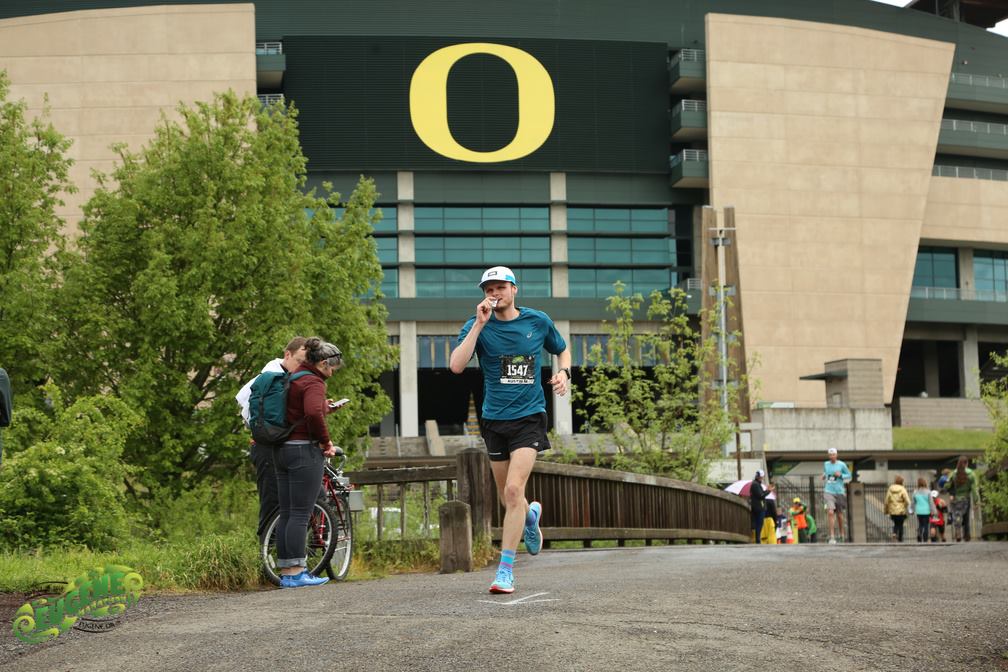
  1. The biggest highlight was probably the weather and scenery of the course. Even though my legs blew up I was able to really enjoy the bright spring weather in Eugene. You run through some beautiful parks and along a big river, and through some highlights of the U of O campus like Autzen Stadium (Go Huskies!).
  2. The track finish is also pretty special if you haven’t run on Hayward field. I believe this race won’t finish on that track next year due to renovations, but hopefully they bring that back.
eugene marathon race report
Photo: Race Hub

Lessons Learned – Share your pro-tips on the race to help the next runner or yourself on the next time around

  1. Pace Management – Be far more conservative in pacing early on in a marathon. It’s a long race, and going even slightly too fast early on can come back to haunt you.
  2. Race Attire – Bring enough clothes to be prepared for any type of weather. I was expecting wet and cold and should’ve had a singlet and shorter shorts.

Most important course specific knowledge to know about the race

There are rolling hills throughout the course. The section running parallel to the river is very quiet and can be lonely.

Organized and well run – Did it feel like a well-oiled machine or were they flying by the seat of their pants?

It’s really well organized, with major Eugene roads shut down and course markings throughout all 26.2, lots of volunteers and aid stations, which all make the race feel professional.

Logistics – Anything special regarding getting to/from the race, hotels around the course, registration…?

Not really, the bib pickup is required the night before, so you have to be in Eugene the night prior to the race or pay a fee. It’s open entry, and good for all levels of runners. Hotels seemed to fill up pretty quickly so the sooner you can book one the better.

Weather and typical race conditions

It’s unpredictable, as is typical North West spring weather. This year called for lots of rain and cold, and it was hailing the night before. Race day was warm and sunny, so be prepared for everything.

Spectators – Is this a friendly course for your friends?

Sort of, the first 10 or so miles are friendly for spectators, as well as the final 2, especially the finish on the track. The 14 miles in the middle are somewhat spectator friendly, but not many spectators make the trek to the river section.

How’s the swag?

Not great, see above.

The Overall Score – How many stars do you give this race and do you recommend that others run it?

4/5

eugene marathon race report

Eugene Marathon Race Report – Julie Urbanski

Race: Eugene Marathon

Runner: Julie Urbanski

Date: 4/29/18

Location: Eugene, OR

Results: 3:43:42

Strava Activity Link: https://www.strava.com/activities/1541717986

eugene marathon race report
Me rockin the TRR unicorn singlet next to Wyatt in space cat taco, at the start. Photo: Race Hub

3 Bests – what aspects of the race did you like the most

  1. Easy race logistically – Sign up was easy, as I signed up with a 25% off coupon a couple months beforehand, so no lottery or year ahead sign up, packet pickup was small and smooth, close drive from Seattle, and well-run throughout the whole thing.
  2. Smaller field – We were just in Boston, where everything felt crowded around race weekend and there were just so many runners and spectators in Boston for the weekend, that it was nice to be in a smaller, hometown-feel kind of race, that was still well-organized and had plenty of runner friendly aspects in town and at the race.
  3. Tons of porta potties – I have been at plenty of races where they just can’t get this right, but this race had tons of them right near the start and we got there about an hour early and there were zero lines, then used them again about 20 minutes before the start and again, no lines. So nice to have this stressful part of the pre-race routine be easy. Runners gotta poop!

Not so much – aspects of the race that didn’t do it for you

  1. Course – They advertise “flat and fast” and I wouldn’t really call it flat, more like rolling with a flatter second half. Thankfully I knew going in to expect some hills, as Wyatt (another runner running it on the team) is from Eugene and his dad knew all the hilly spots. It’s still a fairly fast course if you’re having a good day, but it’s definitely not flat. There are also a fair amount of turns throughout the entire race, which can slow you down.
  2. Swag – The women’s shirt fit really boxy, like a crop top, and the men’s wasn’t men’s, but rather it was unisex, which is a bit odd. Thankfully the Small Unisex fit me great but I feel bad for the men who were trying to fit in the narrowly cut unisex shirts! I’m also not a huge fan of the color black for a running shirt, as it just makes me feel hotter while running; I was really hoping for a kelly green-colored shirt, or even white. Likely going in the donate pile soon, unfortunately.
  3. Finish Line – Only drinks I could find at the finish line were chocolate milk, beer, and water in a Eugene Marathon water bottle. All I wanted was something with sugar or electrolytes, like Gatorade, Juice, or Soda, but couldn’t find anything. I liked that the race had a virtual swag bag vs. tons of crap in the expo bag, but at the end they gave us a reusable bag with lots of food and a reusable water bottle, which felt kind of counter to the whole point of a virtual swag bag. Thankfully Wyatt’s mom was happy to have the reusable bag and Wyatt’s brother wanted the food, otherwise it would have gone to waste (and I shouldn’t have taken it but was a little dazed right at the finish so I just took whatever they handed my way).

Weird factor – what’s the weirdest thing about this race

Not weird so much as cool, especially for track fans and running geeks, that is it finishes on the track at Hayward Field. I don’t usually get excited about that kind of stuff, but it was still pretty cool to run on the track, something I’d never do otherwise since I’m a total average Jane kind of runner.

It was also weird that the shirts were so odd fitting, being a Nike dri-fit running shirt. How do they get that wrong?

Highlights of your race – what did you do well and enjoy about your race in particular

  • I finished. Yep, it was one of those races where the silver lining is that I didn’t quit. I actually didn’t think about quitting until I had already seen Matt and Paavo at mile 18, and about a quarter mile later I thought, “Dang, I should just turn around, find them, and be done.” Then I thought, “Shit, I can’t do that, Matt’s probably left for the finish line because I’m the slowest out of all the runners!” And good thing I didn’t turn around, as he had in fact already left, as he told me later, since I was the last one he was waiting for.
  • As with a lot of races, my first half was beautifully executed. I went out conservatively, just a hair faster than my easy pace, and felt really good at the half, going through in 1:44 and change. Then at about mile 14 I started to feel a little overwhelmed by the distance I had left so I thought that slowing it down a bit would help me save some gas for the final 10k. It kinda backfired and I just felt terrible physically after that, as my legs couldn’t find a great rhythm, my stomach went sour (threw up at mile 24), and I played the death march, pity party game for several miles. After puking I did feel better and shuffled through those last 2 miles.

Lessons Learned – share your pro-tips on the race to help the next runner or yourself on the next time around

  • Trust my pacing. I still don’t really know why I tried to change up my pace, as I felt fine at the time. Maybe I would have had the same end result, but I should have trusted my pacing a bit more and stuck with it.
  • I think I still need more long runs under my belt at steady state, and more medium long runs of ~10 miles mid-week to be a stronger runner in the marathon and beyond. The last couple marathons my legs just haven’t felt that strong throughout.
  • Wear less. I overdressed with a long sleeve and a singlet and was dripping sweat by an hour in. Looking back, with temps in the high 40s, low 50s, I should have worn a short sleeve and arm sleeves, or just a thin long sleeve.

Most important course specific knowledge to know about the race

  • Roll with the hills, know there are more in the second half than the first, but there are still some rollers in the second half
  • Run the tangents as best as possible with how many turns there are on the course, as I imagine you could end up running quite a bit more distance than the marathon if you take all the turns wide
  • Overall it’s a bit of a lonely course in terms of spectators and course “entertainment” (bands), so have music if you’re used to that or have some mental strength to get through some lonelier miles

Organized and well run – did it feel like a well-oiled machine or were they flying by the seat of their pants?

Very well organized from start to finish. Good pre-race email, small expo but at least we got through it quickly, lots of aid stations with plenty of people to hand out liquids, and good race follow up with results and photos. The expo was probably a little underwhelming if you’re expecting a lot of vendors, but since I like getting in and getting out, it was fine with me.

Logistics – Anything special regarding getting to/from the race, hotels around the course, registration…?

Easy to sign up, other races include 5k and Half Marathon, and I found a coupon a couple months out that made for a cheap registration ($75ish). There were shuttles to the start from several locations, but Wyatt’s dad drove us to the start and we had about a 7 minute walk to the start, so not really crowded. We parked a bit further from the finish since there were so many more cars near Hayward Field for the finish. I heard hotels were expensive (when are they not on a marathon weekend though), airbnb is an option, and we stayed with Wyatt’s family, which was fantastic. I love being able to cook in a real home, shower afterwards without worrying about checkout, and we even did a load of laundry before hitting the road.

Weather and typical race conditions

Typically it’s on the warmer side for this race, being in the spring. There’s always a chance for rain, and we got lucky with no rain, cloudy, no wind, and temps in the high 40s, low 50s. So basically, no real typical conditions except there’s always a chance of rain, temps are likely to be in the 40s-60s, and I’ve seen sun and clouds for this race.

Spectators – is this a friendly course for your friends and family?

Pretty friendly if they figure out how to get around town, avoiding the course and finding parking. They can see runners in several spots or just 1-2 spots, and there’s a fair amount of parking around town near shopping centers and Autzen Stadium.

How’s the swag?

Nike drifit shirt that sounds promising but fit terribly, and I’m not a fan of the color black for a running shirt. Reusable bag and water bottle, and typical finisher’s medal. Free race photos, which was a nice touch.

The Overall Score – how many stars do you give this race and do you recommend that others run it

3.5 out of 5. If you’re within a half day’s drive, totally worth running because it’s easy logistically, close to home, fairly fast, and well-run. Definitely not as flat as advertised and the shirts were a bust. I wouldn’t go out of my way to fly to this marathon, but being so close in Seattle, it’s a great Spring option.

Wyatt, me and Stephanie post-race. Not pictured is Austin, also on TRR and ran the race.
portland marathon race report

Portland Marathon Race Report – Pritam

Race: Portland Marathon

portland marathon race report
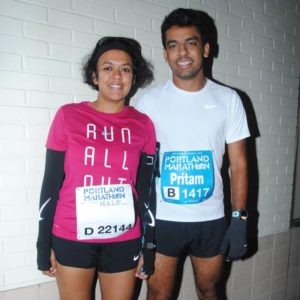
Photo: MarathonFoto

Runner: Pritam

Date: 10/8/17

Location: Portland, OR

Results: 4:00:59

3 Bests – what aspects of the race did you like the most

  • It was a fun race overall so hard to pick 3 things. Portland is a fun, friendly city and the race was well organized. 3 things I can think of:
    • The course – it was along the Willamette river for the most part and included a back & forth over one of the river bridges. So, we got great views of the city. Lots of aid stations so runners don’t need to carry bottles etc.
    • The people – Portland is a friendly city and it showed. People showed up by the side of the road to cheer and high five the runners. That was fun!
    • Location – the start and finish lines were right downtown near the hotel district. So, it was easy to get to and from the race. We took the Amtrak down from Seattle and walked to our hotel from Portland’s Union Station. So, no car/travel arrangements needed beyond the train tickets!

Not so much – aspects of the race that didn’t do it for you

A part of the race was on a highway where only 2 lanes were blocked for runners. So if you were running in the outer lane, high-speed highway traffic was zipping by you. Not a problem in itself, but the draft created by a big Semi going at 55 mph can surprise you!

Weird factor – what’s the weirdest thing about this race

It was weird in a good way! All runners got tree saplings after finishing the race. Given the state of Eagle Creek today, runners could donate their saplings for use in the reforestation effort. The event’s website claims that >150,000 Portland marathon trees have been planted in the Pacific Northwest!

Highlights of your race – what did you do well and enjoy about your race in particular

Followed Matt’s advice ☺. Didn’t go out too hard. Stayed consistent with my pace and form/cadence. This helped me overcome tiredness towards the end and set a PR.

Lessons Learned – share your pro-tips on the race to help the next runner or yourself on the next time around

The uphills are deceptive. Think of it as one big climb starting around mile 6. You climb continuously for 4-5 miles and then turn around. So plan accordingly.

Most important course specific knowledge to know about the race

It’s a road race with very frequent aid stations (1 every 2 miles!!) so plan on running light and maybe set a PR!

Organized and well run – did it feel like a well-oiled machine or were they flying by the seat of their pants?

Overall, it was well organized and the volunteers were amazing.

Logistics – Anything special regarding getting to/from the race, hotels around the course, registration…?

Participants should try staying at one of the downtown hotels. Its near the expo and start/finish lines. Portland has great transit so even if you fly in to the airport, you don’t really need a car. Everything is walkable if you’re downtown.

Weather and typical race conditions

Typical Pacific Northwest fall weather – wet and cool. Though the sun did shine for the last hour or so.

Spectators – is this a friendly course for your friends and family?

Yes! Lots of aid stations and the course winds through some interesting Portland neighborhoods.

How’s the swag?

Pretty standard. But the Portland rose and the tree sapling were winners!

The Overall Score – how many stars do you give this race and do you recommend that others run it

Five stars. Highly recommended!

oregon coast 30k race report

Oregon Coast 30k Race Report – Marc

Race: Oregon Coast 30k

Runner: Marc

Date: 10/8/17

Location: Yachats, OR

Results: 4:05:26, 48th out of 230 runners

oregon coast 30k race report
Photo: Glenn Tachiyama

3 Bests – What aspects of the race did you like the most?

Gorgeous course
Chance to explore the Oregon Coast for a weekend
Very runnable hills with sections of carpet soft trails

Not so much – Aspects of the race that didn’t do it for you

There was a long stretch of pavement at the beginning to get to the trails, and at the end to get to the finish, about 3 mile worth on each side. The long road section at the end felt super tiring after being on the trails. Also, not their fault, but it’s a looong drive from Seattle. Given perennial I-5 traffic, plan for at least 6 hour drive home after the race.

Weird factor – What’s the weirdest thing about this race?

Nothing too weird, really. No medal at the end, just a pint glass.

Highlights of your race – What did you do well and enjoy about your race in particular?

I went out a bit fast due to the flat start, but managed to hang in there through the first 2 hills, and only faded a bit on the last one. The weather this year was beautiful, making everything a real treat.

Lessons for others – Share your pro-tips on the race to help the next runner

The 30k shares most of the course with the 50k, but is run a day later. If you don’t care for the 6-7 mile beach run at the start of the 50k, then race the 30k!

If you can save a little energy for the flat run at the end, you’ll be rewarded. I passed a number of folks in the last few miles, and if I’d had more energy, could have made up a lot of time there.

Most important course specific knowledge to know about the race

The hills are surprisingly runnable for the most part, and the downhills can be really fast. The hills go by quickly, so you can push pretty hard without blowing up.

Aesthetics – Is it a pretty course?

It’s super beautiful, especially when the weather is nice. The view of the ocean from the bluffs above Cape Perpetua is amazing!

Difficulty – Is it a tough course?

I’d give it a 3 of out 5. There was just under 4000 ft of climbing, but each climb was only about 1000 ft, so they were short. It’s rooty and rocky in some places, and the few stairs are super slick, so be careful!

Organized and well run – Did it feel like a well-oiled machine or were they flying by the seat of their pants?

It was super-duper well run! They have the race down to a science.

Competition – Is there a strong field?

The 50k gets the fastest racers, so the 30k is a little more low-key.

Logistics – Does it require a special handshake, registration a year in advance, hotels all booked? Give us the low down on the nuts and bolts of making the race happen.

Races sell out fast, so be sure to get on the list to be notified when the race opens. As I said earlier, long drive from Seattle. I made hotel reservations late, so Yachats was sold out. Stayed in Newport, about 25’ away, and it was fine. The 30k starts late at 10AM, which in a way was nice, since there was no need to wake up super early. Downside is you won’t get home until around 9PM, depending on traffic.

Aid Stations

Standard stuff.

Weather and typical race conditions

It’s the coast; expect sun, clouds, rain or fog, sometimes in combination. It’ll never be too hot or too cold, at least!

Gear – Did you need anything special or is there anything you’d recommend for the next guy?

Make sure your running shoes are ok for a bit of mud and for pavement. Bring a variety of clothes for different temps; hard to guess what you’ll need until race morning.

Spectators – Is this a friendly course for your friends?

Yes

Awards

No medal, but there was a nice metal pint glass.

The Overall Score – How many stars do you give this race and do you recommend that others run it?

I’d give it a solid 4 out of 5.

Great course, hilly enough to be challenging, but not so much that you end up hating life. The long road sections at the beginning and end weren’t my favorite, and the food at the finish was a bit limited, but those are minor gripes about an awesome race.

oregon coast 50k

Oregon Coast 50k Race Report – Stephen

Race: Oregon Coast 50k

Runner: Stephen

Date: 10/7/17

Location: Yachats, OR

Results: 5:48:20

3 Bests –

  • The beach. I think if you have never run on the Oregon Coast – it’s a treat. If you have spent time running on beaches before- well then you are lucky…
  • The convenience of the main Hotel to the finish line. My hotel room was less than 100 feet from the finish line. It was really nice finishing and being able to go take a shower and come back to the post race festivities with warm dry clothes.
  • Getting to see my best friend finish his first 50k and absolutely crushing it!!! Way to go Erik!

Not so much –

  • Some people aren’t a huge fan of the beach run. It can be windy, and wet. Plus sand does not typically play nice in shoes.
  • The weather can be tricky. I have run this race twice and got lucky both years, but have heard before in prior years it rained and had 35 mph winds on the beach. It was gnarly.
  • The lottery. This is a very popular race, so there is no guarantee you will get in.

Weirdest thing –

  • There seems to be a theme with many of my races this year -and bees/wasps. This year was especially bad. I think over 100 people got stung – some multiple times. I got lucky and came away unscathed.

Highlights

  • Seeing my best friend complete a goal he’d been training for, for over a year.
  • Running on the beach
  • Running almost the exact same finishing time I did last year
  • Having my son at the finish line was fun (my wife expected me to “run” with him, but I picked him up and we finished with me holding him. He gave James Varner a high five which was fun!)
  • The after race festivities are great – TONS of food, and lots of options, pizza, vegan wraps, ginger tea, candy, coffee, beer, and so on.

Lessons for next time

I ran this race last year so I knew what to expect. Really two things:

  • Prepare for sandy feet, so either have a change of shoes/socks at the first aid station, or just be prepared for wet/sandy feet
  • Between the second and third aid station is the longest stretch. If it is warmer and you are a heavy sweater (I am) there is potential to run out of fluids. Last year I ran out. This year I came really close, but it was cooler this year.

Most Important Course specific knowledge

  • Don’t go out too fast. Yes the beach is flat and the sand is pretty compacted. It is easy to go out too fast and burn yourself out early. I did last year, and paid for it. I did better this year by slowing it down about 20 seconds per mile and then hitting the finish a bit harder.
  • The little neighborhood you run through on the way out, is the same one on the way back. That is how you will know you are getting close to finishing.
  • There is one little section where you are forced to walk, heed the signs and walk, it is out of respect to the trail system and the visitor center which allows the race to occur using their trails.
  • There is also a section of the trail that was built to honor a Native American named Amanda. There is a story about her that gets sent out in the pre-race email that is sort of sad, and it helps reminds me that we are so lucky to be able to do these great races.
  • Know that there is not a ton of restaurant options in town, and the grocery store is pretty small. So if you are picky on food, it might be worth bringing your own stuff, or do some research before going.

Aesthetics

Yes this is a pretty course. The one thing that is a bit misleading is that you do run through a little neighborhood, and there is a lot of time spent simply in the woods. The views on the trail are few and far between. You are not constantly on the coast line.

Difficulty

This is not an easy course for two reasons.

  • It is flat in the beginning, so the 5k of gain is all contained in the later 30k of the race.
  • The time cutoffs are meant to make it harder. Every year folks that would finish in other races get cut off because this race is a pretty solid 8 hr cutoff.

Organized and well run

Very well run. James Varner is the race director and he is an ultra-runner himself – if you haven’t heard of him – he does Hard Rock 100 and stuff like that. He’s an awesome guy and really nice. He puts on fantastic races all over the Pacific Northwest. He also does the trail running film festival.

Competition

Let me put it this way – last year I was 51st. This year I was 88th, and my time was within two minutes of each other. The competition is growing on this race. There was a solid group of hard core folks in this race this year.

Logistics

  • It is easy to get to and the convenience is second to none. IF you prefer to camp to save a bit of money – there are TONS of campgrounds within 20 miles of the race start. Some are even on the beach front.
  • There is a lottery to get into this race, and there is a lot of people that put in for it. When I asked James, he said it was about 50% this year to get into the 50k and 40% got into the 30k.
    There is also a 30k option on Sunday that does not run on the beach but runs the majority of the course.

Aid Stations

Great aid stations. One aid station usually dresses up and is really entertaining. Last year they were pirates, this year they were Vikings.

Weather and typical race conditions

This is what I discussed earlier. Prepare for wet and wild weather, but know that you can get lucky and have a dry day too. This race happens in October when the weather shifts and it can really be anything. Three years ago it was 35 mph winds and driving rain.

Gear

A vest is good here. A shoe change is worthwhile at the first aid station right when you come off the beach (about half a mile off the beach). Some of the faster folks just ran with a hand held which is always a possibility if that is your style.

Spectators

This is not a super spectator friendly course. Your family and friends get to see you at the first aid station (which is also the finish line) and then at the finish. That’s about it. If your family has knowledge of the course, there are a few other places they could go, but that is risky and is almost not worth it.

Awards

Everyone got a nice metal cup this year. Last year we got nothing. So James Varner is now seemingly starting to give something out to the finishers which I like…

Overall Score

I give this race an 8 out of 10. I would personally like there to be more climbing, and I also would like to run more on the beach (I guess that means the race would have to be longer!) Having done this race two years in a row, I clearly enjoy it. The little town of Yachats is a quaint little town and it is accommodating to the race crowd that shows up. The drive down from Seattle took about 6 hours and that is probably my biggest complaint. Driving home that long with sore legs makes them that much more stiff. Either way, the highlight remains getting to see Erik complete his goal and absolutely smash through a barrier that 2 years ago he would have never thought even possible.

portland marathon team runrun

Portland Marathon Race Info

Lessons Learned from Race Reports

  • Finishers receive a swag bag rather than at the race expo
  • With no gels on the course, bring your own food if gummy bears and pretzels aren’t appealing
  • Wind and rain is always a possibility in Portland, so be prepared for any weather
  • Once you’re out of downtown, you’re running along a flat, industrial, non-scenic part of the city, which you’ll hit again coming back after the St. John’s Bridge
  • Course is mainly flat, but the hills are still challenging, especially since the 2017 course goes up and over the St. John’s Bridge.
  • Going over the St. John’s Bridge is harder on the way out, as the course stays elevated after the bridge, so on the way back there isn’t a hill to go up and over the bridge.

Course

Type: Out and Back starting/finishing along the downtown waterfront (new course for 2017)

Hills:

Full: ~50 ft from miles 3.5-5, ~125 ft from 8.5-13 (with the 100’ of gain from 8.5-10, the St. John’s Bridge), ~50 feet from 21.5-22

Half: ~50 ft from 5.5-6.5 and ~50 ft. from 9.5-10

Map/Elevation:

Marathon Map

Half Marathon Map

Aid stations

Locations of water stations: 19 aid stations about every 2 miles with water and Ultima Replenisher

Locations of electrolyte stations: Ultima Replenisher drink at every aid station

Electrolyte offered: Gummy Bears and Pretzels (No gels), locations TBD

Spectator access

Access Locations: See Spectator Guide

Boston qualifier?

Yes

Race reports

Pritam’s 2017 Race Report

http://brielikethecheese.com/blog/2016/10/race-report-portland-marathon-2016/#.WbGkB1GGM2w

http://thomasg86.blogspot.com/2015/10/2015-portland-marathon-race-report.html

Race Website

http://portlandmarathon.org/

oregon coast 30k race report

Oregon Coast 50k & 30k Race Info

Date

50k: 10/7

30k: 10/8

Avg Temps f.

46/62

Gain/Loss in ft

50k: 4500

30k: 3800

Furthest Aid

7 miles

Highest Elev.

1560

Start

50k: 9am

30k: 10am

Surface

Sand, trail

Time Limit

50k: 8

30k: 6

Sunrise/set

7:21am

6:46pm

Longest Climb

1485 ft/3.8 miles

Summary: Starting on the beach just south of Waldport, Oregon, runners head to the seaside town of Yachats and past it to Cape Perpetua Park. After running a big loop at Cape Perpetua, runners head back to an ocean-side finish in Yachats. Most of the miles are on singletrack and the 50K distance starts with a 6 mile stretch of sandy, but firm beach running, then a small amount pavement and some packed gravel trail.

Lessons Learned from Race Reports

  • Cupless race
  • 50k has to bus to start, no crew/spectator access at start
  • Many runners like to put dry shoes, socks and a towel in the Yachats drop bag so that way they don’t have to run in the same wet, sandy shoes/socks as the ran in on the beach.
  • Your shoes will get wet on the beach
  • Weather is unpredictable and makes the beach running all the harder, especially with wind and humidity
  • Beginning of the descents tend to have rocky, slippery footing
  • Easy to go out too hard on the beginning flat beach miles (50k)
  • Watch for potholes in the lawn around Adobe at the start (30k)
  • Inclines are a mix of runnable and steep, walking type, so be ready to mix between running and power hiking

Elevation

Total gain/loss: 50k: 4500 / 30k: 3800

Total climbs:

50k: 3 big ones (2x~900 feet, 1×1485 feet) miles 8.5-11, 15-18.8, and 23.7-26.2

30k: 3 big ones (2x~900 feet, 1×1050 feet) miles 2.4-4.9, 8.4-11.5, and 13.7-16.2

Longest climb:

50k: 1485 feet from miles 15-18.8

30k: 1050 feet from 8.5-11.5

Steepest climb:

50k: 800 feet from miles 9.9-11.1

30k: 800 feet from miles 3.5-4.9

Maps & Elevation Profiles

Aid stations

Total aid stations:

50k: 4

30k: 2

Furthest distance apart: 7 miles

Locations:

50K: 7,14, 19.5 (no crew access, no drop bags), 24
30K: 6,13

What’s available: Water, potato chips, PB&J, fresh fruit (oranges, bananas, grapes), chocolate/candy, GU gels and GU Brew, tortillas with Trail Butter. Soda such as Coke and Ginger Ale.  

Crew access

Locations:

50k: mile 7, start/finish

30k: None

Pacers

None

Race qualifiers

50k: 3 UTMB points

30k: 2 UTMB points

Race reports

Stephen’s 2017 50k Race Report

Marc’s 2017 30k Race Report

http://6mph.philipkrooswyk.com/2016-oregon-coast-50k-race-report/

http://alittlerunny.blogspot.com/2014/10/oregon-coast-50k-short-review-from.html

https://ranknovice.com/2015/10/14/gust-buster-the-2015-oregon-coast-50k/

Project Talaria video

Strava activities and GPX files

50k:

https://www.strava.com/activities/738681210

https://www.strava.com/activities/739214923

30k:

https://www.strava.com/activities/739923584

https://www.strava.com/activities/739933113

Race Website

http://www.rainshadowrunning.com/oregon-coast-50k–30k.html

Pine to Palm 100 Race Info

Date

9/9/17

Avg Temps f.

84/43

Gain/Loss in ft

20,000/20,000

Furthest Aid

14.5 between full

Highest Elev.

7,457

Start

6am

Surface

Trail, dirt road

Time Limit

34 hours

Sunrise/set

6:47am/7:35pm

Longest Climb

4500ft in 10 miles

Summary: A remote and rugged classic point to point course traversing the Siskiyou Mountains Range in Southern Oregon. Starting in Williams, OR the course winds it way east to Ashland, OR on a mixture of single track trail, dirt road, with less than 4 miles of pavement. The course boasts over 20,000ft of climb and 20,000 ft of loss with 3 climbs to 7,000ft and fantastic views of Mt Shasta and Mt McLaughlin.

Race Details

Lessons Learned from Race Reports

  • Don’t run anything in the beginning that you wouldn’t run after mile 50 because the start is so hard, starting out with 10 miles of uphill
  • The top part of the first descent is very technical and not runnable, so not a nice treat after a tough uphill to start
  • Sections of exposed ridgeline, which makes it tough in any weather condition, and it’s usually hot and sunny
  • Have to climb Mt. Wagner and retrieve a flag
  • Aid stations are sometimes fairly far away, ie if you’re walking ~30 minute miles, 10 miles takes a very long time!
  • Pacers are really helpful
  • Poles could be useful
  • Loooooong, steep, exposed climbs
  • Running a point to point course is a new, unique challenge
  • https://ultrarunning.com/featured/pine-to-pain-the-pine-to-palm-100-mile/ (Really good lessons learned here)

Elevation

Total gain/loss: 20,000/20,000

Total climbs: 4 big ones, two of which have false summits

1x2000ft, 1x3000ft, 1x4500ft, 1x4700ft and countless other small climbs and rollers from 100 feet to a few 500 feet

Longest climb: 4760 feet in 20.2 miles from mile 44.5 to 64.7 (with several false summits)

Steepest climb: 4527 feet in the first 10.4 miles of the course

Elevation profile and Map (Strava Data) 

Aid stations

Total aid stations: 14 total, 11 fully stocked and 3 water only

Furthest distance apart: 14.5 between start and 1st full aid station (water only at mile 4.5); otherwise, 10 miles

Detailed Locations: 4.5 (water only), 14.5, 21.5, 28.5, 35, 41, 43.5, 47 (water only), 52, 59.5, 66, 73.5, 80, 90, 95.5 (water only), 100.5

What’s available: SUCCEED! S! Caps for electrolyte replacement, electrolyte drinks, water and a limited number of GU packets. Beyond that each aid station team will have an assortment of the usual “race food”.

Crew access

Locations: 28.5, 41, 43.5, 52, 66, 80

Crew instructions/directions

Pacers

Allowed starting at mile 65 and can only swap out at mile 80

Race qualifiers

Western States

Race reports

http://www.sweatonceaday.com/2014/09/pine-to-palm-100.html

http://www.atrailrunnersblog.com/2014/09/smiling-through-glorious-2014-pine-to.html

https://ultrarunning.com/featured/pine-to-pain-the-pine-to-palm-100-mile/ (Really good lessons learned here)

Strava activities and GPX files

https://www.strava.com/activities/194765258/overview

Race Website

https://roguevalleyrunners.com/pages/pine-to-palm

marys peak 50 mile

Marys Peak 50 Mile Race Info

Date

6/22/19

Location

Blodgett, OR

Avg Temps f.

75/49

Gain/Loss in ft

~9400/9400

ft/mile gain

188

Highest Elev.

4097

Start

6:30am

Surface

Trail

Time Limit

11.5 hours at mile 44

Sunrise/set

5:29am/9:03pm

Furthest Aid

9.5 miles


Summary: The event starts in Blodgett, Oregon and the 50 Mile runners (there is also a 50k and 25k) have a double accent of Marys Peak, which is at 4097 feet, gaining 5000 feet in the first 17 miles with lots of deceivingly tough rollers and sections in the last 33 miles. Terrain includes lots of roots and some steeper sections in addition to two longer climbs and descents.

Lessons Learned from Race Reports

  • Cupless event
  • Climbs in the latter half of the race are still quite tough, even if you’ve done the majority of the elevation gain in the beginning
  • Power hiking helps on the steep sections
  • The day warms up quickly and there is a fair amount of exposure (see pictures in race reports below)
  • Course is a mixture of mix of logging roads, winding exposed meadows, single track, and the usual green forests.
  • Pay attention to the course markings at the top of Marys Peak, as there are several races going on at the same time
  • With several races going on and day hikers, be prepared for a slightly congested trail and be polite to other trail users
  • Course measures a bit long, so if your watch says it’s been 50 miles, know that you might have a few more miles to go
  • Be prepared for long ascents and descents – it might feel like they last forever
  • Runnable but relentless – one of the best descriptions of the course

Elevation

Total gain/loss: ~9400/9400

Total climbs: 3 with lots of little rollers; mainly uphill from start to mile 15 and from mile 23-28

Course Map/Elevation profile

Caltopo map and elevation profile

Aid stations

Total aid stations: 7 Full + 3 additional water stops

Furthest distance apart: 9.5 miles

Locations:

Aid 1 Mile 9.5 (Base of Northridge Trail) (Drop Bags)
Aid 2 Mile 18 Marys Peak East Ridge (before descent)
Water Miles 20 and 26
Aid 3 Mile 24 (Base of Northridge Trail) (Drop Bags)
Aid 4 Mile 30 Marys Peak East Ridge Again prior to the Northridge Descent
Aid 5  Mile 33 End of Northridge prior to Lower Northridge (Drop Bags)
Aid 6 Mile 40 and bail out point Cut off 4:30 pm
Water Mile 41
Aid 7 Mile 45 prior to Collarbone alley

What’s available: A variety of electrolyte drinks including but not limited to Chips, electrolyte pills, cookies, Gels, Rice Krispie Treats, Trail Mix, PB&J Sandwiches

Crew access

Unsure – none mentioned

Drop bags are allowed at aid stations 1,3, and 5 (miles 9.5, 24, and 33)

Pacers

None

Race qualifiers

None

Race reports

Ashley Nordell’s 2018 50 mile race report

https://denziljennings.wordpress.com/2015/06/21/marys-peak-50k-race-report/


Strava activities and GPX files

https://www.strava.com/activities/1643113768

https://www.strava.com/activities/1643159440

Race Website

http://oregontrailruns.com/event/marys-peak-trail-run-50-mile-50k-25k/

Peterson Ridge Rumble 40 Miler Race Info

Date

4/9/2017

Avg Temps f.

30-55

Gain/Loss in ft

3000/3000

Furthest Aid

7.1 miles

Highest Elev.

3931

Time Limit

9hrs

Start

8am (early start at 7am)

Surface

Runnable trail with some dirt road

Course Records

4:18:36 (Ryan Kaiser)

4:57:05 (Joelle Vaught)

Sunrise/set

6:33/7:43

Longest Climb

700 ft over 6 miles

Hashtags

#petersonridgerumble


Race Details

The Peterson Ridge Rumble is a local race that attracts some speedy people. It’s mostly very runnable, which is obvious from the fast times. On the second long climb there are two steep sections that slow everyone down. There can be snow at the peaks, depending on the year.

Surface

Mostly trail with some dirt road sections


Detailed course description:

  1. The start to mile 3 is flat and fast, with some rolling hills gaining only 100-150 ft on your way to mile 8
  2. Miles 8 to 15 are the first of two long climbs on the course, gaining about 500 ft over 7 miles
  3. The next 10 miles (to 25) are fast and downhill
  4. The second long climb gains around 700ft over the next 6 miles (to 31). There are two steeper sections in this climb, each gaining between 250-300 ft in a mile
  5. The last section loses 700ft over 9 miles, with a couple of small 50-75 ft climbs at miles 33 and 37 to break up the descent.


Elevation

Total gain/loss: 3000/3000

Total climbs: 2 primary climbs

Longest climb: 700ft over 6 miles

Steepest climb: 270 ft over .9 miles

Elevation profile


Aid stations

Total aid stations: 7 (mile 14.8 water/Nuun only)

Furthest distance apart: 7.1 miles

Locations: 7.1, 10.3, 14.8, 18.3, 22.5, 28.5, 35

NOTE: Aid Stations 3 (mi 14.8), 6 (mi 28.5), & 7 (mi 35) are cupless.

What’s available: water, Nuun Hydration, cola, gels, fruit, potatoes, candy, chips, etc.


Race reports

http://joekleffner.blogspot.com/2011/04/peterson-ridge-rumble.html

http://hookedontrails.blogspot.com/2013/04/peterson-ridge-rumble-40-mile-race.html

http://roosterruns.blogspot.com/2012/04/peterson-ridge-rumble-40m.html


Strava activities and GPX files

https://www.strava.com/activities/157267547

https://www.strava.com/activities/284362583/overview


Logistics

Packet pickup

Footzone in downtown Bend Oregon

Friday, April 7, 3 p.m. – 6 p.m.

Saturday, April 8, 10 a.m. – 6 p.m.

Also, at the finish area near the track, April 9, 6 a.m. – 15 minutes before your race starts.


Transportation

Start and finish at Sisters Middle School

Park in the main Sisters Middle School parking lot off of Hwy 242; do not gain access via the rear entrance by the track, as this is reserved for race official vehicles.


Race start and cutoff times

8am start (with 7am early start)

5PM cutoff


Race Website

http://www.petersonridgerumble.com


Registration

https://ultrasignup.com/register.aspx?did=43013


Location

Near Sisters, OR with the start and finish at the Sisters Middle School track


Lodging

http://www.petersonridgerumble.com/?page_id=43


Crew Directions

Start to AS 1 (also AS 5): Go east on McKenzie Hwy towards Sisters. Turn right at the “T” onto Cascade Ave. Turn right on Elm (Three Creeks Rd). Go about 2 miles to FS 4606, turn left. NOTE: THERE IS A GOOD CHANCE THAT RUNNERS WILL BE ON THIS ROAD – USE EXTREME CAUTION!! Drive about 1 mile (1/4 mile past where the runners turn rt). Just past the big filled-in “pit” on the right, turn right and follow this road to AS 1.

AS 1 to AS 2 (also AS 4): Retrace your route back to Three Creeks Rd. Turn left. Drive about 2 miles to FS 1608, turn left. Follow 1608 (stay right at the first left curve) up a short, steep hill. You’ll then cross the race route just before FS 500. This is the aid station.

AS 2 to AS 3: Retrace your route back to Three Creeks Rd. Turn left. Drive a little over 2 miles; just past the top of the steep hill on the left, the race course trail comes to the road. This is the aid station (FS Road 442 is on the right side of the road).

AS 3 to AS 4: Retrace your steps from AS 3 to AS 2/4.

AS 4 to AS 5: Retrace your steps from AS 4 to AS 1.

AS 6: Please do not drive to this aid station, as the runners will be running on this road.

AS 7: From the start/finish, go west on McKenzie Hwy. about 1/2 mile. Turn left on Pole Creek Rd/FS 15. Drive approx. 3 miles to FS 100, turn left. Drive another 1/4 mile and you’re at the Cow Camp Aid Station

Gorge Waterfalls 100k Race Info

Summary: The Gorge Waterfalls 100k, put on by Daybreak Racing, is an out and back course along the Columbia River Gorge, passing waterfalls along the way over varying terrain including rocky trails, smooth single track and some pavement. Two sizable climbs, several intermediate climbs and lots of rolling ups and downs. Due to the Eagle Creek Fire in 2017, this race was postponed for years, with 2022 being the first year back under new race management, Daybreak Racing, and with a new start/finish area along the banks of the Columbia River at Marine Park in Cascade Locks 

Lessons Learned from Race Reports

  • Save something for the second half – lots of people go out too fast and have a really slow slog back to the finish line
  • The course is continuously rolling and therefore exhausting over time
  • Lots of rocky sections, so tough on the ankles, and lots of moss covered rocky sections, so quite slippery
  • Some rocky sections, some smooth, some paved, and generally rolling to hilly elevation changes
  • Weather is very volatile so there’s almost no telling what kind of weather you’ll get
  • Knowing you’ll likely be slow on the way back, aid stations feel like they get further and further away. 9 miles is a long time if you’re going slow, so keep that in mind with regards to what you carry between each one.
  • Since so much has changed since the original course with Rainshadow Running, be sure to do your homework on the new course!

Gorge Waterfalls 100k Elevation

Total gain/loss: 11,000/11,000

Total climbs:

1x 1500’ climbs

3x 400-1000′ climbs

Lots of rolling ups and downs of 100-200 feet

Aid stations

Total aid stations: 7

Furthest distance apart: 9 miles

Locations:

No Name – mile 6 & 56
Yeon – mile 13 & 49  
Cascade Locks – mile 22 & 40
Wyeth – mile 31, the turn-around and halfway point

What’s available: All fully stocked (with the exception of No Name the first time through at mile 6 which will be water and electrolyte only) with water, electrolyte drink, gels, fresh fruit, peanut butter and jelly wraps, chips, candy, and first aid supplies.  

Qualifying Races

Western States – Golden Ticket Race, must complete the race in the time limit of 17 hours

Race reports

Race recap by Dana Notman

Race recap by Ryan Delany

Race recap by David Li

Strava activities and GPX files

https://www.strava.com/activities/132815893/overview

https://www.strava.com/activities/125495388/overview

https://www.strava.com/activities/275657814/overview

Photos/Videos

Ginger Runner Gorge Waterfalls 100k Race Video

Project Talaria’s 2014 Gorge Watefalls video

Paul Nelson’s Gorge Waterfalls 100k Preview

Race Website

https://www.daybreakracing.com/gorge-waterfalls

Need help training for an ultra? Check out our awesome coaches.

Mountain Lakes 100 – Daisy C

“This course is absolutely gorgeous! It starts and finishes at the lake with a view of Mt. Jefferson. Views are incredible from the first section loop, then you head north on the PCT, which is pristine forest and soft, singletrack. You get views of Mt. Hood before darkness falls. The weather was perfect! Sunny and blue skies on race morning. I think the high temps were 65. It did drop into the 30’s overnight, but not a problem at all. The next morning it warmed up quickly into the 70’s. Although I was hot for the last 10+ miles, it felt good to finish warm and not need to get wrapped up in blankets.”

Race: Mountain Lakes 100

Runner: Daisy C

Date: Sept. 24th-25th

Location: Olallie Lake. Mt. Hood National Forest, OR

Results: Down to the wire! 29:30

Bests:

This course is absolutely gorgeous! It starts and finishes at the lake with a view of Mt. Jefferson. Views are incredible from the first section loop, then you head north on the PCT, which is pristine forest and soft, singletrack. You get views of Mt. Hood before darkness falls.

The weather was perfect! Sunny and blue skies on race morning. I think the high temps were 65. It did drop into the 30’s overnight, but not a problem at all. The next morning it warmed up quickly into the 70’s. Although I was hot for the last 10+ miles, it felt good to finish warm and not need to get wrapped up in blankets.

image7This is NOT a technical course. There are rocky sections, but if you run any trails up off I-90, you will be just fine here. It is very runnable and suitable for trail novices.

Course is well marked, volunteers and staff were very supportive.


Things to consider:

This race is REMOTE! There is no cell service, no internet and the roads are rough once you leave civilization off highway 224. Crew will need to navigate tough forest service roads to get to aid stations. AWD vehicle highly recommended!

There are no drop bags for large sections. So, if you are like me and rely on your own fuel, you will be carrying extra weight (I trained for this). *this is why pacers can actually “mule” for you after mile 72.

The nearest town is over 1.5 hours away. Plan to stay near the start by renting a cabin or camping.

image4


Highlights:

Certainly the beauty of the area was a major highlight for me. And the fact that this was my first 100 miler, I was super happy for most it given the lows and pain that you get stripped down to at this level. I trained well and approached this race with a strong mental base, which was applied again and again over the course of the last 70+ miles.

image8Running with my first pacer, Arya on the Timothy Lake loop miles 55-72 was probably one of my favorite sections. First, I was elated to run with a friend and mentor. Second, sharing the outer limits of my mileage and hitting 100k was momentous! Arya kept me focused and reminded me how strong I had become in training. That helped me stay positive!

I ended up not having a pacer for the last 30+ miles. This could have been a disaster, but instead it’s one of the things I’m most proud of! I mustered all of my stubbornness and fight and finished alone.

The last two things that went very well were my fueling and my feet. Now, I’m sure I’ve said this before, so bear with me! You MUST train your gut! There is no way around it. If you don’t, you will most certainly have GI issues. I spent the last year dialing in my fueling and hydration. This doesn’t mean I was guaranteed no gut problems, but I had ZERO GI issues. Not a single one. Really! I stayed hydrated, I ate every 30 minutes. It was fantastic!

I’m a believer in foot care. During training, during races. I had two small areas of hot spots and a small blister under a callus that we drained and taped up at mile 29. After that, no issues. Drymax socks! The best!!

image6

Lessons:

image9Smile no matter what! Take in the beauty of each moment and appreciate the privilege of being a part of the ultra running community. There is nothing else quite like it. I can only say that this race changed my life. It pushed me through some of the most painful moments I have ever experienced. It helped me see how strong and resilient I can be when it’s warranted. 100 miles is hard work and there is no way I would have finished if I didn’t have such amazing people in my corner. I injured my knee pretty bad at mile 29, and for a brief second I worried about not finishing. My crew had strict instructions to not let me quit under any circumstances and once I got my knee doctored up, I was determined to keep running no matter what and finish this race. I also had the opportunity to face fears, which now has instilled in me a new level of confidence that I can apply to all areas of my life! Running alone in the dark provided plenty of time for me to reflect on how I want to proceed in my life and why it matters to live your passion and share your joy with purpose and kindness.

This running ultras shit is crazy good stuff!

image10

Difficulty:

Beginner friendly in terms of elevation gain at just under 11,000 feet. It’s still 100 miles. But overall, this is great race to try as a first. Not technical. Mountain weather can be a problem. This race was shut down in 2013 due to a typhoon!! And last year the nighttime temps were less than 20 degrees. The climbs are doable.

image5

Aid Stations:

Pretty darn awesome! But keep in mind that if you go without crew, you will rely on them more or carry lots of food with you. I avoided the warming tents and fires, because I knew I’d have a hard time leaving. Hot veggie broth at 4am is a game changer!

image2

Gear:

Salomon Sense Lab vest. 1.5 hydration bladder. 500 mL soft bottle.

Altra Olympus 2

Drymax medium weight socks

CEP calf sleeves

Garmin 920XT (it lost battery at 19 hours–unacceptable!)

Headsweats cap

Buff wrap

Oiselle team singlet

Oiselle bra

Oiselle roga shorts

2XU compression shorts

Oiselle Burke jacket

Northface neoprene gloves

Petzl Nao and Reactik headlamps

image3

Crew Access:

I was able to see crew at six locations. This was perfect. You can only pick up pacers at miles 55 and 72. The roads are rough, but the longest they had to drive from the start was about 1.5 hours.

image12

The Overall Score:

A+

Hands down a great race. I would recommend it to anyone who wants to try a 100, and as a fast finish for my more experienced friends. You just can’t beat the flowing single track trail on the PCT. And nearly every portion is spectacularly beautiful.

So, what’s stopping you? Are you considering a 100 miler? Go do it!

image1