You’re standing on the start line wishing to be elsewhere, or you’re wide awake in bed full of pre-race anxiety and jitters. We’ve all been there before. The night, several nights, or weeks before a big event, an uneasiness occupies the belly. We aren’t sure we’re ready. We second guess even starting, imagining in all sorts of ways to self sabotage. No, I am not talking about taking your SATs all over again. I’m talking about showing up to and crushing that race you signed up for so many months ago!
Runners at the start line of Grandma’s Marathon experiencing pre-race anxiety and jitters. PC: grandmasmarathon.com
Pre-race anxiety is a totally normal feeling, and oftentimes not something we can do much about. That said, there are ways to effectively cope with these feelings and perform our best in spite of them.
4 Tips to Reduce Pre-Race Anxiety and Jitters
#1: Do your homework!
Preparation in the weeks leading up to the race can make all the difference. Start by visiting the race website to find the course map. Study the course and read any information available about it online. Take note of where any uphills are, downhills, aid stations, and other course features. If possible, train on the course.
Grandma’s Marathon course map and elevation profile. PC: grandmasmarathon.com
When I ran the San Diego 100 in 2016, my first 100 mile race, I was scared out of my mind. But what really helped me out was a solid familiarity with the course. I had crewed a friend at this race several times prior, and actually paced some miles on the course once too. A month before, I took a trip to San Diego to log a 40 mile run on the race course. When race day came around, I knew what I was getting into… kind of. You’ll never know everything that will come your way, but doing your race homework will reduce the number of the surprises, alongside your pre-race anxiety and jitters, leading up to and on race day itself.
#2: Get some sleep!
While rest is important throughout any training block, its importance magnifies in the weeks leading up to a goal event. Being fully rested and ready to go unlocks the biggest improvements in your training and racing. Many coaches, exercise scientists, and athletes swear by 8-10 hours of sleep per night, plus a short nap during the day. For most of us, myself included, logging this amount of sleep is both impractical and unrealistic. I acknowledge that I am terrible at napping, and I can’t sleep for 10 hours, but I am really good at sleeping for 8. So getting at least 8 hours of sleep is what I focus on.
A word of caution: Don’t worry about your sleep the night before your race, pre-race anxiety and jitters have a habit of sabotaging that. Your mind will be racing far before your legs. That’s okay! Let your mind race, and use that time to visualize your event going well. See yourself having fun, and pushing hard when you need to. Put a little smile on your face. And, then try to get some sleep!
#3: BYOF, if you’re at all worried about it!
Don’t let the race day fueling options add to your list of worries. Choose one of two options: either train your gut, as well as your mind and body, to handle the variety of different nutrition products available at your event, or make sure you bring your own fuel (BYOF) on race day. Racing successfully is all about avoiding disaster, and a bad tummy can quickly ruin your day!
#4: Practice makes perfect
TRR Coach Kyle Fulmer running on the race course ahead of his event. See tip #1 to reduce pre-race anxiety and jitters.
Even if your A race is several months out, sign up for some intermediary races along the way. Put yourself in the race environment to warm yourself up for the big dance and become more familiar with pre-race anxiety and jitters. Using a 5K or 10K to fine tune for a half or full marathon is great practice. Similarly, a 50K or 50 miler before a 100K or 100 mile race will aid your preparation for your goal event.
Use these intermediary races to create and dial in a racing routine that you can take into future events. Consider your night-before meal, race day breakfast, fueling before and during, gear, shoes, travel, navigating the race expo/ pre-race registration, logistics like getting to the start with enough time, carrying your nutrition and hydration on-course, pacing, and more. The more work you put in before the goal event, the better off you will be when the A race finally rolls around.
Pre-Race Anxiety and Jitters: Will They Ever Go Away?
Although we will never be able to fully shake the pre-race anxiety and jitters, there are several actions we can take to lessen the worry. Start by checking off some of the suggestions above and I can almost guarantee you’ll be feeling much better walking up to your next start line. Remember that old sporting adage: if you’re nervous before a big race – GOOD! – it means you care!
Hopefully this will be only one race of many, so while some of the same pre-race anxiety and jitters will always be there, at least you’ll know what to expect and how to handle it better than before.
Kyle Fulmer is a coach with Team RunRun and our social media manager extraordinaire. He is an experienced trail and ultra coach and athlete based in Boulder, Colorado.
Achieving goals often requires us to change certain habits that can be tough to let go of, often termed the sacrifices runners make. It might mean adjusting our nutrition, or reshaping how weekends look. Perhaps it’s eliminating time spent doom scrolling social media, or even navigating shifts in personal relationships. Often without realizing it, we’re required to adjust schedules and become more effective problem-solvers. Whether training for a race, running for overall wellness, or chasing milestones, athletes make sacrifices to move forward and improve.
What’s not often discussed is the reality of sacrifice and the challenges that arise with it, especially as adults.
Understanding Why Runners Make Sacrifices
Like most things in life, change is tough. It can be especially difficult for the people in your life who have a fixed image of you, the version of you who’s always flexible and available. But when your goals matter, setting boundaries is essential, even if others don’t fully understand them. Stay flexible, yes, but also stay focused on your goals.
That might mean blocking certain times off for the purpose of your training, or adjusting your availability for after you’ve got your run in. Being open with the people in your life about why your goals matter can help them see your perspective. If you’re training for a specific event or race, invite those who’ve seen your commitment come to support you. It’s a powerful way to show what it looks like to follow through and take on a tough challenge.
Team RunRunner Jay achieving his running goals despite a family busy life.
Fitting Training into Life
Balancing training with work or family commitments can be tricky. Many athletes juggle unpredictable schedules and packed calendars. Staying adaptable and working with a coach who understands your life outside of running can help you stay on track without burning out. Running isn’t one-size-fits-all. It’s dynamic and constantly evolving. Sometimes it means shifting your training time or pushing dinner with a friend back by thirty minutes to make it all work.
The Reality of Sacrifices Runners Make
The sacrifices runners make don’t require canceling every single personal plan—but it does mean learning how to effectively pivot, reevaluate, and manage your time so you can show up for your training with confidence. Sacrifices may come with headaches, conflicts, and maybe feeling a little lost. Know that the work that you are putting in every day is a tribute to your commitment and dedication.
Above all, remember that challenging yourself to be uncomfortable in a world full of comfort offers growth and achievement.
Tanner Amrhien is a coach with Team RunRun based in Charlotte, North Carolina. He helps athletes improve performance through thoughtful training, science-based nutrition guidance, and injury prevention strategies.
Everything you need to know before you race one of Canada’s premier 10Ks.
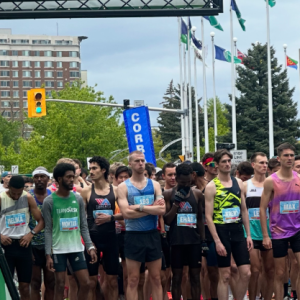
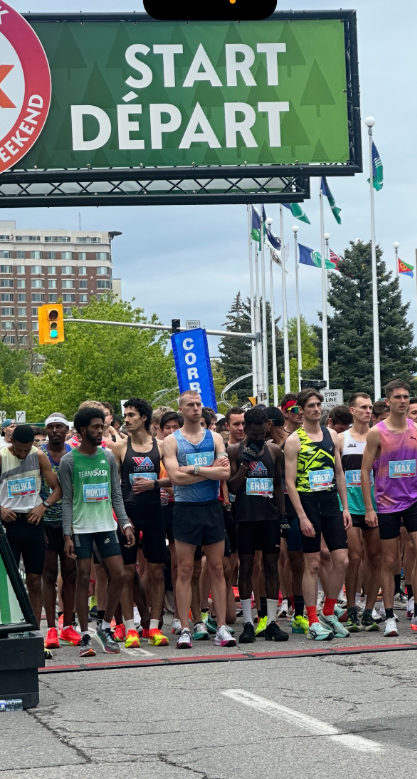
Start of the elite men’s race. Elite runner and TRR Coach Thomas Nobbs in the center wearing bib 193.
There’s something unforgettable about racing in Ottawa. The energy, the layout, and the chance to run alongside Canada’s best make the Ottawa 10K one of the most electric and accessible races in the country.
“By the time we hit the Bronson bridge at 5K, I knew it was one of those rare days cool air, smooth legs, and the buzz of a big race on a perfect course.”
This year, I had the chance to coach three athletes in the Canadian National 10K Championships, and all of them walked away with massive personal bests. But whether you’re gunning for the front or just hoping for your fastest time yet, this course delivers and I’m going to tell you why.
Ottawa 10K Course: Fast, Flat(ish), and Fair
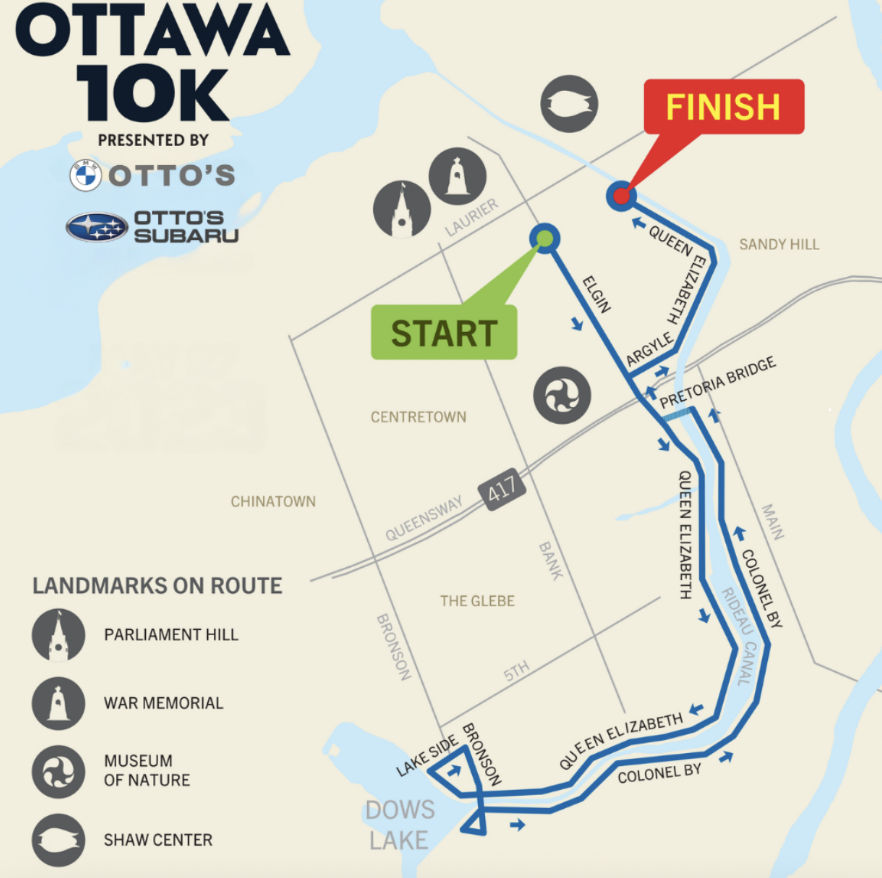
The Ottawa 10K race course is essentially a curving out-and-back that hugs the scenic Rideau Canal. If you’re into races that balance crowd energy with PB (or “PR” for our American friends) potential, this one checks all the boxes.
Here’s what to expect:
Start to 5K: Slight downhill, packed crowds, easy to go out too fast. Soak up the energy, but check your watch.
Bronson Bridge (~5K): Short incline over the overpass—the only real climb on the course. Stay relaxed and know you’ll get it back soon.
Back half: Flat and honest. Focus on running the tangents as the course curves alongside the canal.
Pro Tip: If it’s windy on the way out, you’ll likely be shielded or helped on the way back due to the layout of the canal path. Stay patient early and aim for a negative split.
Race-day soundtrack: Optional, but if you run with music, expect it to get drowned out by the crowd noise through the first 2K in a good way.
Ottawa 10K race course.
The Conditions: Cool, Crisp, Perfect
This year brought ideal racing conditions–a cool spring evening with overcast skies. If you’ve raced the Ottawa 10K before, you know it can get hot, but 2025 gave us one of the best setups in recent memory. No excuses. Just fast racing instead.
Real Results: What’s Possible on This Course
Three of my longtime athletes (and TRR coaches) used the Ottawa 10K as part of their spring speed series before heading into fall marathon prep. They were in different phases of training, but all walked away with PRs:
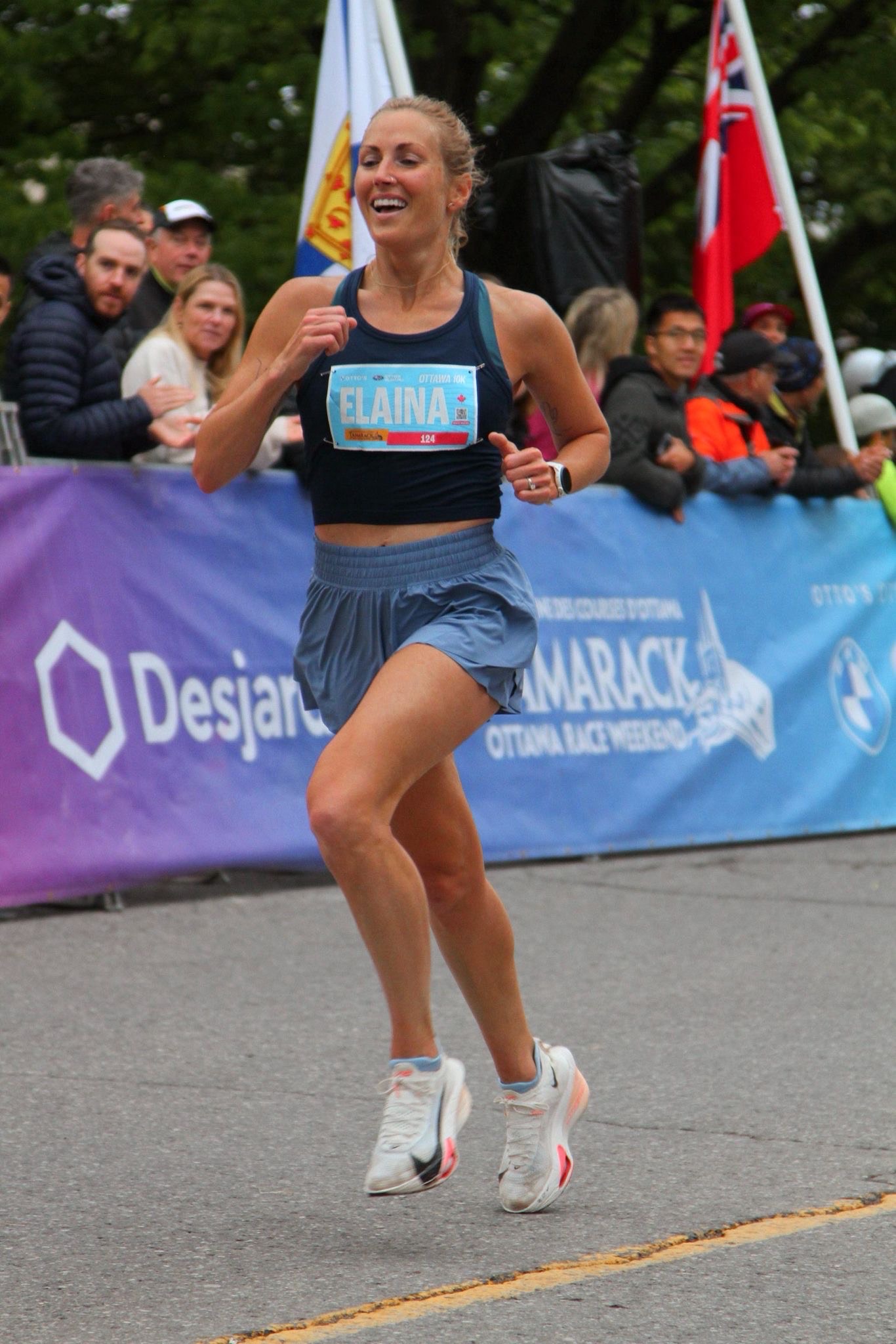
Elite runner and TRR Coach Elaina Raponi racing the Ottawa 10K.
Thomas Nobbs – 6th in the men’s national field in 28:58
These are athletes I’ve coached for years and what this race showed again is that when you combine great prep with the right course and competition, magic happens.
Ottawa 10K Logistics: Stress Free and Spectator Friendly
Expo: Quick in and out. Bib pick-up took under 10 minutes.
Gear check: Efficient and easy to access post-race.
Bathrooms: Ample, never a long wait.
Warm-up space: Tons of room around City Hall, as well as along Elgin Street and the Canal.
And if you’ve got friends or family coming to cheer? They’ll love it. The canal path makes it easy for spectators to see you multiple times, both by bike and foot, and the finish area is super accessible from both sides of the city.
Mental Notes: Strategy Tips for First-Timers
Don’t get greedy early. The downhill start and crowd noise will tempt you to go out too fast. Hold back.
Stay smooth over Bronson. It’s the only climb, and you’ll get rewarded with a downhill right afterwards.
Run the tangents! The curves along the canal are deceiving, therefore running the tangents can save seconds.
Save something for the finish. You’ll hear it before you see it, and there’s nothing like closing strong with the crowd going wild.
Final Thoughts: Should You Race the Ottawa 10K?
100% yes!
The Ottawa 10K is a course that rewards smart racing, attracts deep competition, and offers a smooth, exciting experience from start to finish. Whether you’re chasing your first 10K finish, your fastest, or something in between, you’ll have everything you need to run your best.
So when you’re planning your 2026 race season, mark the Ottawa 10K down.
Brant Stachel is a coach with Team RunRun based in Kingston, Canada. He works with runners and triathletes of all skill levels, from beginners to international and professional athletes.
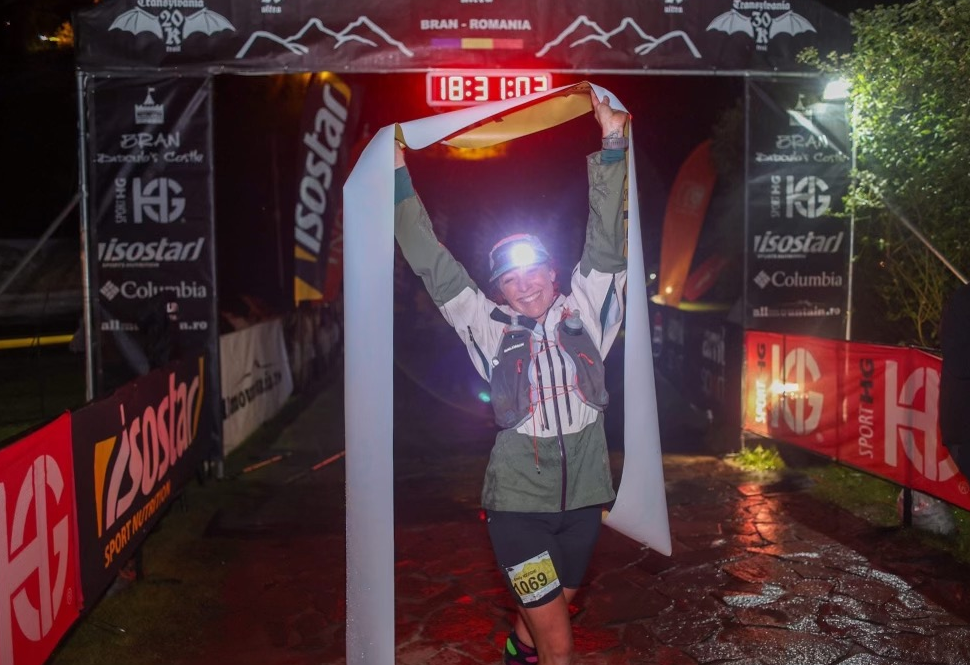
TRR Coach Emily Keddie winning the Transylvania 100K in Romania.
3 Bests – What aspects of the race did you like the most?
It is hard to highlight only a few things about the Transylvania 100K: a great problem to have!
Organization and execution: From the course markings (including blinking lights marking the way for nighttime), to the fully manned and stocked aid stations, and the well-planned race expo and awards ceremony, it is clear that this race has nailed every aspect over the past 10 years.
Stunning scenery: It calls to mind the ascents and descents of Tour du Mont Blanc, mixed with the rugged feeling of Crazy Mountain 100, and the technicality and trail-less aspects of Swiss Peaks or Tor de Geants. The course takes runners up into the alpine and then down, back up again and then down, proving constantly changing views and terrains. You get an intimate experience of the Bucegi Mountains.
Excitement and camaraderie: Both were contagious. The stoke for this race is very high, with people come back year after year. For 2025, there were almost 2,000 runners over the 5 different race distances. Running in other counties with racers of different nationalities is fun and exciting: an opportunity to share common ground (literally) with people from around the world.
Not so much – Aspects of the race that didn’t do it for you
There really wasn’t anything I didn’t enjoy or appreciate about this race. It is extremely challenging with over 21,000 feet of elevation gain, making it the most difficult 100K I’ve completed by far! Conditions—mainly the amount of snow on course—vary. The weather seems similar to Colorado in the U.S., where storms can come on quickly in the afternoons and become quite severe, as one did the night before the race. There are also brown bears—an equivalent of grizzlies—so runners often pair up for safety.
Weird factor – What’s the weirdest thing about this race?
One weird and certainly unexpected thing was seeing a dead brown bear! I kept saying I wanted to see a bear (just maybe not up close), and I did! A couple runners (not in the race) I passed told me I’d see a dead bear ahead. I wasn’t sure if they were kidding or not, so it still took me by surprise when I came across it suddenly right on the trail. It was massive!
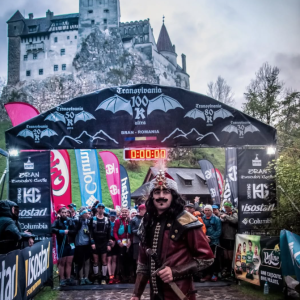
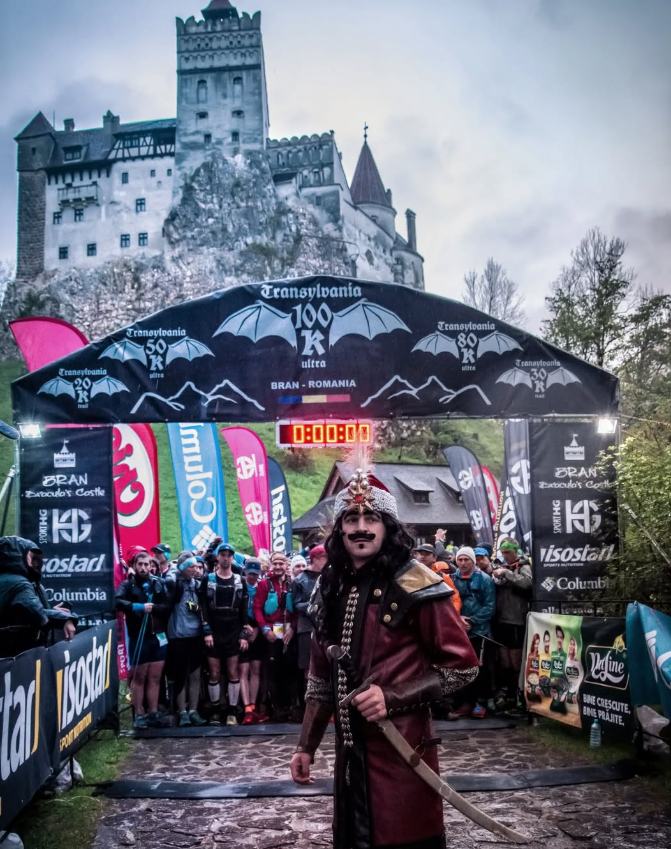
Also weird, but very cool, is that the Transylvania 100K race starts right beneath Bran Castle, better known as “Dracula’s Castle.” It has to be the most unique start/finish location I’ve ever been to.
Highlights of your race – What did you do well and enjoy about your race in particular?
This was the first time I can truly say I “ran my own race.” Coming off an overuse injury in my shin from racing a lot early this year, my training milage had been quite low and I wasn’t sure I was back to 100%. Even hiking in Romania the week before the race, I could feel it mildly. My plan was to start easy and smooth, pay attention to my body, and not run through pain, as I didn’t want to set back all of my recovery progress. The further I got into the race, the more surprised I became that my shin was holding up great. When people started to tell me I was in first place, I couldn’t believe it! From there, I just continued to move smoothly, rather than pushing myself into a potentially unsustainable higher gear. Just completing the Transylvania 100K would’ve been a success.
The beauty of the race, superimposed with the difficulty, was both such a challenge and reward. You have to be incredibly determined.
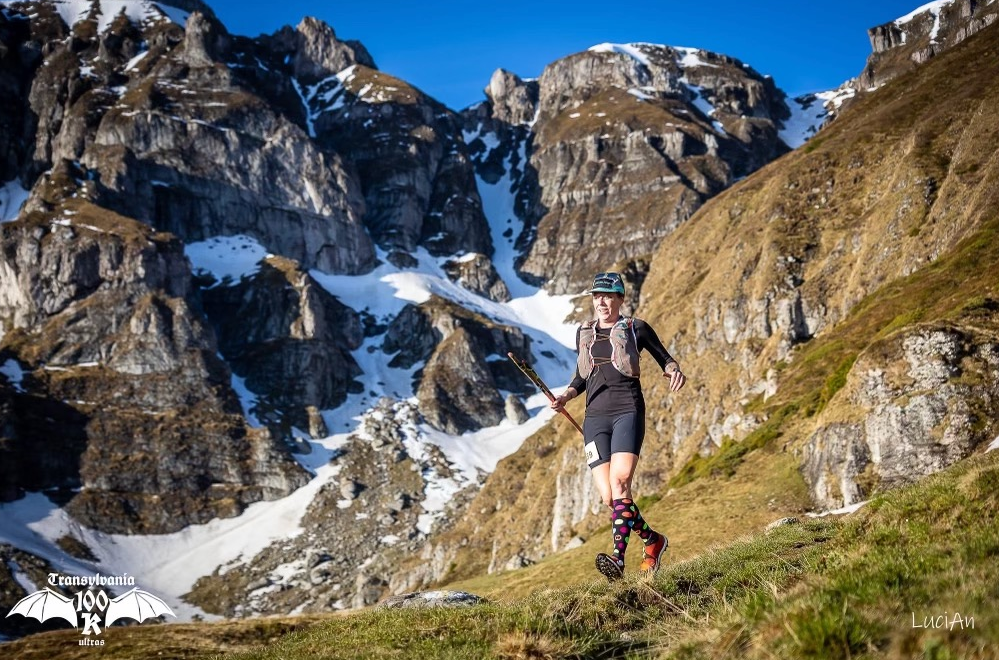
A look at TRR Coach Emily Keddie running the beautiful, yet challenging, Transylvania 100K course. PC: Lucian Anghel
Lessons for others – Share your pro-tips on the race to help the next runner
You really need to practice steep uphill hiking for this race. You use completely different muscles to hike a 30-40 degree slope (common in this race) compared to 10-20 degrees outside or on a treadmill. There are also several “no fall” areas, meaning if you trip or slip off the trail, you’ll very much injure yourself, or worse.
It is extremely rugged. Expect your time to be longer than you think, because the terrain is highly technical. Before the race, you want to be familiar with using your poles, including having a good system for putting them away/taking them back out again. Also, some water stops are spread quite far apar, so making sure you carry enough water is important!
Lessons you learned that will help you next time around
Pacing! I read shortly before the race started a reminder for runners not to go out too fast for the first climb (about 8-9 miles). At around 4800 feet, this first climb is huge and will leave you tired no matter what! I let my body adjust to the demands of the course, not worrying who passed me or my pace, and ran more by feel. After that, I eased into running the flats and downhills so that my legs could recover.
While the front half of the race has a ton of climbing, it doesn’t necessarily make the back half easier. The rugged terrain never ends!
Most important course specific knowledge to know about the race
Definitely download the course GPX onto your watch! The course is very well marked, but there are a few times you’ll exit a dirt road onto a less obvious trail (or no trail) and it’s easy to miss these even with markings.
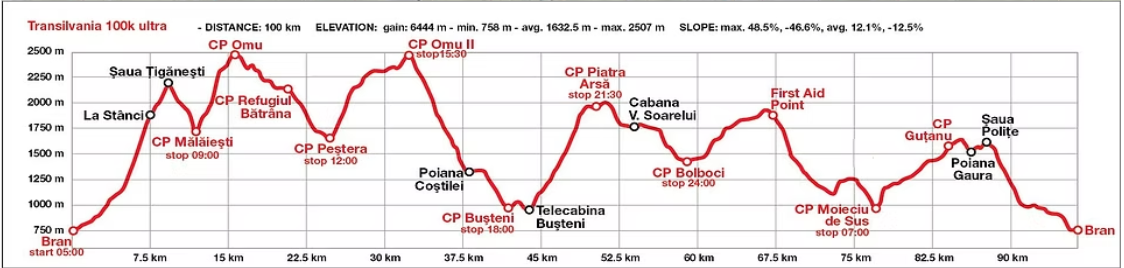
Then make note of what to expect with the elevation. The first 28 miles has around 12,000 feet of gain, leaving 9,000 feet for the other 35 miles, but it’s not a lot easier. The high point is around 8100 feet, and you get close to that twice within the first 28 miles! Remember that every time you drop down, you’re about to go right back up! Enjoy the runnable trails and dirt roads, they are a reprieve.
Aesthetics – Is it a pretty course?
The Transylvania 100K course is extremely beautiful. There are jagged mountains, rock formations, beautiful alpine rolling hills, lush forests, small towns, lakes, and, of course, the castle. One of my favorite courses for sure!
Difficulty – Is it a tough course?
Beautiful and rewarding, but the most difficult 100K race I’ve ever done! It is up there in difficulty with the Ouray 100 miler, Swiss Peaks 360K, and Crazy Mountain 100. If you like vert heavy races, the Transylvania 100K is one for you! Expect technical trails, steep and scrambly descents, snow traverses, and plenty of rocks, roots, and mud.
The 31 hour cutoff on a course this tough poses another challenge.
Transylvania 100K course elevation profile.
Organized and well run – Did it feel like a well-oiled machine or were they flying by the seat of their pants?
This was the 10th edition of the Transylvania 100K, and it was run exquisitely. Everything was well organized, making for a great runner experience.
Competition – Is there a strong field?
This year there was a lot of press over François D’Haene (legendary trail and ultra runner; multi-time UTMB winner and course record holder) competing in the 100K. I stood near him at the front on the start line, knowing he was the favorite to win, and having no idea that I would be the female winner! There were strong females in the race, and the men’s field was very strong too. Nationality-wise, there were very few Americans in it.
Logistics – Does it require a special handshake, registration a year in advance, hotels all booked? Give us the low down on the nuts and bolts of making the race happen.
This race is extremely affordable. It did not sell out, and it only cost 100 Euros (currently that is around $125 US). For a week in Romania, including airfare, Ubers (do not bother renting a car), trains between Bucharest, Brasov, and Bran, all meals, and the race, it cost under $2,000. We did have apartments booked ahead of time—I recommend trying to book something in Bran as close to the race start/finish as possible. Brasov is an excellent place to spend the week before the race, with plenty of trails and exploring for that taper week. Nearly everyone speaks English everywhere we went, making travelling and being tourists quite simple.
Aid Stations – Standard fare or anything special to know about the aid stations in terms of what’s available or when?
Aid stations were wonderful. I brought plenty of my own snacks and actually ended up eating very little of them! Most were stocked with fairly standard offerings: pickles, olives, chips, wafer cookies, sour gummy worms, nuts, etcetera. Some aid stations had hot food: soup, pizza, and pasta arrabbiata. Isostar is the on-course hydration brand, common in Europe, and it is actually my favorite electrolyte drink of all. There was one place for a drop bag, surprisingly early on at mile 28. I didn’t need or want it at that point, wishing it was available later, but grabbed a few snacks and changed out my jacket. The race provides the same 10L drop bag to every runner—I couldn’t fit my shoes in it, so used the same pair for the whole race.
Weather and typical race conditions
The race start line below Bran Castle (better known “Dracula’s Castle”) in Romania.
Warning, this is a mountain race with weather similarly unpredictable to Colorado in Spring! There were significant snow sections throughout the first half of the course, and microspikes were recommended but not required. The amount of snow on course varies year by year though, so it’s not always a given. I ran in shoes with sizable lugs (Speedland GL:SVT), which were the perfect shoe for this race with all of the snow and mud. The weather forecast called for rain, but fortunately it held off until the last 2 hours. And the temperatures were in the 40’s-60’s degrees Fahrenheit (5-15 degrees Celsius).
Gear – Did you need anything special or is there anything you’d recommend for the next runner?
I would absolutely recommend using poles, as well as having a well-practiced system for stowing your poles. Opt for shoes with a more aggressive tread capable of handling a wide variety of gnarly terrains in different weather conditions. Also, give your nutrition carrying capacity some thought: I only brought two 600ml flasks, but wished I had a third at a couple points.
Spectators – Is this a friendly course for your friends?
I forgot that many of the other runners are from here, and therefore had crew throughout! I did not have crew, but had help from people at aid stations, and there were people cheering in the towns we ran through. A lot of the course isn’t easily accessible for spectating, but for family or friends who want to join in the fun, there are tourist activities they could do during the race! The finish line setting is spectacular, and there is an awards ceremony at the conclusion of the race on Sunday, both of which are great for spectators to enjoy too.
How’s the Swag?
The swag is outstanding! All of the runners get a t-shirt, and extra one is optional. You’re provided a 10L drop bag, and a printed map of the course which you are required to carry. Also included in the runner’s swag was a bag of chips, protein bar, and chip timer which was scanned many times at checkpoints throughout the race. At the finish, a medal is presented.
On top of that, the winner’s swag was the most extensive I’d ever seen: two more shirts, two buffs, a hat, Scott trekking poles, a Columbia 7L running vest, commemorative plaque, book about Bran Castle, and a bottle of Romanian red wine! Absolutely incredible!! The race director also let me keep the finish line time: a really fun souvenir I have yet to decide what to do with.
The Overall Score – How many stars do you give this race and do you recommend that others run it?
5/5 stars for the Transylvania 100K, without question, and 10/10 I would do it again! It was a great international trip to a unique country, a really well organized race, stunning, and challenging.
Emily Keddie is a coach with Team RunRun based in Bend, OR. She is an experienced runner and dedicated coach, with a PhD in Psychology. Emily coaches a wide range of athletes in road and trail/ultra running, from 5K to 200+ mile distances.
If you’re reading this, I’m assuming you want to actually improve your running or, as is the case with a coach or friend, help another runner improve. This is the article for you.
Let’s get this out of the way: stock running plans aren’t cutting it anymore.
Sure, they’re accessible. Sometimes free. They look neat, pre-packaged, and “official.” But if you’ve ever felt confused mid training, plateaued in performance, or suffered an injury that “shouldn’t have happened,” then you’ve experienced what many runners discover too late: one-size-fits-all training plans rarely fit anyone well.
Two runners with Team RunRun coaches who write them unique and personalized plans.
If you’re serious about improving–whether it’s chasing your first 5K, qualifying for Boston, or anything in between–it’s time to rethink your approach and consider what happens when your plan actually fits you.
The Illusion of Personalization in Stock Plans
Stock plans try to offer simplicity: pick your race, plug in your finish time goal, and boom, here’s your 12-week roadmap! The problem: you’re not a spreadsheet. You’re not a series of formulaic, quantitative data that an algorithm can detect and use to optimize your training. You’re a human being with a unique history, schedule, stress levels, strengths, weaknesses, and recovery curve.
Stock plans can’t possibly account for:
Injury history
Work, family, and life demands
Other external stressors
Variation in recovery ability and training adaptations
Your natural pacing skill
Sleep, nutrition, health
The result? You attempt to force your life into a plan, rather than fitting your plan into your life.
Short-term, this might work for you and you may see results. Long-term, however, life interferes and any number of the above factors make strictly adhering to the stock plan, at best, challenging, if not impossible. Your progress stalls, motivation drops, and the goals you set for yourself now seem totally out of reach.
Real Coaching = Real Results
When you work 1-on-1 with a running coach, the difference is immediate and powerful. You’re no longer a name on a download list. Instead, you’re a person whose training plan evolves as you do.
What personalized online coaching actually delivers:
Customized plans built for just you, not mass-produced
Ongoing adjustments based on feedback, fatigue, or surprise life events
Direct communication with someone who knows your goals
Injury prevention and recovery support
Race strategy, pacing advice, and mental coaching
Accountability, motivation, and insight from an expert who sees your blind spots
But What About the Cost?
Sure, online coaching isn’t free. But neither is lost time through ineffective training, injury costs like doctor and PT appointments, frustration, or months of guessing. Let’s frame it differently: if you spend hundreds on shoes, gear, and race entries, shouldn’t you also invest in your training to make those other expenditures worthwhile?
And here’s the kicker: 1-on-1 coaching is more accessible, and affordable, than you think. At Team RunRun, our coaching starts at $1/day, much less than a coffee–or energy gel–a day! In fact, that’s also cheaper than many paid stock plans and online programs!
Want to Actually Improve Your Running? Here’s Why Coaching Wins
This Team RunRunner used a 1-on-1 coach to actually improve their running amidst a busy life and parenting.
Let’s bring this home. You want results. You want confidence. And overall, you want to get to the start line healthy and to the finish line proud.
That doesn’t happen by luck. It happens when your plan:
Adapts to your [unique] body
Flexes around your [unique] life
Builds your [unique] strengths
Addresses your [unique] weaknesses
And none of that comes in a downloadable PDF.
Still Not Sure? Ask Yourself This…
Do I want to keep guessing, or start progressing?
Am I running the same race year after year with no improvement?
Do I need someone to help me balance running with my busy life?
Would I benefit from an expert guiding me to peak performance?
If you answered yes to even one, it’s time to leave the stock plan behind.
How to Actually Improve Your Running: Work With a Team RunRun Coach
At Team RunRun, we pride ourselves on having a coach for every runner. We’ve helped thousands of athletes:
Progress consistently
Stay healthy and injury-free
Crush new PRs
Qualify for Boston
Fall in love with running again
Our coaches listen, adapt, and coach the runner in front of them.
Ready to actually improve your running? View our coaches here and get started today!
FAQs
Here are some of the questions runners transitioning from a stock plan to individual coaching often ask me.
Q. What if I’m just a beginner? A. That’s exactly why you need a coach. You’ll avoid common pitfalls and set a foundation that lasts.
Q. What if I miss runs or get sick? A. Your coach adjusts the plan in real time: no guilt trips, just smart training.
Q. Can I still follow a race specific plan? A. Absolutely, because your coach builds your plan around your race, your individual goals, and your unique timeline.
Q. How often do I talk to my coach? A. That depends on your coach, but most runners get daily or weekly feedback and messaging support.
Q. Is online coaching worth the money? A. Short answer: yes. Runners waste more on race fees, physio appointments, and gear than they would on coaching that prevents the disappointment of missing a goal or being injured.
Brant Stachel is a coach with Team RunRun based in Kingston, Canada. He works with runners and triathletes of all skill levels, from beginners to international and professional athletes.
Warmer weather is creeping into the training season–at least, it is for those of us in the northern hemisphere–alongside the talk of hydration and electrolytes for runners. Similarly to carbohydrate consumption, hydration is currently another trendy topic and “electrolyte” has become a buzz word. It seems there are an endless number of new hydration mixes and electrolyte options popping up. Should runners be paying attention? Do these salt mixtures really work?
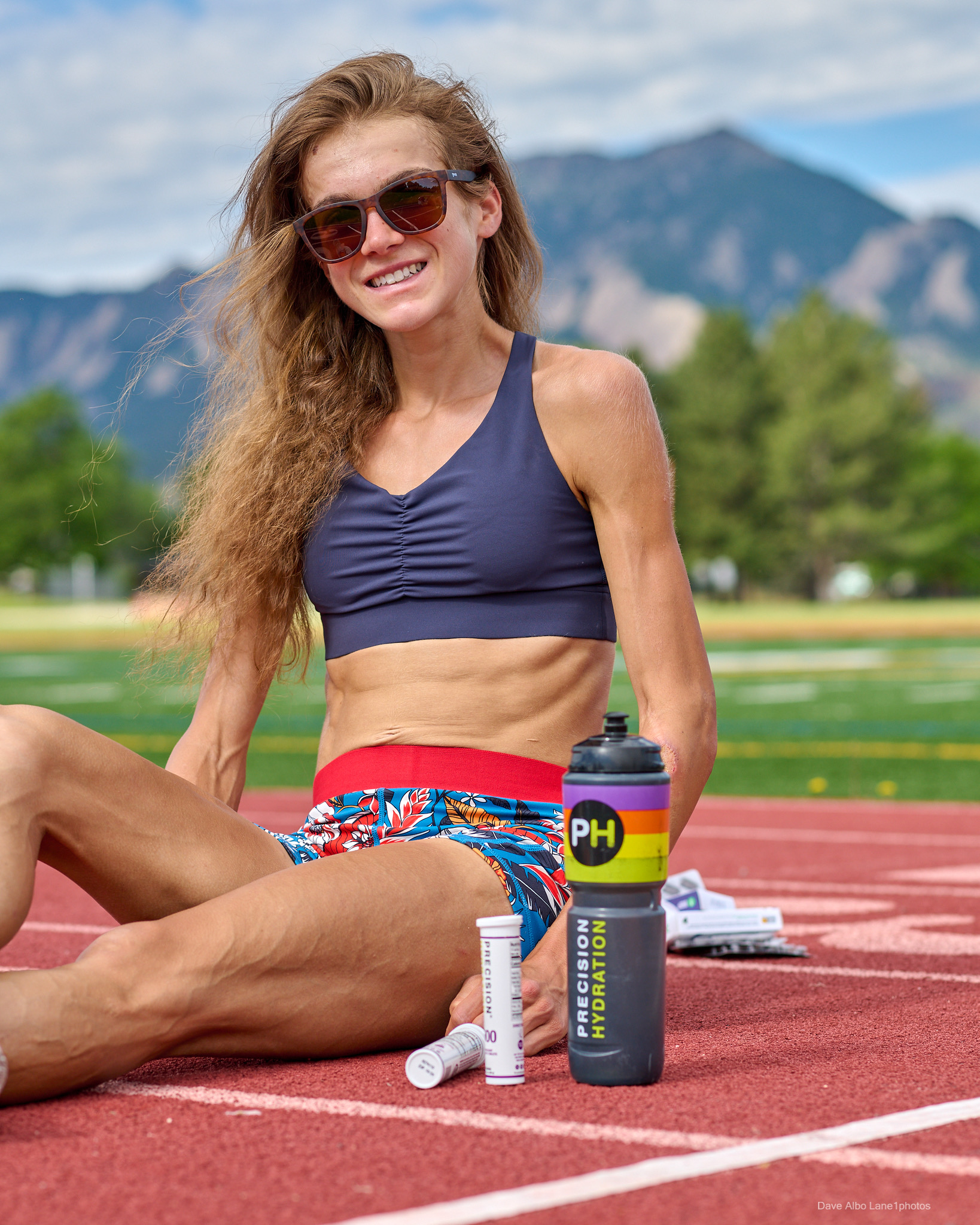
Runner rehydrating with Precision Fuel & Hydration PF 1500 electrolytes. PC: Dave Albo
An Introduction to Electrolytes for Runners
It’s not all marketing hype. Electrolyte balance is important when training. As temperature and humidity rises, the body’s electrolyte equilibrium can get out of whack during our long runs. The major electrolyte lost is sodium, followed by potassium, calcium, and magnesium. Replacing these electrolytes will keep your runs feeling good and your body functioning as it should.
Why do we Need Electrolytes?
Electrolytes are needed by the body to maintain fluid balance and, especially relevant to us runners, for optimal muscle contraction. On top of that, electrolytes are essential for cognitive function, absorption of nutrients from the gut, and the nervous system.
When the Electrolyte Balance is Upset
Consuming electrolytes during runs longer than 60 minutes helps to maintain blood volume and pressure. This maintenance is vital for adequate blood flow to our working muscles, not to mention the rest of our body for basic functioning. When blood flow diminishes, we start to experience negative effects in our workouts or race.
Symptoms of this imbalance range from fatigue, muscle weakness and cramping, to medical emergencies and even death. For the heavy sweaters out there, even with the slightest increase in temperature, consuming electrolytes during runs can be beneficial.
Understanding Sweat Rate and Electrolyte Loss
While figuring out your exact rates of sweat and electrolyte loss during sport can be complicated, there are ways to approximate them.
For a simple calculation of sweat loss, simply weigh yourself before your run and then immediately after. For optimal accuracy, weighing yourself without any clothes on is recommended, and avoid using the bathroom between the two weigh-ins if possible. Clothing will absorb sweat during your workout and may result in your post-run weight being higher than it should. Whereas using the bathroom will lead you to believe your sweat loss is greater than reality. Weigh any fluid or nutrition consumed during your run and subtract that from your post-run weight. The difference between your pre- and post-run weights reflects your sweat loss.
For reference: 16 fluid ounces of water = 1 lbs; 1 liter (1000 ml) of sweat weighs 1 kg
Once you have calculated your sweat loss, you can estimate electrolyte losses too.
According to Trailrunner Magazine, 315 ml (~10.5 oz) of sweat contains, on average, 220 mg of sodium, 63 mg of potassium, 18 mg calcium, and 8 mg magnesium
315 ml (~10.5 oz) of sweat = ~220 mg of sodium, ~63 mg of potassium, ~18 mg calcium, ~8 mg magnesium
Unfortunately, the electrolyte breakdown of sweat varies wildly between runners, likely due to genetic factors. However, these provide a useful starting point for understanding your losses, especially in relation to the electrolyte composition of different sports nutrition products. From here, use some trial and error to dial in your hydration strategy.
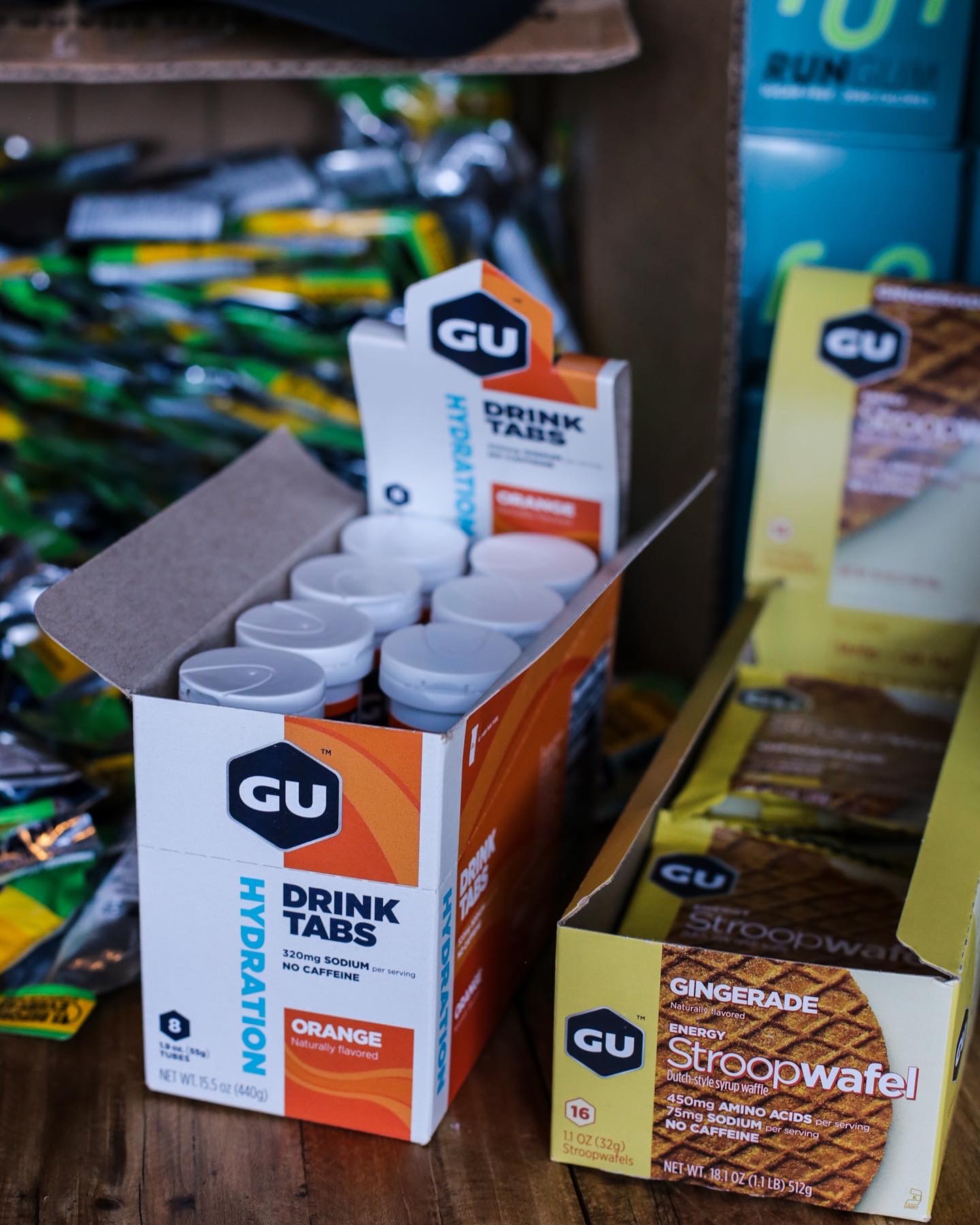
GU Energy hydration drink tabs.
More precise sweat and electrolyte data can be gathered through scientific testing at many sports facilities and labs. This offers runners more detailed insights into their unique hydration and electrolyte losses, allowing for specific fluid and electrolyte consumption plans to be made.
As with nutrition, you should develop a personalized hydration plan for consuming fluid and electrolytes when running, then refine it during training. Remember, your needs will vary depending on the heat and humidity, so be flexible with your plan.
It’s not uncommon to find drinking while running a challenge. Popular reasons runners give for not drinking include breathing difficulties, coughing or spluttering as they try to sip and swallow, not wanting to feel fluid sloshing around in their stomach, or perhaps simply the awkwardness of carrying a drink. The solution to all of these? Practice. Start small, then gradually increase your consumption as you become accustomed to it. Trust me, the benefits of fluid and electrolytes for runners outweigh the negative effects that you may experience at first.
How to Replace Electrolytes While Running
Thankfully, today the electrolyte industry is booming! There are a wide array of options that are more appealing to athletes’ palates and easier to consume than ever before.
On the run, electrolytes can be taken in many forms: drink mixes and powders, dissolvable tablets, salt pills, ready-made liquids and sports drinks.
Common choices and their breakdown of key electrolytes for runners:
(Note: nutritional information is for when prepared/ consumed as directed)
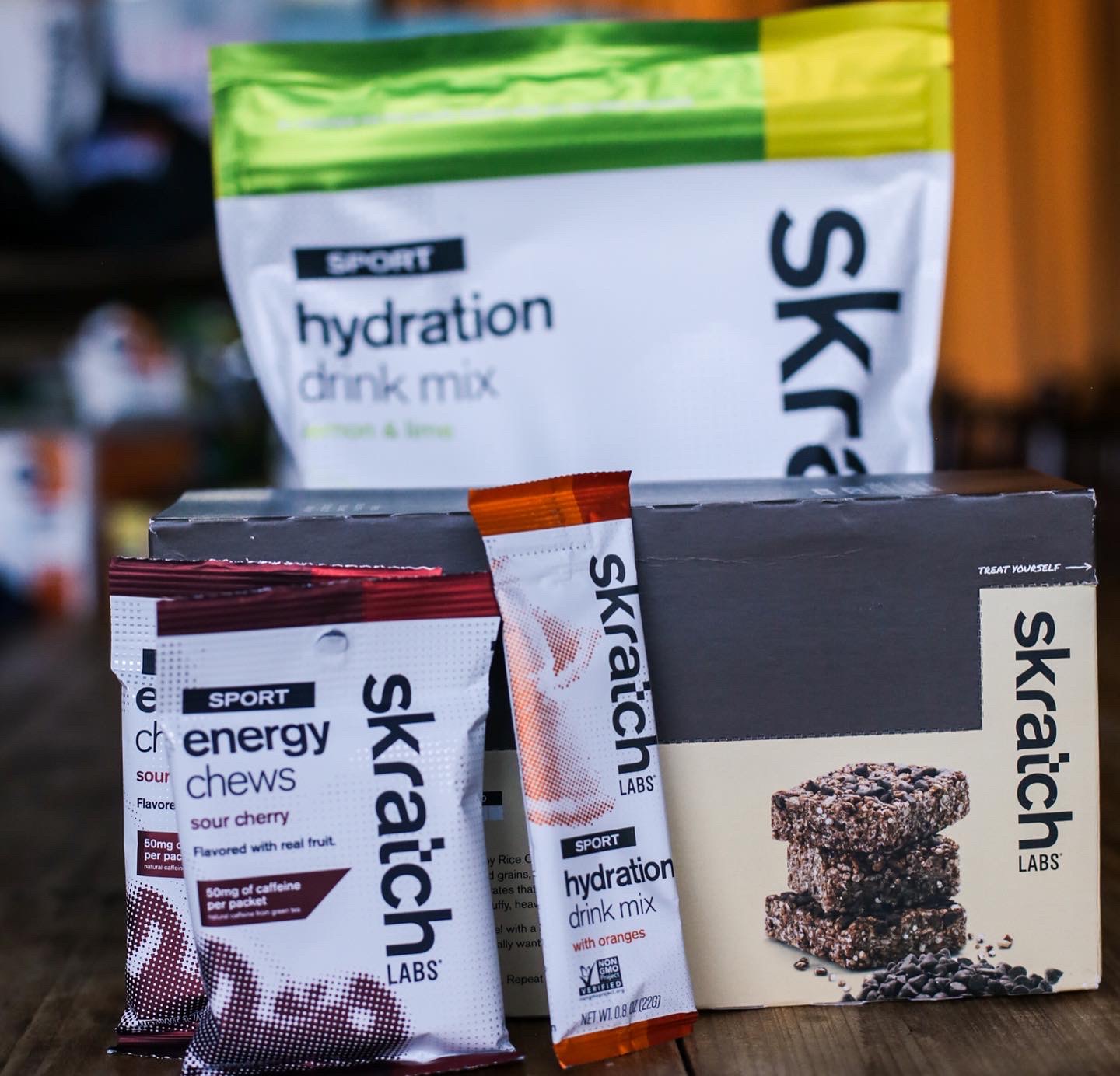
Skratch Labs hydration drink mix and sports nutrition products, one of many kinds of electrolytes for runners.
Find one that you like the taste of and, importantly, sits well with your stomach while running. Practice in training so when race day arrives, you are ready to go the whole distance!
Rebecca Holso is a coach with Team RunRun based in Rapid City, SD. She specializes in road races, helping athletes balance a busy life while working toward their personal goals.
There’s a sad part of coaching no one really prepares you for. It’s not in the books or the certifications. It’s rarely mentioned in coaching circles. But if you’ve coached long enough—especially youth or young adults—you know exactly what I’m talking about.
It’s the goodbye.
A Team RunRun athlete at the Cocodona 250 finish line, which may also mark the end of a coach-athlete partnership.
The day every athlete, eventually, moves on.
When a Coach-Athlete Partnership Ends
Sometimes they head to a different program. Perhaps they age out or shift their focus. And sometimes, they just outgrow what you can offer. It’s not always a dramatic departure. Often, it’s quiet—gradual even. A drift. A change in goals. A new direction. And while we know from the beginning that we’re part of a journey, not the whole story, it doesn’t make it any easier when the chapter ends.
I was reminded of this recently as I scrolled through old group photos—snapshots from workouts, races, and post-run coffees taken over the last decade. Faces frozen in time. Some I knew would stick it out. Some surprised me and did. And then there were the ones I was sure would-be lifers, but they never made it past the start line. Smiles, heartbreaks, tears, and joy—all wrapped up in these people. Every one of them shaped me as much as I may have shaped them.
Because the truth is, as coaches, we pour a little piece of ourselves into every athlete. Not just into their training plans and feedback sessions—but into their growth. We see potential they might not yet recognize, and we help them discover what’s possible.
And then, one day, they go.
A Relationship Destined to Cease
That’s the job, really. To take someone as far as they can go with you—or as far as they want to go. And then, to let them go, hopefully more prepared for whatever’s next.
I actually try to acknowledge this truth right from the start. I tell every athlete I work with: if it ever stops working—if your needs change, if life shifts, if it just doesn’t feel like the right fit anymore—don’t stress about it. Don’t overthink it. Just say, “Hey… thanks… but…” and I’ll understand. That moment isn’t a failure. It’s just part of the process. And it remains the sad part of coaching.
Coaching isn’t about holding on—because coaching, at its core, is about giving. It’s about believing, building, and eventually becoming a spectator on someone else’s journey.
I still enjoy getting the texts and phone calls—hearing how someone did, where they are today. Sometimes they call me as the coach. Other times, it’s validating as an observer. But that’s life. And honestly, it’s a privilege either way.
Corey Turnbull is a Team RunRun Coach based in Ottawa. He works with beginners just starting out or with seasoned runners looking for a breakthrough. Corey helps athletes maximize the limited training time they have, prioritizing consistency, focus and fun.
And how to get the most out of your summer training.
Before diving into the topic of heat adjusting your running paces, let’s start with a quiz.
Team RunRun athlete racing successfully in the heat.
What feels easier: running 10-minute miles in 55°F or 85°F?
If you’re like most people, you probably said the first option—and with good reason. Same pace, but completely different conditions. Running in the heat simply feels harder.
Reduced blood flow to the working muscles means less oxygen delivery, more cardiovascular strain, and a higher heart rate at any given pace. And when your heart is working harder, your perceived effort goes up—even if your pace stays the same.
When it’s hot out, your body goes into “survival mode”, so to speak. To keep your core temperature in check, your body redirects blood flow toward your skin to help you cool down through sweating. But here’s the catch: that blood has to come from somewhere. In this case, the body redirects some blood away from your working muscles and towards the skin.
What Happens When You Don’t Heat Adjust Your Running Paces?
Trying to force your usual pace—whether that’s easy pace, marathon pace, tempo, or anything in between—on a hot, humid day can lead to burnout, dehydration, or worse, heat-related illness.
Even if you manage to push through and run your normal paces, you’re not training smart.
Ever heard the expression “Just because you can, doesn’t mean you should?” That’s especially true in this scenario.
Pushing through without adjusting for the heat might feel like a win in the moment, but it comes with a cost. Recovery gets harder, progress slows, and you risk burning yourself out.
An athlete doing a track workout in the heat using perceived effort to heat adjust their running paces.
Why Is Heat Adjusting a Smart Strategy?
Heat adjusting your running paces isn’t a sign of weakness. On the contrary, it’s a sign of maturity as an athlete. While it may mean putting your ego on the shelf and slowing down in the heat, it also shows that you’re more in tune with your body and the conditions you’re running in.
Many experienced athletes use pace adjustment charts or calculators (such as VDOT) to determine how to heat-adjust their running paces in warmer conditions. The higher the temperature and humidity, the greater the adjustment.
How to Heat Adjust Your Running Paces
Use perceived effort. Focus more on how the effort feels rather than what the pace says. Don’t stress if you’re a few seconds slower than your normal tempo pace, so long as you feel like you’re running tempo effort.
Listen to your body. If your heart rate and breathing feel more elevated than usual, take a log off the fire and slow down the pace a bit.
Hydrate more frequently. Be proactive rather than reactive. Don’t wait until you’re thirsty to hydrate. Hydrate early and often during warmer conditions.
Extend your recoveries. Warm temperatures place extra strain on your body, so don’t be afraid to take more rest between intervals or sets.
The Big Picture
You’re not weak for slowing down in the heat—you’re wise. Trust your coach, trust the process, and trust that showing patience now will lead to performance later.
Elaina Raponi is a coach with Team RunRun based in Kingston, Ontario. Elaina loves helping athletes of all abilities and experience levels achieve their goals, while finding confidence and joy in the process!
How to get the most out of the relationship with your online running coach.
Two happy athletes meeting their online coach from Team RunRun in person at a race.
Building an effective coaching relationship is essential for fostering an athlete’s self-worth and confidence in running and life outside of sport. Rick McGuire, author of Chapter 1 on Positive Coaching in USATF’s Track & Field Coaching Essentials1, describes a running coach as an “environmental engineer” who helps create a positive atmosphere for athletes. As such, the coach-athlete relationship demands considerable attention.
For adult runners with demanding schedules, an online coach can provide flexibility and convenience where in-person coaching may not be feasible. However, online coaching has faced criticism for lacking personalization, providing generic training plans, and using athletes to generate income with minimal thought and effort. Therefore, it’s natural for athletes to wonder if the experience they are receiving from their coach is being fully utilized and tailored to their needs and expectations.
Despite the challenges of remote coaching, with a little effort, it can be equally as rewarding as working with an in-person coach. In this article, we’ll explore key principles for building an effective coaching relationship.
Define Communication Expectations and Research Coaches
An important first step in maximizing the coaching relationship is to define why you’re hiring a coach. Before contacting the coach, researching the coach’s background and determining your preferred communication type and frequency can indicate how successful the athlete/coach match will be. Use the initial intake call to discuss running history, injuries, training patterns, and goals, and ask prospective coaches about their interaction level, athlete load, and approach to building training plans.
Provide Honest and Frequent Feedback
Providing feedback on training sessions is one of the most beneficial actions an athlete can take to assist the coach and make the coaching relationship more successful. In-person coaches can observe an athlete’s mood, physical health, and fatigue before, during, and after workouts. Coaches can then make training adjustments based on these observations.
In contrast, remote coaches are limited to the outputs of the watch versus the workload as prescribed. Without athlete-driven feedback, there is little to indicate why paces were or weren’t achieved. This can lead to coaches misinterpreting athletes’ training, guessing at the apparent mismatch in workload to current fitness level. Ultimately, this can increase injury risk and sacrifice optimal performance on race day. Leaving feedback for a remote coach with honest insights about how workouts feel allows for conversations around the non-physical–but equally important–areas of the sport: mindset, confidence, enjoyment of the training, and more.
An athlete writing feedback for their coach in their training diary: a key principle for building an effective coaching relationship.
Honesty in feedback is essential. Athletes might hesitate to disclose injuries or issues due to fear of judgment or negative consequences. However, withholding such details handicaps the coach from providing the best plan for the athlete. For athletes uncomfortable or unable to share, general phrases like “work stress”, “family schedule”, “medical situation in the family”, etc., are often more than enough insight to allow the coach to guide an athlete’s training more productively.
Ask Questions
Another key principle to building an effective coaching relationship is not being afraid to ask questions. Tonya Phillips, an athlete working with an online coach, began the tradition of asking questions in the comments section of her running log. This allowed her to learn why her training is programmed a particular way, how her coach sees things, and ask for advice on everything from nutrition to footwear. Phillips also used the process of asking running-related and personal questions as a way of building trust.
Tonya Phillips: “Initially, I only knew my coach by their coaching profile page, as well as their history as a successful runner and coach to others. But through these questions, they became more than a name to me. I have a person who cares enough to think about my questions and answer them. And I trust the information I’m receiving.” She adds, “If I’m a silent participant, it doesn’t help the coach or me progress. Questions help us both.”
Explore Other Opportunities for Interaction
Team RunRun coaches Brant and Elaina at the California International Marathon (CIM).
Alongside asking questions, in-person opportunities to interact with an online coach may be more accessible than athletes realize. Many athletes assume that communication with online coaches is limited to phone calls and video chats. If an online coach is local, consider moving coaching and race planning calls to in-person conversations. For athletes with questions about running form, video analysis with a coach can be beneficial. Additionally, many coaches attend major racing events, hold pre-race runs, and may even run races with their athletes. You’ll never know if you don’t ask!
For example, Team RunRun is often present at popular races, offering athletes the chance to interact with coaches ahead of race day. Athletes can join Team RunRun coaches for shakeout runs, group meet-ups, and panel discussions. Pre-race Zoom calls allow athletes and coaches to discuss a particular race in detail, talking event logistics, travel, course knowledge and more. Team RunRun members can see upcoming meet-ups here.
Be Your Own Advocate
All too often, athletes are reluctant to question their training plan for fear of appearing confrontational. If the training feels too hard or too easy, the athlete needs to speak up. Similarly, if an athlete feels their training plan doesn’t align with their goals, communicate that to your coach. When conducted respectfully between coach and athlete, these conversations build understanding and trust, allowing for a more effective coach-athlete collaboration. Remember, your coach is working for you. If you, as the athlete, feel that you are not receiving the full value of services paid for, addressing the situation is deserving of time and attention.
Consistency and Patience
Recognize that consistency and patience are essential elements for building an effective coaching relationship. No two athletes are identical. As a result, it may take a training cycle or more for the coach to understand an athlete’s wiring. As the understanding of the athlete’s physical needs grows, developing the interpersonal relationship lays the groundwork for deeper communication and knowledge of the athlete as a whole person. Remote coaches often serve as an anchor for runners who are unable to interact face-to-face with the running community. Coaching/athlete interactions often develop from a purely goal-oriented focus to the longer-term development of the athlete more hollistically.
Sources:
1Freeman, Will. (2015). Track & Field Coaching Essentials. USA Track & Field.
Christina Mather is a coach with Team RunRun based in Atlanta, GA. She works with athletes running all distances from 5K to 50K on both the roads and the trails. She especially enjoys helping female athletes and those looking to balance training with a busy schedule.
Instagram advert for On’s #SoftWins campaign featuring Elmo and the Cloudsurfer 2. PC: Instagram @on
Well, well, well, I finally got to try a pair of On running shoes: the On Cloudsurfer 2. After seeing the On logo everywhere–in the mall, on various roads and running paths, on Rich Roll’s t-shirt–I finally got to see (well, feel) what all the Swiss fuss is about.
The On Cloudsurfer 2 is the main protagonist in On’s new #SoftWins campaign. This updated Cloudsurfer model has had a starring role in TV commercials alongside Roger Federer, Yared Neguse and Elmo. While I was under no impression that the On Cloudsurfer 2 would give me the footspeed of Yared or the hand-eye coordination of Federer, I was hoping the shoes would impart some Elmo-like whimsy into my daily runs.
On Cloudsurfer 2: A Brief Overview
The premium every day trainer in the On lineup, the Cloudsurfer 2 is a cushioned, neutral shoe designed with the everyday runner in mind. It’s $160 price tag places the Cloudsurfer 2 in the upper tier of the daily trainers, but a notch or two below other superfoam competitors. The midsole, made of On’s proprietary Helion superfoam, together with the computer-optimized outsole create a smooth, cushioned ride.
Did the On Cloudsurfer 2 deliver any of that long sought after running-whimsy? It’s time to find out!
Upper
On first impression, the On Cloudsurfer 2’s upper looks and feels heavy. While not overdone with overlays and plasticy patchwork, the mesh upper materials feel thick to the touch. However, once on the foot, the stretch of the mesh does a good job of forming to your foot shape, without feeling constricting. Breathability? Dialed for warm weather running. The upper has kept my feet from getting too warm on the run, although I also wear ultrathin lightweight socks with the Cloudsurfer. Better safe than overly sweaty feet!
Kyle Fulmer modeling the On Cloudsurfer 2.
Midsole
I had heard that previous On models were a bit stiff and rigid underfoot. With the new #softwins campaign, I wasn’t quite sure what to expect. In my opinion, this midsole is neither overly stiff, nor overly soft. I have grown a bit annoyed with the uber-softness of the Hoka Clifton 9s, and so the responsive, but not overly “soft” transition of the On Cloudsurfer 2 was a welcome relief. Their signature CloudTec Phase cushioning, while not super obvious, allows for a smooth rocker like flow, while maintaining the advertised neutral ground feel.
Outsole
Side profile of the On Cloudsurfer 2, showcasing the outsole’s CloudTec system and upper design. PC: On website
After 50 miles, I am starting to see some very slight wear on the back of the sole. I am a heel striker, who tries his darndest to be a midfoot striker …one of these days! The rest of the outsole looks great. Word of warning, the CloudTec system does pick up rocks and debris if you’re jogging on gravel paths and trails (see picture to the right). It is definitely a road shoe, not an “all-rounder”. I usually mix in some dirt running on almost every outing, so I have to pay attention to not picking up any unwanted stones on the go.
Fit
True to size. I wear a US Men’s size 12.5, and the fit is spot on.
Weight
Weighing in at 314g for my US Men’s size 12.5, the On Cloudsurfer 2’s do not feel heavy. While they would not be my go-to for hard workout days, they are just fine for my daily miles, alongside random strides and intervals from time to time.
Weight comparison with my other daily trainers in the shoe cubby: (Again, for a US Men’s size 12.5)
On Cloudsurfer 2 – 314 grams
Hoka Clifton 9 – 294 grams
Nike Pegasus 40 – 341 grams (!!)
On Cloudsurfer 2: Overall Thoughts
In summary, I think On is very close to making a very fine daily trainer with the Cloudsurfer 2! With a minor tweak to the upper (thinner mesh materials), this shoe would be a standout. My usual barometer for shoe durability is upwards of 350-500 miles, and I hope this shoe can take me there. For daily running, I am more often than not gravitating to the On Cloudsurfer 2 over the other trainers listed above. Next up, I’ll look to try some of their trail offerings, since I saw some of those on the trail yesterday!
For more nitty gritty details and shoe technology, take a look here.
Kyle Fulmer is a coach with Team RunRun and our social media manager extraordinaire. He is an experienced trail and ultra coach and athlete based in Boulder, Colorado.
There’s no better way to feel a greater sense of connection and belonging in the running community than by volunteering at a race. But you’re a runner, right? You go to races to run the event. At least, that’s what I thought at first.
I started to think more about what it takes to put on the races we love so much, and how excited everyone involved with events always are. I wondered what brought them here–do they have friends in the race? Or perhaps they know the race director? Do they enjoy spectating, or do they really just like to help runners stay fed and hydrated?
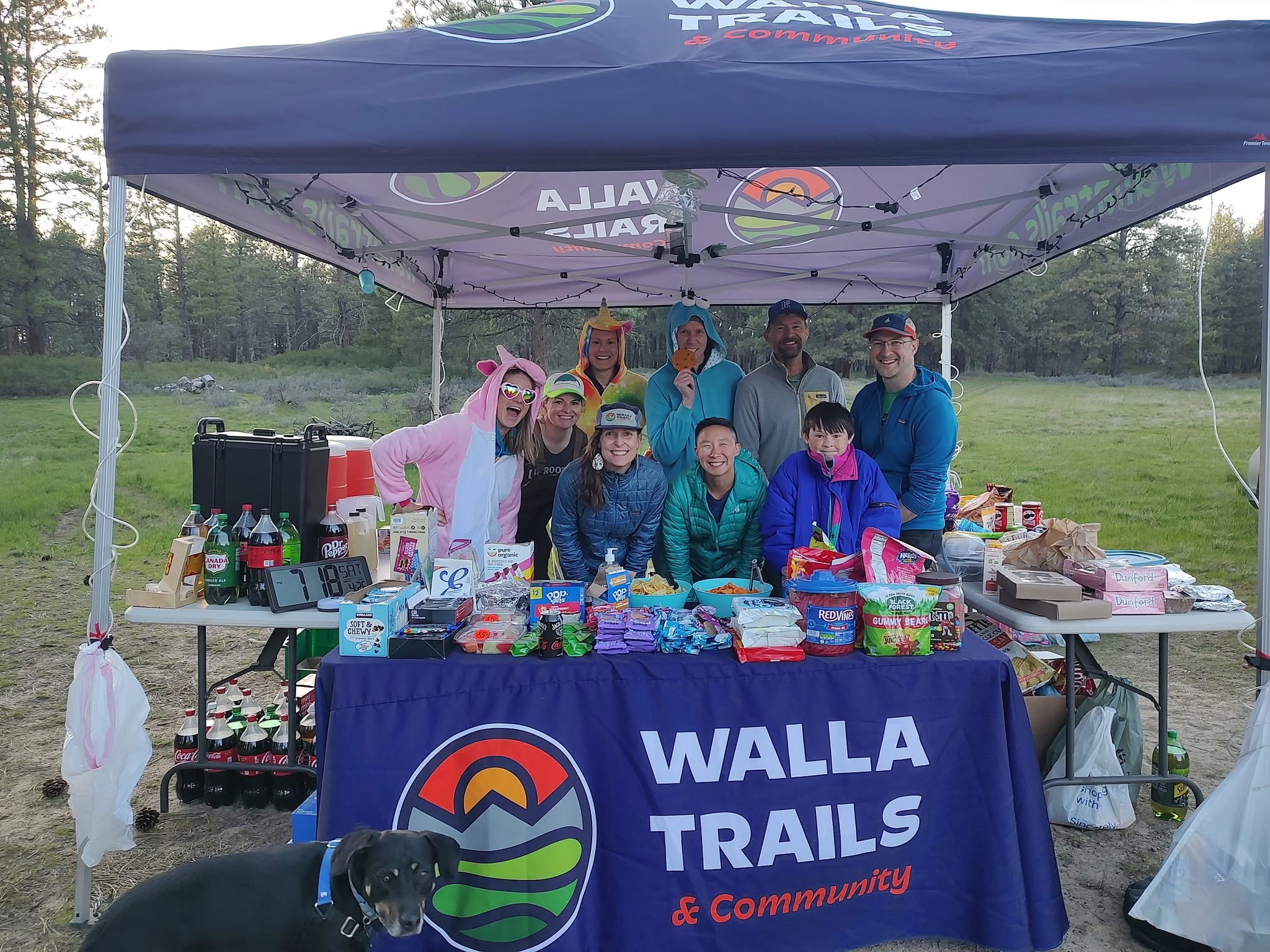
A race aid station stocked with snacks, drinks, volunteers in costume and more! PC: Alicia Jenkins-Browder
So this year, between running my own spring races, I went in search of answers!
Volunteering At A Race: Roles and Responsibilities
Race organizations usually rely heavily on volunteers to put on the races we love to run. There are all kinds of volunteer positions to choose from:
Aid station volunteers
Those folks stationed throughout the course only too happy to refill a runner’s bottle, offering up snacks, encouragement and good energy! Sometimes they’re even in costume, or have decorated the aid station with a fun theme!
Pre-sweepers
The first people to cover the course ahead of the runners, ensuring safe course conditions with adequate markings.
Sweepers
The people following the last runner, picking up flagging, signs and trash along the course.
Course markers
This might involve some trail work in the days leading up to clear the course of hazards and debris. Closer to the race, course markers go out to put up flags and signs along the race route.
Other roles for volunteering at a race
Start/Finish line setup and take down
Registration and pre-race check-in
Medical (some qualifications may be required)
Finish line help serving food and drinks, handing out medals and more
Race timing
Pacers
Athletes running the race to help others achieve their goal times rather than focusing on their own performance.
This role offers you another opportunity to be involved in a race, with benefits for both you and your runner. While pacing, you have the chance to experience the course, terrain, aid stations, and great race vibes, all while helping a runner. From a handful of miles to 50 or more, pacing segments vary in distance.
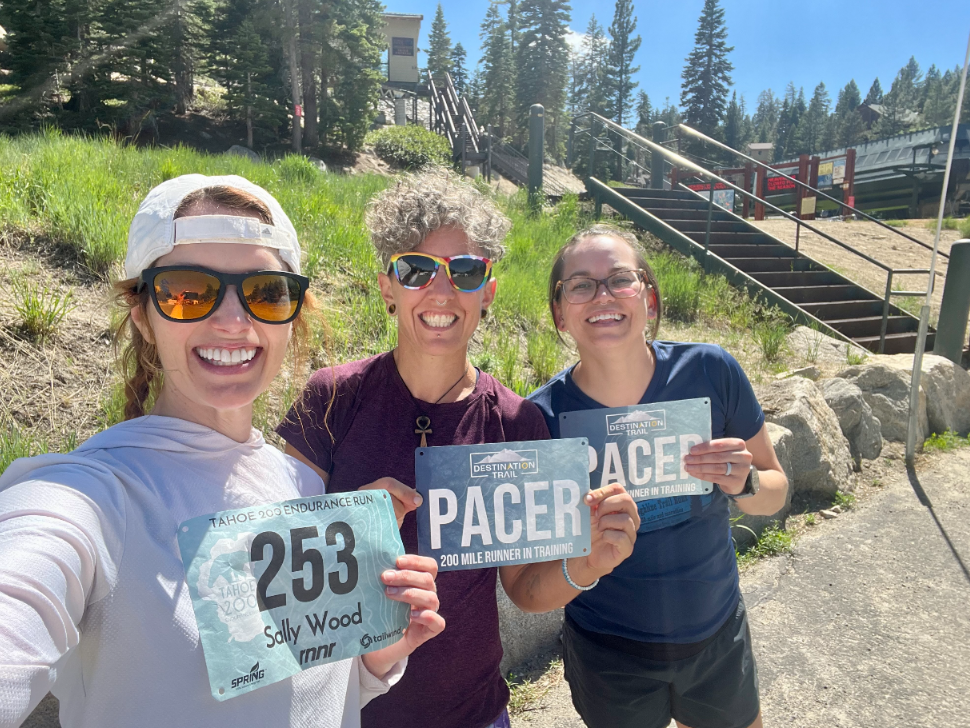
Team RunRunner Sally Wood with her team of pacers before her 200 mile race. PC: Sally Wood
The longer the race, the more important a pacer becomes for many reasons:
Safety
Course navigation
Help keeping alert and awake overnight
Moving consistently
Having reminders to eat and drink
Morale boost
Encouragement
If you’re interested in pacing, I suggest joining social media groups for specific races where people post questions or look for support. Sometimes pacers drop out at the last minute. Other times, they are coming from out of town and don’t have anyone traveling with them. In both situations, finding a pacer is a huge relief.
My Experiences Volunteering at a Race
This year, I mixed in a little of each of these opportunities, out of both a curiosity and a desire to spend more time giving back to the sport I love. Here is a look into the different experiences I had volunteering at a race:
Aid station at the Orcas Island 100
A friend and I signed up as aid station volunteers at the Orcas Island 100 Miler in February. Runners traverse a looped course in the gorgeous San Juan islands in Washington State. Stationed up on a mountain top, we could see runners multiple times and at different points in their race. While up there, I was able to do a training run myself on the same trails, so I got a good feel for the race. I also stayed for the morning-after ceremony, complete with a photo slideshow that made everyone emotional. Definitely an experience that made me want to come back to the event! An added bonus was earning race credit to put towards a future Rainshadow Running race!
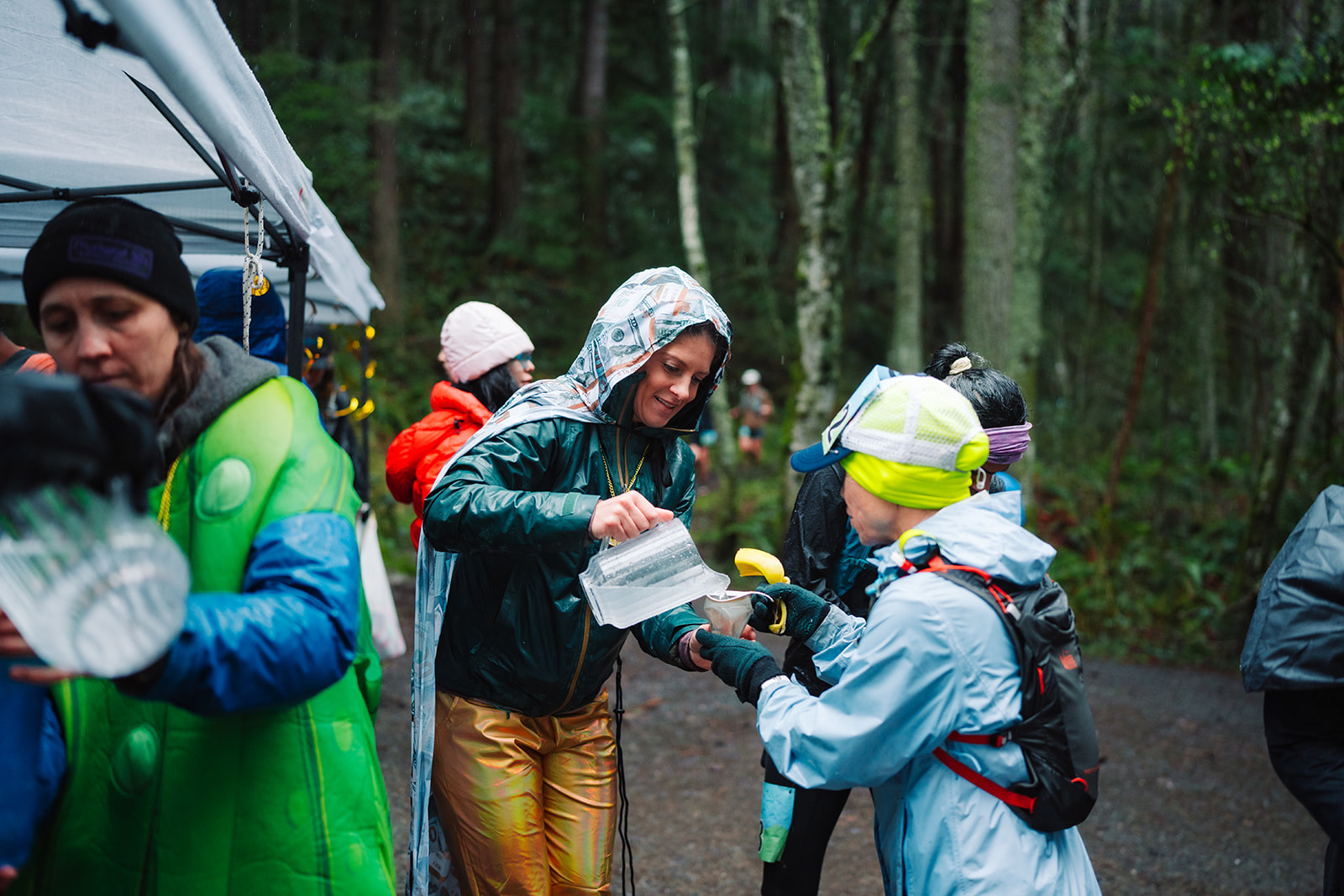
TRR Coach Alicia Jenkins-Browder volunteering at a race aid station. PC: Alicia Jenkins-Browder
“Pre-sweeper” and aid station at The Big Alta
I also volunteered at The Big Alta, a 2-day event organized by Daybreak Racing and Freetrail. With both 50K and 25K races, alongside wonderful organization, the weekend attracts new ultra runners as well as an impressive elite field, making it exciting to spectate! The first day, I had signed up via Ultrasignup to “pre-sweep” a section of the course. This role involved running half of the 50K route to make sure the course markings were still up and untampered with, before the runners came through. Myself and another runner were able to experience the course ahead of the racers, while enjoying getting to know each other for a few hours! The following day, I worked at an aid station, cheering on runners as they came through, filling their water, offering snacks and other assistance. The Big Alta is another race I’d love to run!
Pacing at the Arizona Monster 300
Another fun opportunity is pacing a runner! I had planned to pace a friend at the Arizona Monster 300, but when she ultimately dropped from the race early on, I took to the race’s Facebook group to see if anyone was looking for a pacer. Plenty of people were, and I had the pleasure of running the last segment of the race with a new friend from Australia. Pacing can mean a lot of different things. Sometimes runners have specific time and pace goals, and a pacer is meant to keep them on track and moving quickly. Other times, a pacer is wanted to keep a runner moving through the night, or even for company and conversation (telling jokes is usually a good pacer skill).
Crewing at the Canyons 100
Finally, I had the chance to crew a teammate at the Canyons 100 mile race. Crewing is like being part of a little family, all caring about the runner you’re supporting. The mission is to meet them at “crew-able” aid stations with everything that they might need: changes of clothes, fresh shoes, food options, drinks, headlamp batteries, etc. Crewing is also important to reduce the time runners spend at aid stations, while also serving as encouragement to keep the runner going. Helping my friend and being a small part of her huge success in the race was rewarding and so satisfying; time very well spent!
Benefits of volunteering at a race
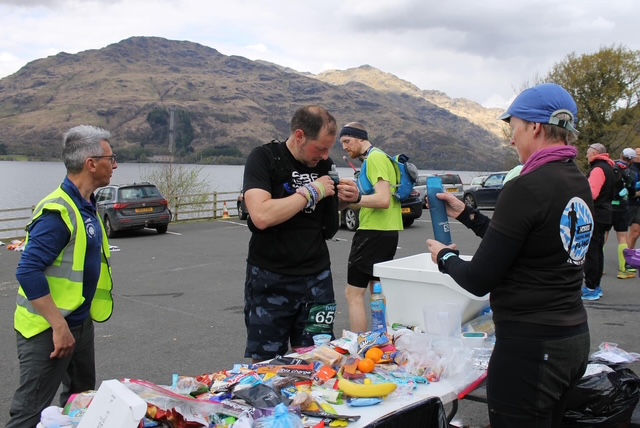
A team of people volunteering at a race aid station to help a runner.
I have never felt so connected to the running community as I have this year. The more involved I become, the more familiar faces I see, and the more I feel a deeper sense that I belong here in this community. It’s easy to see just how much the runners and race directors depend on the community to support their races.
Beyond connection, I also feel more than ever a sense of balance. Racing is exciting and personally rewarding for sure, but being involved in other aspects gives the excitement of the race without the stress of running it. You can get a feel for a race before running it yourself. Add to that, being surrounded by so much positivity and witnessing people work hard is incredible. I always leave feeling like it was time well spent, inspired to take on my own “next big thing.”
Added perks of volunteering at a race are the bonuses many race organizations offer those helping, such as swag, like t-shirts or hats, or even race credits! Credits can be used to save money on race registration fees. While these are great benefits, do not assume or expect anything.
So, should you volunteer at a race?
If you’ve ever wondered whether it is worth it to spend your time doing something other than running at a race, the answer is absolutely yes!
Volunteering at a race is such a rewarding and appreciated way to give back to the running community. Not only that, it leaves you with a fulfilling sense of balance: you feel the highs of being in the race environment without necessarily having to train for and race the distance yourself.
Consider volunteering at a race between your own events, in your off-season, or during times you’re decreasing or stepping back from training. Take the opportunity to connect and network with the wider running community: the racers, their crews, race directors and other volunteers. You may even walk away with race swag or a race entry of your own, but for sure, you’ll be thinking, “I belong here.”
Emily Keddie is a coach with Team RunRun based in Bend, OR. She is an experienced runner and dedicated coach, with a PhD in Psychology. Emily coaches a wide range of athletes in road and trail/ultra running, from 5K to 200+ mile distances.
How a Running Coach Eases the Transition to Life from College Sports
As a recent grad, hiring a running coach probably isn’t front of mind. However, it could be the perfect post-college move, especially for former college athletes.
NCAA Division I college athletes racing cross country as a team. Photo Courtesy of LMU Women’s Cross Country/Track & Field. Credit: Christian Gutierrez
Transitions are hard, and graduating from college/university can be one of life’s biggest transition points. Entering the “real world”, without the structured academic and athletic schedule you had grown accustomed to as a college athlete, can be disorienting at best…and downright panic-inducing for some. Whether your primary sport was running (cross country or track), incorporated a lot of running (e.g., soccer, field hockey, lacrosse, etc), or focused on a different athletic skillset (e.g., swimming, rowing, football, etc.), you can find value and fulfillment in starting a new running-focused fitness plan with a 1-on-1 coach.
5 Reasons Why Recent Grads Should Consider a Running Coach:
1. Infuse more structure into your post-grad life
Having specific training blocks, goals, and benchmarks can provide the comfort of the organized life you became familiar with in college. A running coach will use their expertise to build you a structured plan that keeps you motivated, engaged, and building confidence the whole way through.
2. Motivation
Whether you ran in college or not, a running coach can help recent grads achieve their own personal goals, like running a marathon for this Team RunRunner.
Perhaps you feel burnt out after years in your sport and are struggling to start on a new fitness routine. Or maybe you find a full day of work draining your energy in a whole new way. We know staying active is important, but if you don’t know where to go from there, a running coach can help. Coaches care about you as a complete person and want you to succeed. They can talk through all of the mental blocks and scheduling challenges standing in your way, crafting a super individualized plan for you. Entering this new phase of adulthood, perspective from someone who has been in similar shoes can help a lot.
3. Maintain an athletic identity that is compatible with real life
While athletes who ran in high school or college will find familiarity in the training plans and philosophies of personal running coaches, I encourage you to give running a shot regardless of your sporting background. If you have been a lifelong athlete, it’s likely that you consider being an athlete to be a big part of your identity. As a recent grad, working with a running coach will provide you with a way to maintain that athlete mentality. Graduation doesn’t need to be the end of your athletic career!
One of the best things about running is the flexibility it allows for. A coach helps you fit training around your life, rather than being tied down to set practice times. Enjoy running most anywhere and anytime. You don’t need to coordinate with other people, book field or court space, or adhere to the schedule of a recreational league. With running, you avoid a lot of the logistical challenges that plague other activities.
4. Personalization of a plan tailored to your goals only
Especially if your collegiate athletic experience was on a large team, completely individualized, one-on-one attention from your new run coach feels amazing! Instead of prioritizing the needs of a team, your coach can help define goals that will be personally fulfilling for you. You can choose what races you want to enter (if any), what distances you want to run, etc. Above all, your coach focuses solely on you and wants you to be happy!
5. A training plan to follow: knowing what to do, when, and why
For many college athletes, designing or deciding on a training plan on your own is a foreign concept. You’ve likely worked out under the direction and supervision of your coaches for years. A “one size fits all” plan or “more is better” approach is probably not right for you. Therefore, embarking on a training plan on your own can be risky, not to mention unnerving when you’re used to following prescribed workouts from coaches. Figuring out a new movement plan by yourself can take a lot of mental energy, energy that you may not have as you’re navigating a time of change in your life. Many former college athletes end up pushing too hard when there isn’t oversight from a coach. If you unintentionally overdo it, you could find yourself sidelined by an injury, burnout, or exhaustion. No one wants that!
Loyola Marymount University’s men’s and women’s cross country teams. Photo Courtesy of LMU Women’s Cross Country/Track & Field. Credit: Christian Gutierrez
Finding the Right Running Coach for Recent Grads
I know money may be tight as a recent college grad just at the start of your professional career. I want you to know that there are awesome coaches available at every price point. Fortunately, you will be able to find a coach who is a great fit for you!
Congratulations to all of the student-athletes who will be graduating this month! If you are interested in learning more about online running coaching, I encourage you to consider Team RunRun! We pride ourselves on having a coach for every runner, starting as low as $45/month. I recommend chatting with different coaches before committing to find one that you gel with best. We hope to hear from you!
Amanda Hamilton is a coach with Team RunRun based in California. She is a former sprinter turned marathoner, who specializes in coaching post-collegiate athletes and postpartum moms. In addition to coaching individual athletes through Team RunRun, Amanda is the assistant coach for a Women’s NCAA Division 1 Cross Country/Track team.
Team RunRunner Jenny Windham finishing the Big Sur Marathon. PC: Marathon Foto
3 Bests – What aspects of the race did you like the most?
Course support
Race organization
Proximity of events: The expo, pub run, shakeout run, etc, were all conveniently located, ideal for when you travel to a race and don’t have a car.
Not so much – Aspects of the race that didn’t do it for you
There was a long wait in the cold before start.
The Big Sur Marathon cutoff time could be longer, because many runners were unable to finish. (Due to permitting and road closures, the time cutoff for the marathon is 6 hours, the equivalent of running 13:45 minutes-per-mile for the marathon.)
Road camber slant was noticeable.
Map of the Big Sur Marathon course. PC: Big Sur Marathon official website
Weird factor – What’s the weirdest thing about this race?
More unique than weird: there were Taiko drummers halfway up the climb to Hurricane Point, a pianist at Bixby Bridge, belly dancers near mile 24 and much more! Local musical groups provide entertainment throughout the course and at the finish.
Highlights of your race – What did you do well and enjoy about your race in particular?
The whole event was a highlight: absolutely wonderful scenery, great organization and pre-race communication, awesome pacers and event MC!
Lessons for others – Share your pro-tips on the race to help the next runner
Pre-race: I packed extra snacks for the pre-race wait, as well as clothing I could leave there for donation. I also bought a $5 stuffed animal at Walgreens in town beforehand, which helped make the bus seat more comfortable with the seatbelt digging into my back. It also was something soft, dry and warm to sit on to conserve energy before race start. Many runners brought trash bags or emergency ponchos.
Post-race: It’s important to plan ahead for finisher village meetups with spectators. There is no cell service and lots of traffic, so I would include a change of clothes in your drop bag to change into after in case you have a wait to find family/friends or get back to your hotel etc.
Lessons you learned that will help you next time around
I am a back-of-the-pack pace, and felt the stress of the tight 6-hour time cutoff. In future, I would likely do a shorter distance to reduce this stress and increase enjoyment of the run and scenery. Thankfully, we had a great pace group that helped each other keep up, but it was a lot more miles pushing the pace than I’ve ever had to do. This was my 11th marathon, and most difficult by far.
Most important course specific knowledge to know about the race
There was some information about the road being cambered/slanted, but it did not indicate it would be just about the entirety of the race. Fortunately, the climb up to Hurricane Point was not as daunting as reported, but we also did not have intense winds. We DID have rain just about the entire course, so be prepared with layers and mental strength!
Aesthetics – Is it a pretty course?
Yes, one of the most scenic in the world! From Redwoods, to pastoral sights, to rugged ocean views.
Difficulty – Is it a tough course?
Yes, the cambered roads and constant hills make for a very challenging course. Although I was aware there would be many hills, I did not fully realize just how many. Mile 25 greeted us with a final hill, so we had to really push the pace in order to make the cutoff. I finished with just 9 min to spare. There was a SAG vehicle in view from mile 10 on.
The Big Sur Marathon course profile. PC: Big Sur Marathon official website
Organized and well run – Did it feel like a well-oiled machine or were they flying by the seat of their pants?
Very well organized with plenty of race support and volunteers. They were amazing and energetic, even calling out our names from our bibs.
Competition – Is there a strong field?
Yes, the Big Sur Marathon had 3 corrals to divide the competition: fastest runners in corral A, then B, and finally C (my corral).
Logistics – Does it require a special handshake, registration a year in advance, hotels all booked? Give us the low down on the nuts and bolts of making the race happen.
The Big Sur Marathon is not the easiest or the hardest to get into. There is a lottery entry, with VIP or charity options as well.
Aid Stations – Standard fare or anything special to know about the aid stations in terms of what’s available or when?
Very frequent aid stations (about every 2 miles) stocked with plenty of water, Nuun hydration, GU energy gels, and even oranges and strawberries. There were plenty of port-a-potties and medical aid along the course.
Weather and typical race conditions
The weather is typically on the cooler side, 45-60 degrees, and can range from overcast/foggy to sunny. For instance, this year we had light rain the entire way.
Gear – Did you need anything special or is there anything you’d recommend for the next runner?
I wore a running vest to hold additional snacks/fuel/pickle juice in the hydration space, and carried a collapsible water bottle that was easy to fill at water stations, or I could just grab a cup of water.
Spectacular views of mile 13.
Spectators – Is this a friendly course for your friends?
No, due to the remote area, there is no space for spectator driving or parking. They are limited to the finish area.
How’s the Swag?
The finisher tee was nice: long sleeved, sustainable dry-wicking material with a nice scenic image on the back. In addition, the medal was also nice and unique. The Expo was a decent size, not too small or big.
The Overall Score – How many stars do you give this race and do you recommend that others run it?
5 out of 5 stars! Above all, as the description says, do not attempt the full marathon as your first one, and do not underestimate the hills. If you are near the back of the pack, I would suggest opting for one of the shorter distances or relay. Great to say I finished, and wonderful destination race taking in the sights. The Big Sur Marathon was a bucket list race of mine!
Jenny Windham is a coach with Team RunRun based in Bigfork, MT. Jenny is both a running coach and personal trainer, so she’s familiar with incorporating additional exercises into run training to get you started with your first race or aiming towards your next PR.
Before diving into the reasons for working with a running coach, let’s do the unthinkable and box runners into totally arbitrary, made-up, overlapping boxes!
Five Broad Categories of Runners:
Working with a running coach helped this runner achieve a PR!
Novices: those new to the sport, new to a particular distance, or new to a type of terrain.
Returners: runners returning to the sport after an injury or break.
Chasers: runners who desire to attain the next level of success.
Stagnaters: those trying to break through a plateau or achieve a long-desired goal.
Community Builders: runners who desire more interaction and growth within the sport.
These categories are not mutually exclusive, and you don’t need to box yourself in. You likely might find yourself resonating with a few. Regardless, these subtypes are useful for the purpose of this article. A runner in any of the preceding categories may benefit from using a running coach to guide them towards their goals. However, finding the best fit for a running coach requires an investment of one’s time and finances. How does one decide if they really need a running coach? Under what circumstances does having a coach provide the most fulfillment and the most benefit to an individual?
Who Needs a Running Coach?
There are many reasons that a runner may be curious about working with a running coach. Let’s break them down using the above categories.
1. Novices
New to Running
The Covid pandemic saw running’s popularity increase (turns out that might happen when you have nothing else to do!) with new runners finding joy in movement and seasoned vets increasing their training frequency. Better yet, the running boom has continued post-pandemic with increasing opportunities to socialize and race.
For many novice runners, hiring a running coach may sound and feel like overkill. The commonly held belief is that coaches are for the experienced and competitive athlete, not for “runners like me”. How does one know when they may need a running coach, even as a beginner?
A static training plan may be enough for a runner without any pre-existing health conditions entering the sport with the primary goal of gaining fitness. Additionally, novice runners have the unique opportunity to see a high number of gains in a short amount of time compared to more seasoned athletes due to their lack of training. Runners with an athletic background may be able to appropriately gauge how hard to push themselves as the body is adapting to the new stimulus of continual running or new terrain. However, it can be harder for novice athletes experiencing rapid gains in fitness to determine the right amount of volume and intensity that can be sustained over time.
A coach can identify the appropriate level of training and tailor it specifically to the individual. By helping to mitigate the types of overuse injuries and setbacks that tend to plague newer runners, a coach maximizes individual’s fitness gains. As runners transition to different types of terrain and distance, working with a coach early on can help to establish healthy movement patterns and practices as they are being learned.
New to Distance and/or Terrain
In addition to road running and racing, trail and ultrarunning are becoming more popular among runners and mainstream media. Recent findings report a 12% increase in trail running annually since 2010, alongside a 345% growth in ultrarunning since 1996! Such remarkable increases in participation indicate that a large proportion of trail and ultrarunners are newer to the distance.
Seasoned road runners transitioning to the trails face a unique set of challenges given the many nuances to environmental conditions, terrain management, and equipment. A marathon runner who jumps into a local 5K trail race is likely to be successful in learning from the experience without the guidance of a coach. However, a marathon runner training in the southern United States has a significant learning curve if attempting an ultra-distance trail race on the west coast with mountainous terrain, different environmental elements, and altitude. Afterall, you don’t know what you don’t know. A runner with limited time or resources to train and learn the nuances of running a particular distance or terrain would likely benefit from a coach’s wisdom and guidance.
2. Returners
Returning to Sport After Injury or Significant Break
Injured runner holding his knee.
Unfortunately, and probably news to no-one, runners get injured, often. Research suggests up to 70% of competitive and recreational runners get injured yearly, with 50 to 70% being caused by overuse. Running injuries can happen to anyone regardless of experience and/or training level. However, a running coach can help athletes identify any training triggers that might have contributed, hopefully preventing future injuries too!
When injured, a runner often seeks out the help of a primary care doctor, physical therapist, or sports medicine doctor. Many specialize in the treatment of runners and may offer strength training and rehabilitation exercises to heal an injury. However, there is often a gap in return to sport specific recommendations. For example, a runner recovering from a bone issue may be told to cross train. The specifics of how much and when in comparison to the running plan prior to injury may be more vague leading runners into unfamiliar territory. A running coach can work with the guidance of the medical team to more specifically advise a runner on the best ways to maintain fitness during the injury and create a path to return to running post injury.
Whether planned or not, returning from an extended break in training has its challenges. It’s common for athletes to struggle reconciling with where they were fitness wise prior to the break and currently. A running coach can objectively assess the athlete’s current fitness, then program the correct training at the right time. Importantly, a coach can ensure the athlete progresses from non-training to more consistent training at an appropriate rate that maximizes fitness gains while minimizing their injury risk.
3. Chasers
Reaching for a Personal Best in Distance, Pace, or Consistency
This runner used the support of a running coach to persist through a tough race.
Once a runner has passed from the beginner stage, improvement can become harder to attain. As general fitness gains start to level out, it requires additional stimulus to see performance increases. Here, a running coach can help fine tune the right amount of stimulus for them to achieve the desired pace and/or distance results. For those striving for big goals, breaking time barriers, achieving a personal best or qualifying time, having the support of a coach to build a plan, push training to the appropriate level, and provide a realistic timeline, could make all the difference in reaching such goals or not.
Runners desiring more consistency with training but are caught in a cycle of injury, life stress, or fluctuating motivation, can turn to a running coach to trouble shoot or align a training schedule that supports their current lifestyle. A coach can alleviate the stress of creating training plans that balance training, recovery, and overall life demands. This can be especially important for runners who have inconsistent schedules due to school, work, or family. Other athletes may benefit from and need a running coach to stay motivated and be a source of accountability.
4. Stagnaters
Assistance in Breaking Through a Plateau
Runners experiencing a plateau in running physically or mentally often benefit from a fresh perspective from someone with running experience. Sometimes, fine-tuning all the dials in a training plan can be hard to accomplish on one’s own. Coaches can also be beneficial in recognizing elements outside of a training plan that may be the cause for plateau. Think fueling, hydration, recovery, etcetera. Although a coach is often not a sports dietician, sports doctor, or psychologist, seasoned coaches can recognize common issues and themes that may be hard for an individual to identify or vocalize to non-running peers. A coach can assist with addressing issues of burnout without athletes abandoning the sport. They help runners avoid injury, and overcome continued fatigue, diminished performance, and decreased enjoyment of running and daily activities.
5. Community Builders
Desire for Connection, Learning, and Growth Within the Sport
Although running has become a popular way to connect and meet others, not every runner has access to running groups. Many runners may also lack the running social networks that allow them to learn from and relate to others. Again, this is where a coach can assist! They will be more than happy to feed your curiosity to learn about the sport. They become your go-to person to talk training nuances, and nerd out on the latest supershoes and tech!
Team Run Run, for example, not only assists athletes in finding a running coach, but works to provide greater opportunities for connection through insights into running events, resources for runners, newsletters, pre-race shakeout runs, discounts, information sharing forums among athletes and coaches, and more!
Proud athlete and coach after a successful race.
So, Do You Need a Running Coach?
Hopefully, now you can appreciate why the majority of runners who work with a running coach are not elite athletes. They are individuals striving to show up as the best version of themselves that they can be. A running coach is there to create excitement, and provide support and joy throughout a runner’s journey. They’ll help their runners continue to learn, push performance, and explore new boundaries that they desire, were unsure how to reach, and maybe never even thought achievable.
Sold on working with a running coach but not sure where to start? Check out Team RunRun’s coaching directory and browse by budget, goals, location, or level. With over 300 coaches, we have a coach for every runner!
Christina Mather is a coach with Team RunRun based in Fort Worth, TX. She works with athletes running all distances from 5K to 50K on both the roads and the trails. She especially enjoys helping female athletes and those looking to balance training with a busy schedule.
3 Bests – What aspects of the race did you like the most?
Simon Pollock after finishing the Gorge Waterfalls 50K.
Scenery: As advertised, there were so many waterfalls and beautiful views of the Gorge.
Course profile: It’s fun! And better yet, the course gets more and more runnable as you work your way back (even for us back of the packers).
Organization and event weekend: Daybreak Racing and Freetrail put on a really well-run, fun weekend in town. It was awesome to be a part of the trail community hanging out all weekend. I would encourage anyone running the 50K on Sunday to arrive a couple days early to enjoy the vibes!
Not so much – Aspects of the race that didn’t do it for you
Just one area: the start was late and felt rushed. Part of this was because the start area was difficult for shuttle buses to access. However, driving 10 miles west of the start area without communicating that the buses would turn around was nerve-wracking. The late arrival made for a horrible bathroom line wait after 45 minutes on the shuttle and 300+ people crowding the lines. Though runners were encouraged to join the wave they selected at sign-up, a number of us in Waves 3 and 4 had no recollection of being able to select one. This also made for a chaotic first climb with multiple full stops on the trail.
Weird factor – What’s the weirdest thing about this race?
The second to last section of the Gorge Waterfalls 50K course is an out-and-back on the Pacific Crest Trail. It’s a beautiful trail, but expect to dodge runners ahead of you as they zoom back down into Cascade Locks #2 aid station. This is my major (only?) real piece of feedback for Daybreak on the course. I personally didn’t hate the idea of the out-and-back, but some guidance from Jeremy (the race director) and the team for how runners should observe right of way would have been nice. It would be good to clarify whether the correct etiquette is always ceding to uphillers, or asking slower runners to step of the trail.
One other note: you’ve only got one spot for a drop bag at this race, so either bring crew or train with the on-course fuel.
Highlights of your race – What did you do well and enjoy about your race in particular?
I had to throw my time goals out in the first 6 miles or so, but once I did that, I stuck to my race plan and process goals. As a result, I moved up a ton of spots, and even improved my splits for the latter 20ish miles. I problem solved for a side stitch, a brief calf cramp, and some warmer temperatures. In my previous two 50Ks, I mostly went out conservative and stayed that way. My plan for the Gorge Waterfalls 50K, regardless of actual splits, was to race myself and take some risks. I definitely did that!
Running through the Gorge with waterfalls in the backdrop. PC: James Holk
Lessons for others – Share your pro-tips on the race to help the next runner
Be ready for some *very* technical trail, especially the descents in the first 8-mile section of the Gorge Waterfalls 50K. You climb almost 2,000 feet in the first two miles, before descending almost immediately! It’s not just slippery or steep stuff—there are a number of sections with sharp rocks. My best advice is to wear what you need to protect your feet, prepare yourself to handle that terrain, and practice on the course (if you can) ahead of time.
And a warning for trail runners who abhor road: there’s a decent amount of pavement in this course. Personally, I enjoyed the reprieve after the super-techy stuff, and was able to move up a bunch of spots on the two miles of gentle road rollers. But if you’re a trail purist, this might be a dealbreaker for you.
Some of the gorgeous waterfall views throughout the Gorge Waterfalls 50K.
Take note of the time cutoffs. I don’t think these cutoffs are particularly aggressive, BUT I’ve done other races with a much more generous approach. Even though nine hours may seem pretty generous for a lot of folks, you’ve got nearly 12, 000 ft of elevation change (~5900 up and 5900 down) and that includes the aforementioned technical first section. Plan accordingly: if you’re in the back of the pack, you’ll have your work cut out to make the first time cutoff at the Wahclella aid station.
Most important course specific knowledge to know about the race
Check out the above notes about technical trails, footing, paved sections, and time cutoffs.
Aesthetics – Is it a pretty course?
YES, it more than lived up to the hype! (see image to the right)
Difficulty – Is it a tough course?
Sure is! Again, if you’ve read this far, you’ve already got a feel for the challenge.
Organized and well run – Did it feel like a well-oiled machine or were they flying by the seat of their pants?
Other than the aforementioned start line stuff—which was somewhat out of Daybreak’s control—yes, the Gorge Waterfalls 50K was very well run. There was great communication beforehand, a super thorough website, and an easy-to-use new race weekend app!
Competition – Is there a strong field?
Yes, top class competition! The Gorge Waterfalls 100K race served as the qualification race to make Team USA for the 100K World Championships, so, unsurprisingly, great runners showed out! Course records fell across all races distances and divisions.
Logistics – Does it require a special handshake, registration a year in advance, hotels all booked? Give us the low down on the nuts and bolts of making the race happen.
This race sells out! If it’s on your bucket list, don’t wait to sign up.
We booked an AirBnB right in Cascade Locks two months out. It seemed like there were a few hotel/motel options in town, with plenty more across the river in Stevenson or 20 minutes east in Hood River. Camping is popular too. That said, I can’t recommend staying in town enough. We were easy walking distance to the Cascade Locks aid station and the Marine Park Pavilion finish line which made for a great atmosphere!
Aid Stations – Standard fare or anything special to know about the aid stations in terms of what’s available or when?
The four 50K aid stations were well staffed, well run, and well stocked with: Neversecond gels and hydration drink, water, soda, PB&J sandwiches, cookies, various fresh fruit options, potato chips, gummi snacks, trail mix, and basic first aid supplies. Shoutout to all the Wy’east Howl and Cowgill volunteers!
Weather and typical race conditions
It was 62ºF and sunny this past weekend, but this race happens in April in the Pacific North West, so be prepared for any and all conditions! Also, don’t count on anything other than wind coming down the gorge.
Gear – Did you need anything special or is there anything you’d recommend for the next runner?
It’s not a road shoes course!!
Spectators – Is this a friendly course for your friends?
For a longer trail race, yes. While there is no aid station access for spectators at mile 8 (Ainsworth), there’s lots of opportunity for support at Wahclella (mile 15) and Cascade Locks #1 and #2 (same spot; outbound is mile 20 and inbound is mile 28). The finishing area is a great spot to hang out at too with full on trail party vibes.
How’s the Swag?
Great, high quality stuff from Territory Run Co., especially the hat. Instead of the standard medal (which, let’s face it, we all have too many to know what to do with), finisher’s receive a sweet, custom jar that you actually want to keep! You also get a voucher/ticket for food and beverages at the finish area (and the food is actually really good!).
The Overall Score – How many stars do you give this race and do you recommend that others run it?
I give the Gorge Waterfalls 50K 4.5 stars out of 5. You can always count on Daybreak Racing and Freetrail to put on a great race weekend! Take a look at more of their races here.
Check out this article to learn more about other Daybreak Racing’s great events: Wy’east Wonder 50 Mile Race Report. And there’s still time to sign up for the Wy’east Trailfest on August, 9-10th if you’re interested!
In a world of running, we can spend a lot of time alone. Especially when we are first starting, we lace up our shoes, head out the door (or to the treadmill), and run with our own thoughts. Running is truly a sport where we battle with ourselves, where we strive to reach new goals and break our old PRs. We might have gotten into running to race other people, but it always comes down to bettering yourself and reaching personal goals. Joining a running club helps make this individual journey of setting and achieving goals a little less lonely.
Pocatello Running Club 2024 Halloween Run
Here are 10 reasons why you should join a running club:
1. Great way to meet new people… especially when moving to a new town.
Back in 2021, my wife and I moved to Pocatello, Idaho from the Midwest. We had no family, friends, or connections in Pocatello when we first moved.
Usually, when people look up a new city they want to move to, they look up the cost of living, entertainment, climate, job availability, etc… But for us runners (or if you want to get into running), one of the top searches should be, “Is there a running club?”
The biggest reason we chose moving to Pocatello was because there was an active running club. We looked up their Facebook page, scrolled through the recent club photos and events, and even gave them a follow. So, when my wife moved out west a month before me, the first thing she did was go to the Tuesday night track workout with the running club. She made friends instantly! I moved out a month later, and I was already welcomed to a night out for Octoberfest (three hours after driving for two days straight) and a trail run the next evening before I could even unpack. All because my wife went to a few running club group runs and found people that shared the same interests.
Whether you are moving to a new town or already living in one, the easiest way to make friends as a runner is to join a running club. We did and now we have so many great “family members,” friends, and connections in town.
2. Learning new routes and amazing sights.
Once you make the leap to joining the running club, you will get a lot of opportunities to see the town you live in through a whole new lens. Pocatello has a huge trail network through the mountains, and it was quite overwhelming to learn. Lucky enough for my wife and I, we had the running club to help.
Wednesday night group trail runs were the perfect way to learn the town’s trails, without any fear of getting lost. Most Saturdays, the Pocatello Running Club hosts Saturday long runs on either road or trail. We were able to explore the town with people that have lived in Pocatello for decades. We got their opinions and knowledge on the best places to do tempo workouts and hill intervals. And they shared which parts of the neighborhood we needed to be careful of when venturing off alone!
The friends you make will show you even more routes to run during non-sanctioned group runs. Switching up the routes you run can help you avoid burnout. If you’re into photos and social media, you can also ask someone to take some awesome “action shot” photos of you and wifey (or dog, or new friend, or favorite plant, etc.). You’ll get to learn your town in its entirety and see views that will be remembered forever.
My wife, Whiskey (dog), and I during a Wednesday night group trail run.
3. You can always find people to run with (and push you on harder runs!).
Speaking of burnout, another way to combat it (instead of just running new routes) is by running with different members of the running club. Whether you are training for your first marathon or trying to improve your 5k time, there are almost always people in the club at the same level or faster than you who are willing to help you achieve your goals.
Some people might be running their easy runs at 8 min/mile pace and you need to hit that pace for a marathon pace training run. Ask them to join you. I’m sure you can find a date/time that works for the both of you. If you have track nights, find someone at your level or a little ahead to do the workout with. First time running 20 miles? Find multiple people to help you throughout the long run. Alternately, join the club’s long runs to make the huge mileage seem less scary. Whatever the workout may be, running with someone else makes it easier. Go find someone to push you, and soon you’ll be achieving goals you never thought possible.
4. For motivation and accountability. #accountabilibuddies
A few of my #accountabilibuddies at the Pocatello Running Club 2025 Goal Setting Party..
Ever not want to wake up for an early morning run? Find yourself getting home from a long day of work and not wanting to do your workout? Joining a running club can help with those days of no-to-low motivation.
If people from the running club hear that you are having trouble finding the motivation to do your workout, they will help you overcome your worries or even join you to give you an extra little push. Most of the time, it’s just getting out the door. There are plenty of times I have reached out to people that are having trouble fitting in a run or lift, and I will invite them to join me. That’s the whole reason my wife and I started the Monday morning coffee runs for the running club. We wanted to get people out of bed and start the week off right–to motivate people to continue their training despite what their week looks like.
Running clubs might even have a goal setting party every year (and if they don’t, you can start your own) to help with getting the motivation to set and achieve your big goals. While we all have our own individual goals, we want to help people achieve their goals too. You and your running friends can even hold each other accountable for the goals we set at the beginning of the year throughout the year. Find your #accountabilibuddies and possibly give them a shoutout on social media. Having a community and the support it brings is what makes a running club so special.
5. Build community connections. (They may even help you find a job!)
When I first moved out to Pocatello, I brought my job with me remotely. While a ton of change was going on with the company, it was nice to have that job security.
When I started to get a little frustrated with the direction the company was moving, I started to look for a new job. Now job hunting can be really scary, but by being in the running club, I got insider knowledge from locals about what companies were great to work for. I even got a reference from an employee at the company I work for now because we were both members of the running club. We got the opportunity to get to know each other and find out the type of job I was after. Then later, I got my current job because of that reference. I’m forever grateful for the connections I have built over the few years of being in Pocatello.
Our running club, like most running clubs, has close connections with the running stores in town. We work with the city to help with the local fun runs. If you are active enough in the running club, you might even get to try out some demo shoes or get free entries to races! Don’t be afraid to make connections. A running club is basically an in-person LinkedIn. You never know when you might need their help or advice.
6. Running education and advice on different training styles.
One thing that has helped me since joining a running club is the advice I can get from many different experience levels or training styles. A lot of clubs have a very diverse array of runners, from total beginners to seasoned veterans who have been running for 40 years.
For newer runners, a club might even host training programs to help with getting started. For example, the Pocatello Running Club has led “Couch-to-5k” plans in preparation for the local 5K fun run series. You might have a local running coach or physical therapist in the group that can give you advice or help you overcome an injury. I had a running coach that was also a physical therapist when I first moved out to Idaho, but over the years, I was able to learn from those around me in the running club to find a style of running/recovery that works for me.
Joining my club motivated to me to get certified and become a running coach with Team RunRun. This allows me to share even more advice with my local running club about different running styles or programs. Team RunRun also strives to help people improve their knowledge by offering blog posts about relevant topics. We can always improve our running IQ and ways to better take care of our bodies.
Several members of the Pocatello Running Club at Beaverhead 100k in July 2024.
7. Training for the same race with teammates, or intel from previous race finishers.
Another great thing about being in a local running club is having teammates running the same race as you. Last year, eight members of the Pocatello Running Club (including myself) had the same goal of completing the Idaho 208k challenge, where you run River of No Return 108k in June and Beaverhead 100k in July (a little less than 1 month apart). We were able to join each other for long training runs, talk logistics, camp or drive together, and basically motivate each other for the entire journey. A few of us even ran the entire race from start to finish together, making the experience that much more special. Club runners who had completed these races in the past offered up crucial advice and tips about the course. Members of the Pocatello Running Club even formed their own relay team for the Le Grizz race in Montana!
One thing I love about coaching with Team RunRun is the feeling of being a part of another virtual running club with the other coaches and athletes. I can ask the Team RunRun community for advice about races across the world, and I know they can go to me if they have any questions about local races in Idaho. Team RunRun even has meetups and group runs for major events, allowing you to connect with the Team RunRun community before the race. So, whether you need help training for a race or simply some advice, consider joining a local running club or get a coach through Team RunRun and join their virtual running club.
8. Petting all the running doggos!
An added bonus for us dog lovers: meeting all of the various running dogs on group runs. Plus, your dog gets little play dates and social time with other local dogs while you run! A huge win-win! Check out this blog by Team RunRun Coach Ryan Williams about Running with Your Dog for all the tips..
9. Intellectual or silly conversations. Whether it’s at a running club’s book club or philosophical ramblings on the trail.
Do you ever have deep thoughts about life on solo runs? Or perhaps you want to stop annoying your non-running friends with constantly talking about running? Then it might be time to join a running club.
From talking about whether certain animals would win in a fight, to discussing the lifestyle/training of elite distance runners, a running club can satisfy all of your crazy needs! Seriously though, I feel that some of the best conversations in life come on long group runs. Conversations that make you laugh or think. Conversations that will give you inside jokes for the rest of your life. The suffering seems easier when you have friends around you and you are not actually thinking about running sometimes. A running club helps facilitate such spaces and conversations.
10. Sweet swag and running club discounts.
Like I mentioned in benefit #5 above, most running clubs are associated with the local running stores. This can come with awesome benefits and discounts for running club members. Some running clubs host races to help pay for club activities or merchandise for members to enjoy. Others come with a small membership fee, but you get swag and access to discounts on local races that make up for the fee you paid. Communities like Team RunRun offer members discounts on races (like Orca Running and Evergreen Trails races), clothing, nutrition, and more. Being a part of a running club, even virtually, has its perks!
The Pocatello Running Club Saturday group long run in early 2024.
Conclusion
Running clubs offer so many more benefits than simply being a way to meet people. These few years in Pocatello, Idaho have been some of the best years of my life. I’ve grown both personally and physically, thanks, in large part, to the Pocatello Running Club. Whether you are living in New York City or Topeka, Kansas, consider joining a running club. And if your town doesn’t have a running club yet, or one you resonate with, consider starting a club yourself! You’ll never know who you might meet or what goals you can achieve in your running career until you do.
Brian Lettner is a Pocatello-based running coach training runners from the 5k up to ultras, on both roads and trails. He helps runners fit training into an already busy lifestyle, and has knowledge of strength and menstrual cycle training.
3 Bests – What aspects of the race did you like the most?
Community: I love that the community is building for this race. Some more local ultra runners are getting out to it and it’s start to feel like a party.
Race Director: The RD Jason Mabe is fantastic. He is there the entire time. He’s supportive and engaged and logistically that are no issues.
Time of year: It’s such a great early spring event. The weather is always up in the air; you can guarantee you’ll get some wind, but also flowers on the course.
Ryan Williams smiling while running the Genesee Valley Ultra 24 Hour Race. PC: John Roemer
Not so much – Aspects of the race that didn’t do it for you
The on course offerings are quirky to say the least! We always call it “Genesee Valley aid”: there will be pancakes but no syrup or utensils. This year, in the middle of the night, someone will brought hushpuppies that no one wanted to eat that in the middle of an ultra. They’ll also have a lot of random food that has been donated. You don’t know what is going to be there or when it is going to come, but that is sort of the old school vibe of it.
Weird factor – What’s the weirdest thing about this race?
Running 2.5 mile trail loops for 24 hours with about 225 feet of vert per loop is pretty weird! Part of the loop is through wide open fields where you just get wrecked by wind.
Highlights of your race – What did you do well and enjoy about your race in particular?
On the same course and in the same time, I ran two miles further this year than last year. This was in spite of unseasonably hot conditions this year, suggesting I did a good job of staying on top of my hydration, even though it was nearly impossible to do so. I’m happy with reaching my “C” goal: I set a new 24-hour distance PR of 90 miles!
Lessons for others – Share your pro-tips on the race to help the next runner
It’s a 24 hour race, so you really need to pace yourself! For the past two years, I’ve been in 1st place for the first 100K, before slowly falling apart after the 12 hour mark, reducing me to walking. This course seems like an easy loop but it can beat you up over a 24 hour time period. My advice is to walk the hills, take advantage of the flats, and be prepared for it to get cold at night. Also, know that there is a 90% chance of winds over 15 mph because of the location and lack of wind shields on the second half of the loop.
Ryan Williams working his way through a tough spot in the race. PC: John Roemer
Lessons you learned that will help you next time around
Pacing! This is a skill that comes with time, but I knew enough to be concerned about being in first place even around 50 miles. Each loop, I’d focus too much on trying to stretch out the gap between me and second place. As a result, I wasn’t running my own race anymore. I needed to go a lot slower. This race doesn’t start until 50 miles, so who cares if I’m leading before that? In future, I need to keep a steady pace for the entire time limit. I don’t want five hours of power hiking at the end.
Most important course specific knowledge to know about the race
There are some technical trail sections, but 80% of the course is either on grass, smooth double track, or open field. I think you could do really well with just a cushioned road shoe for the 24 hours. I’ve used trail shoes the past two years but I’m over that. At the same time, both years the person who has out-lasted me was just wearing road shoes. I think that’s something worth paying attention to!
Aesthetics – Is it a pretty course?
Very pretty! The course is on an environmental center in rural Maryland. You’re in these beautiful open fields and in the woods. It’s a beautiful loop that you won’t mind running over and over again.
Difficulty – Is it a tough course?
It shouldn’t be but it is. There is a big incline in the middle of the loop that takes it toll over 30-40 loops. While the diverse surfaces you’re running on offer variety for the legs, it also tends to beat you up over the time duration. With half of each loop (and thus half of the race) in a valley, it’s usually really cold or really hot here. This year, it was just stagnate air in the valley and you couldn’t breath or get your heart rate down when you were in there.
The biggest challenge is the weather. For every year this race has been held (three so far), it has either been freezing cold with rain and wind, or very hot and stagnate.
Organized and well run – Did it feel like a well-oiled machine or were they flying by the seat of their pants?
The Genesee Valley Ultra 24 Hour Race is very well-oiled machine! The RD Jason Mabe runs an amazing race. It was super hot this year, and once that heat set in, Jason had ice and cold water out on the course for us. He’s far enough away to direct, but close enough to help out.
Competition – Is there a strong field?
Ryan Williams running downhill during the Genesee Valley Ultra 24 Hour Race. PC: John Roemer
To some extent. While there aren’t any pros that come, each year some good local talent always show out.
Logistics – Does it require a special handshake, registration a year in advance, hotels all booked? Give us the low down on the nuts and bolts of making the race happen.
No issues at all here. You can probably sign up for the Genesee Valley Ultra 24 Hour Race the day before. There aren’t really any hotels locally, but the race does offer camping the night before and during the race. They have a big field set up with water access for camping.
Aid Stations – Standard fare or anything special to know about the aid stations in terms of what’s available or when?
There is only one aid station in Race HQ, accessible every 2.5 miles. As mentioned before, the food options are limited. Most runners set up their own table and personal aid station on the course by the start/finish. You can just pop off the course and access your aid each loop. That seems to work the best.
Weather and typical race conditions
If you’ve made it this far, you probably already know the answer: variable, lol!! With half of each loop (and thus half of the race) in a valley, it’s usually really cold or really hot here. This year, it was just stagnate air in the valley and you couldn’t breath or get your heart rate down when you were in there.
Besides the duration, the biggest challenge of the Genesee Valley Ultra 24 Hour Race is the weather. For every year this race has been held (three so far), it has either been freezing cold with rain and wind, or very hot and stagnate. And always be prepared for wind!
Gear – Did you need anything special or is there anything you’d recommend for the next runner?
Nothing special, except you are required to have a headlamp for the overnight hours (which I’m not sure why you would want to run without). I’d recommend setting up your own aid station on the course. You can waste a lot of time going into Race HQ for suboptimal food offerings.
Spectators – Is this a friendly course for your friends?
Yes definitely! The great thing about repeating a small 2.5 mile loop is that spectators can see you every loop. They also allow pacers, so friends could even sign up to run a bit with you.
How’s the Swag?
Think old school ultra. You get a t-shirt. Minimal awards. The way it should be, lol!
The Overall Score – How many stars do you give this race and do you recommend that others run it?
I give the Genesee Valley Ultra 24 Hour Race 5 stars! I would definitely recommend it to anyone looking to explore the mind-challenging format of a 2.5 mile trail loop for 24 hours!
Ryan Williams is a parent, proud dog dad, athlete and coach who believes running is a metaphor for life. He specializes in forming positive bonds with runners of all ages, distances, and abilities from couch-to-5k to ultramarathon.
And how to build an effective running roadmap to achieve your goals
For many runners, having a race on the calendar provides purpose to their training, adding extra motivation to getting out the door. The prize many seek at the finish line? A shiny new PR (personal record; “PB” or “personal best” in other parts of the world)! While setting a PR is exciting and leads many runners coming back for more, there’s much more that goes into any given PR than just race day. Race day can be seen as the product of all the training days coming together in synchronized harmony to bring out a runner’s best.
After following the 5 tips for planning your next PR, Team RunRunner Mat A. was able to ring the PR bell!
That said, this article will seek to address the full running roadmap, including building a training cycle and racing season, with considerations for what to train and race for and when to do it. It’ll also address the topic of setting goals and expectations, as life, and by extension training, can often be in flux.
5 Tips for Planning Your Next PR
1. Write Goals in Pencil, Not Permanent Ink
As hinted at, while setting preseason race goals are great, it is also important to be flexible in your planning. You never know when an injury might come up and sideline you from running, or when life events–be them work related or personal–make it more difficult for you to get your training done as envisioned. In the event of injury, various forms of cross training allow you to maintain fitness as opposed to advancing it like a consistent running program would. This is one of many reasons why it’s important to have a variety of goals beyond solely finish lines and PRs.
2. Create a Goal Hierarchy
As a coach, regardless of whether I’m working with one of my high school athletes or Team RunRunners, I always emphasize having multiple tiers of goals (A, B, and C goals). The A goals are for when everything is clicking: it might be a stretch to achieve but is still attainable (after all, part of the SMART goals framework is that they are attainable and reasonable). B goals are the solid middle ground: expect B goals to take significant effort to achieve, but appreciate that there’s a high degree of confidence you’ll get there. Finally, come C goals: still good achievements worth celebrating, but are often benchmarks to fall back on when things don’t go as envisioned. This is all the more reason why no matter how big, training milestones should be celebrated and pride should be taken in a runner’s ability to stay consistent.
3. Avoid “In An Ideal World” Goal Setting and Acknowledge Your Constraints
In order to give yourself a chance at achieving a goal, it’s crucial to understand that different seasons of life add context to your running roadmap. For example, compared to the high schoolers I coach prepping for the mile in track season, an adult long removed from their scholastic running days would have different factors and considerations if they had hopes of returning to the mile for the first time since high school. Even avid club runners who still raced track in college and adulthood have different looking mile training than when they were in school due to the more advanced training age. The point being, even three runners all training for the same thing require different roadmaps and lists of expectations for getting to their final destination.
Niwot High School cross country team after their “A” race.
4. Trust the Process (Goals)
While we fortunately have the COVID pandemic in the rearview mirror, it was a time where we had to be flexible in expectations and goal setting. The same principles still apply now, though we don’t have to resort to virtual races and solo time trials. In this article, “Setting Running Goals during COVID-times”, I discussed different types of goals. This included the importance of having process-oriented goals alongside your outcome-orientated ones. Afterall, process goals often lead to those results-based goals, such as PRs and distance milestones. Consider both quantitative process goals–ones that you can measure, like covering a certain number of miles–and qualitative goals–those you can’t, such as running a new route each week.
5. Be Open to Trying Different Events
Set yourself up for success in your primary event by going after PRs in “off events”. For example, a marathoner might pursue a new mile PR following a marathon training cycle. Or perhaps it’s a road runner taking to the trails and trying to set an FKT (fastest known time). This variety builds a more complete runner and can help address individual weaknesses. Don’t shy away from dedicating a mini training cycle to some lower tiered goals. In the long run, it can prevent you from burnout and becoming stale.
How to Build a Running Roadmap
Team RunRunner Therese M. running a “C” race dressed as a banana!
Now this just leaves the question of how to build a training cycle and racing season. The fall and spring are commonly seen as the marathon seasons, but don’t forget that there are plenty of great marathons year-round. Similarly, depending on where you are in the world, the seasons in the Northern and Southern hemisphere don’t align: fall cross country in one region might be spring track season for the other. Even just in the United States, the Midwest and East Coast puts much more emphasis on indoor track in the winter than the West Coast does.
Periodization and Race Planning
Linking back to the aforementioned marathoner who lacks footspeed, they may want to hone in on shorter distances for all or part of a cycle to improve this area of weakness. Great! Thanks to the concept of periodization, it can, and should, be done together with the above 5 tips for planning your next PR. According to Runner’s World, “periodized training is structuring your training for a goal race so that on race day you’re at optimal fitness for the demands of that race.” Periodizing your training takes the concept of having multi-tiered goals and applying it to a training cycle, with the goal race representing your “A” race and tune-up races consisting of your “B” and “C” races. Often periodized training breaks the season into different cycles, each with one or two key objectives being focused on that build on each other towards accomplishing your primary goal.
This might look like running an “off-event” as an early season “C” race to remember what racing feels like. Consider “B” races more like a tune-up, racing something more similar to the goal “A” race. You might take these opportunities to implore different racing strategies, approaches to nutrition, and other considerations as a way to test and see what works and what doesn’t before the big day. Then it’s the goal “A” race: you’ve tapered, dotted your I’s and crossed your T’s, and are ready to lay it all out there before ending your season with a break and/or base building phase.
Final Thoughts
In this article, we have highlighted 5 tips for planning your next PR, alongside building a comprehensive running roadmap that will hopefully lead you to achieve your goals. Like any good travel itinerary, it factors in all the stops along the way. From periodization and varying your training and race calendar, to setting realistic expectations when injury or life happens. This extends to the setting of expectations when taking on something new, whether that be distance or terrain.. While this article not only seeks to inform, hopefully you feel enlightened, dare I say enchanted, to tackle something new with a holistic approach not only to training but to goal setting as well.
Brian Comer is a coach with Team RunRun based out of Portland, Oregon. His goal is to help you grow as a runner and a person through consistent training.
3 Bests – What aspects of the race did you like the most?
The Course (without the mud) – It’s a really runnable course and definitely more along the lines of my strengths vs. tons of vert and technical trail.
Different Races – I love that the races are on different days so couples with kids can each race and still have childcare covered. Matt ran the 120k on Saturday and I ran the 46k on Saturday. UTMB week is like this too but for some reason it felt more doable to both race these races since they didn’t require quite as much heavy training as the verty, more technical trails of Chamonix require. One could get away with mainly road training and some trail training and still run this race really well. I only trained on trails 1 day a week for my weekly long run.
Smaller – As much as I love UTMB week in Chamonix, it’s A LOT, like too much hype, too many people, just over-the-top for the main event, and it was nice doing a smaller UTMB event that wasn’t so hyped up.
Not so much – Aspects of the race that didn’t do it for you
Starting line bathrooms – they just need more of them. They had about 16 total, 8 in one area and 8 in another, for over 1000 starters, and as a woman (and therefore only about 25% of the racing field) we were actually lucky with the gender specific bathrooms, since that meant a higher ratio of bathrooms to female runners. For once the men’s bathroom line was longer than the women’s!
The mud – not something the race can control but holy hell, it was sooooo muddy, as it had rained for the days leading up to the race, and given the 120k and 73k had already run on much of the worst sections, it was like Slip & Slide meets downhill skiing, but also out of control.
Weird factor – What’s the weirdest thing about this race?
That MUD! The picture below was one of the “lighter” mud sections. I also find it weird when runners avoid puddles, like, “Um, do you see this course? Ain’t no way those shoes are staying dry.” Just bite the bullet, run through the puddles, and embrace the wet feet and move forward as fast as possible.
Gotta smile for the camera with mud like this!
Highlights of your race – What did you do well and enjoy about your race in particular?
About 15k in my hamstrings started cramping, like balling up and everything, I never experience cramping. I figured it had to do with so much stabilizing in the mud, as it was a fight to stay upright, let alone run fast on the muddy sections. I had this feeling of doom, like, “OMG, my race is ruined if I don’t get a hold of this situation.”
Instead of getting super negative I turned to humor to get through the mud and some other jedi mind tricks and race adjustments to get through the hamstring cramping, and overall I felt like I just enjoyed the hell out of my time out there. That was such a big highlight for me.
At one point I looked up as I slid sideways, to see one guy up ahead slide on his ass, another besides me staggering forward as he dug his poles in the mud to stay upright, and another behind me yelping as he went down in the mud. I suddenly started giggling and couldn’t stop, then I was doubled over laughing, which only caused me to laugh even more. Like, hysterically. I felt like Charlie in Willy Wonka’s factory, having had some kind of laughing fizzy, and I looked over to see the guy next to me and he at least had a smile on his face, though no one else seemed to find it funny.
Like Russell Crowe in Gladiator, when no one seemed to find it as funny as me that there we were, grown adults, paying good money to slip slop around in the mud in order to get to the finish line as fast as possible, I wanted to raise my arms and ask, “Are you not entertained?!?!”
Lessons for others – Share your pro-tips on the race to help the next runner
Have some baby wipes on you for the pre-race bathrooms, all of them were out of toilet paper.
Book a room either in Radda right away or somewhere the race shuttles go. We booked at the Orlando Glamping, totally overpriced, but worth that free shuttle to/from the race.
Tank up on water at the aid stations, 3 within 46k is actually not much, and we had a fairly chilly day, so I can’t imagine how thirsty I would have gotten had it been hot and sunny.
The course is fairly exposed, so I bet it gets HOT in the sun. If you don’t carry the water, at least drink a lot at each aid station before taking off.
Lessons you learned that will help you next time around
I would have drank a bit more water at each aid station, as I came in empty and thirsty each time and had just two bottles.
Most important course specific knowledge to know about the race
A lot of the uphills are runnable – train on that grade that you’d rather walk but in reality is actually runnable. I found myself pulling away from a lot of runners that walked every single uphill, no matter the grade, when in actuality a lot of the grade was very runnable.
Train on bombing both technical downhills and gravel roads. The race had both and while I sucked at the technical trails, as there were at least two distinct downhill technical sections, there were a few dirt roads that I let loose on because I had trained running hard downhill on gravel roads and I loved those bits.
Aesthetics – Is it a pretty course?
Yes and no, it’s lots of sweeping vineyard views, though we had a lot of cloud cover until we neared the end, so I’m not the best judge of that. It’s nothing like Chamonix, but I also didn’t have to work as hard for the views, so…tradeoffs 🙂
Kind of a cruel, last uphill ascent, followed by stairs. HA!
Difficulty – Is it a tough course?
Light/Medium. If it hadn’t been so muddy, it would have definitely been easier, then again, I would have pushed the pace more. 1700 meters of gain in 46k, a vert/km ratio that’s totally doable to train for without having big mountains to train in. The mud was the most difficult factor, but that’s something impossible to prepare for!
Organized and well run – Did it feel like a well-oiled machine or were they flying by the seat of their pants?
I thought it went well, plenty of volunteers at each aid station, at each road crossing, and at the expo. For how many races they had to put on in such shit conditions, I thought they did really well.
Competition – Is there a strong field?
The main competition was in the 120k the day before, Killian and Jim Walmsley, for a golden ticket into Western States, so YES, but like all UTMB races, the fast runners seem to always show up. I was absolutely glowing about being 25th female and 4th in my age group.
Logistics – Does it require a special handshake, registration a year in advance, hotels all booked? Give us the low down on the nuts and bolts of making the race happen.
Extremely minimal lodging in Radda, so we stayed at the Orlando Glamping. Overpriced but there was stuff available within 2 weeks of the race, so not bad!
Use the race shuttle, parking in town is a bitch!
The coop grocery store in Radda was surprisingly well stocked, though we stocked up on groceries in Florence beforehand.
We flew in/out of Florence and rented a car, it was about an hour drive. Renting a car in Italy is a bit of a pain, and we looked at booking a shuttle, but it was ridiculously expensive. Taking a bus is maybe an option, albeit a pain in the ass one.
Aid Stations – Standard fare or anything special to know about the aid stations in terms of what’s available or when?
Naak products, drink mix and waffles. I only used the drink mix.
Standard fare for UTMB races – meat and cheeses!
I think they could use 1 more aid station in addition to the aid at 12k, 24k, and 39k. I was sooooo thirsty by 39k.
Weather and typical race conditions
I’m guessing mid/late March in Italy is unpredictable, so have your typical cold and warm weather kits for you normally would for UTMB Chamonix races.
Our race started out cloudy and cold, then warmed up throughout.
It was not this sunny in my memory, nor do I remember even running by this building!
Gear – Did you need anything special or is there anything you’d recommend for the next runner?
There’s a required gear list and it seems nearly non-existent compared to the Chamonix races and compared to what the 120k runners had to carry. In other words, it was super minimal!
Have some grippy shoes in case of mud.
Spectators – Is this a friendly course for your friends?
Not at all, only start and finish, though there were clumps of people out on the race course, cheering people on. Not having looked at a map ahead of time, I had no idea where they accessed the course!
How’s the Swag?
Lots of swag to purchase at the race expo
T-shirt included and finisher’s medal, so typical and a bit meh for me!
120k runners got a bottle of chianti, so I was a little jealous we didn’t get much of a wine-themed swag.
The Overall Score – How many stars do you give this race and do you recommend that others run it?
3 out of 5 – For a race that’s fairly easy to access, fairly “easy” to run when it comes to vert/technical trails, and for collecting stones in a pretty location, totally worth it! I would maaaybe do this again, only if I could guarantee there wasn’t so much mud!
Proof that I smiled all the way to the finish, even on the uphill!
The curious case of the dead headphones and missing running mojo.
As a knowledge worker, I’m behind a computer screen consuming media for most of the day. It’s constant stimulation: DMs, email, meetings, phone calls, etc. Going out to run in the morning or at lunch is my way to free the body and the mind. I’m suddenly out of the chair, away from the dings and beeps, running free down the trails with time as the only constraint.
When running started to suck
I love this free feeling. It’s what drew me to running many years ago. A couple months ago, though, I found that feeling wasn’t there during the run, and I didn’t feel rejuvenated or empowered afterwards either. I couldn’t figure out why. Instead, I felt mentally exhausted, and it kept piling on day after day. The joy was disappearing. What was happening?
Runner adjusting their headphones pre-run.
The case of the dead headphones and missing mojo
Deep in a training block, taking a long retreat to reevaluate my perspective and purpose wasn’t really an option. Instead, I just kept trucking along like a rusty old robot in desperate need of something to light my soul. Then one day, I went to grab my headphones and realized I forgot to charge them. No big deal. I enjoy running without them, so I just decided to go.
The accidental solve
Arriving home an hour later, I could not tell you where I went or what I thought about. My mind was blank for the entire hour. I just settled into the grooves on the trail, went where my feet wanted to go, and came home with that old spark of freedom and clarity I used to have. Whoa! What happened? Was it the trail? Was it my energy that day? Some superfood or special supplement I had unknowingly taken?
Then it hit me. I had been using my runs to consume things, media to be specific, trying to “maximize my time”, caught in the productivity trap. Audiobooks, podcasts, phone calls, music. My mind was getting that dopamine stimulation all day long at work and now my runs, which had previously been a break, were part of the stimulation tornado too. I’d been sucked in.
Reclaiming running free
Realizing this, I started leaving the headphones at home, any expectations alongside them. I didn’t have anything planned to think about. I just ran and let my mind do whatever it wanted to do. Daydream? Sure. Brainstorm about work? Sure. Nothing? Sure. My runs were once again my mind’s playground, and I felt energized and free.
Media while running: In or out? Or can a happy balance be found?
I’ve always been someone who takes big pendulum shifts of change in my life. That cheesy pizza last night upset my stomach, so today I’m cutting out dairy completely. Terrible choice by the way, pizza is magical for runners, dairy too. I’ve come a long way in realizing that I need gradual change not drastic change. This experience also fell into that category.
It was drastic at first. No media while running. But now, I’m in a much better place. I still don’t do podcasts or audiobooks, but I did reintroduce music. Anything that enhances, not detracts, from the running experience is what I’m looking for. Cue Bertha by the Grateful Dead for an easy trail run. I’m looking for a way to escape the noise, the stimulation, and business of modern life. I’m looking for the pure form of something, something that connects me to nature, to myself, and makes me feel whole afterwards. If music enhances that, then plug me in.
Runner logging some miles without consuming media.
How to reevaluate your own media while running relationship
As a coach and runner, I’m always looking to fulfill mind, body, and spirit: the holistic running experience. I want to set myself and my athletes up for long-term success and enjoyment in the sport. As I look back at this experience with media while running, I realize that sometimes you just need to reevaluate what you’re doing and why. I don’t want to lose the joy and freedom I find in running. When that joy and freedom disappeared, it was a big red flag for me. Both my performance and my mental health suffered. If you’re feeling this way, take account of how you’re treating your mind during runs. Are you giving it the space it needs? Are the things you’re doing during your runs serving you or hindering you?
For me, I needed to reclaim that calming space that running gives me. I’m a more free and peaceful version of myself on and off the trail by giving my brain some time to just be, without the headphones. If you’re the opposite and find that consuming media truly adds to your running and life, great, keep going! Figuring out how you want to feel before, during, and after running can start with you asking yourself “what’s here for me today?”. Or, as in my case, with forgetting to charge your headphones and involuntarily reclaiming the calm, peace, and simplicity of a daily run and realizing what you’ve been missing all along.
Ryan Williams is a parent, proud dog dad, athlete and coach who believes running is a metaphor for life. He specializes in forming positive bonds with runners of all ages, distances, and abilities from couch-to-5k to ultramarathon.